 网硕互联帮助中心
前言
- 上一期我们把 RIGGoalSelector 引入了探索系统——通过 RRT 偏向高信息前沿来评估路径代价,比单纯的 Nearest 和 Utility 已经有了明显提升
- 往期内容:
- 第一期:【10天速通Navigation2】(一) 框架总览和概念解释
- 第二期:【10天速通Navigation2】(二) :ROS2gazebo阿克曼小车模型搭建-gazebo_ackermann_drive等插件的配置和说明
- 第三期:【10天速通Navigation2】(三) :Cartographer建图算法配置:从仿真到实车,从原理到实现
- 第四期:【10天速通Navigation2】(四) :ORB-SLAM3的ROS2 humble编译和配置
- 第五期:【10天速通Navigation2】(五) :基于gazebo仿真的复杂地形的ORB-SLAM3配置
- 第六期:【10天速通Navigation2】(六) :Navigation2基础配置与参数解析
- 第七期:【10天速通Navigation2】(七) :Hybrid-A*全局规划器的原理推导与Nav2插件实现
- 第八期:【10天速通Navigation2】(八):RRT与RRT*采样规划器的原理推导与Nav2插件实现
- 第九期:【10天速通Navigation2】(九):LQR最优控制器的原理推导与Nav2插件实现
- 第十期:【10天速通Navigation2】(十):MPC模型预测控制器的原理推导与Nav2插件实现
- 第十一期:【Navigation2进阶】(十一):自主探索的起点——Nearest 与 Utility Frontier 算法推导与 Nav2 插件实现
- 第十二期:【Navigation2进阶】(十二):自主探索性能优化与 RIG 算法推导与 Nav2 插件实现
- 但往期三种探索策略有一个共同缺陷:"信息增益"的计算本质上只是在数 UNKNOWN 邻居格子——在 OccupancyGrid 的三值(-1 / 0 / 100)地图上,这已经是能做到的最好了
- 说人话就是:我们的地图只知道"这里有没有东西",不知道"这里有多不确定",所以"信息增益"只能近似地认为——前沿挨着的 UNKNOWN 格子越多,去那里探索"应该"越值
- 本期我们就来解决这个问题:
- 先手写一个概率地图发布节点 prob_map,用 log-odds 递推 + 逆传感器模型 维护每 cell 的连续占据概率 P ∈ [0, 1]
- 再实现 MI(Mutual Information,互信息)目标选择器,从候选前沿质心发射虚拟光束,累加可见 cell 的香农熵作为真正的信息增益
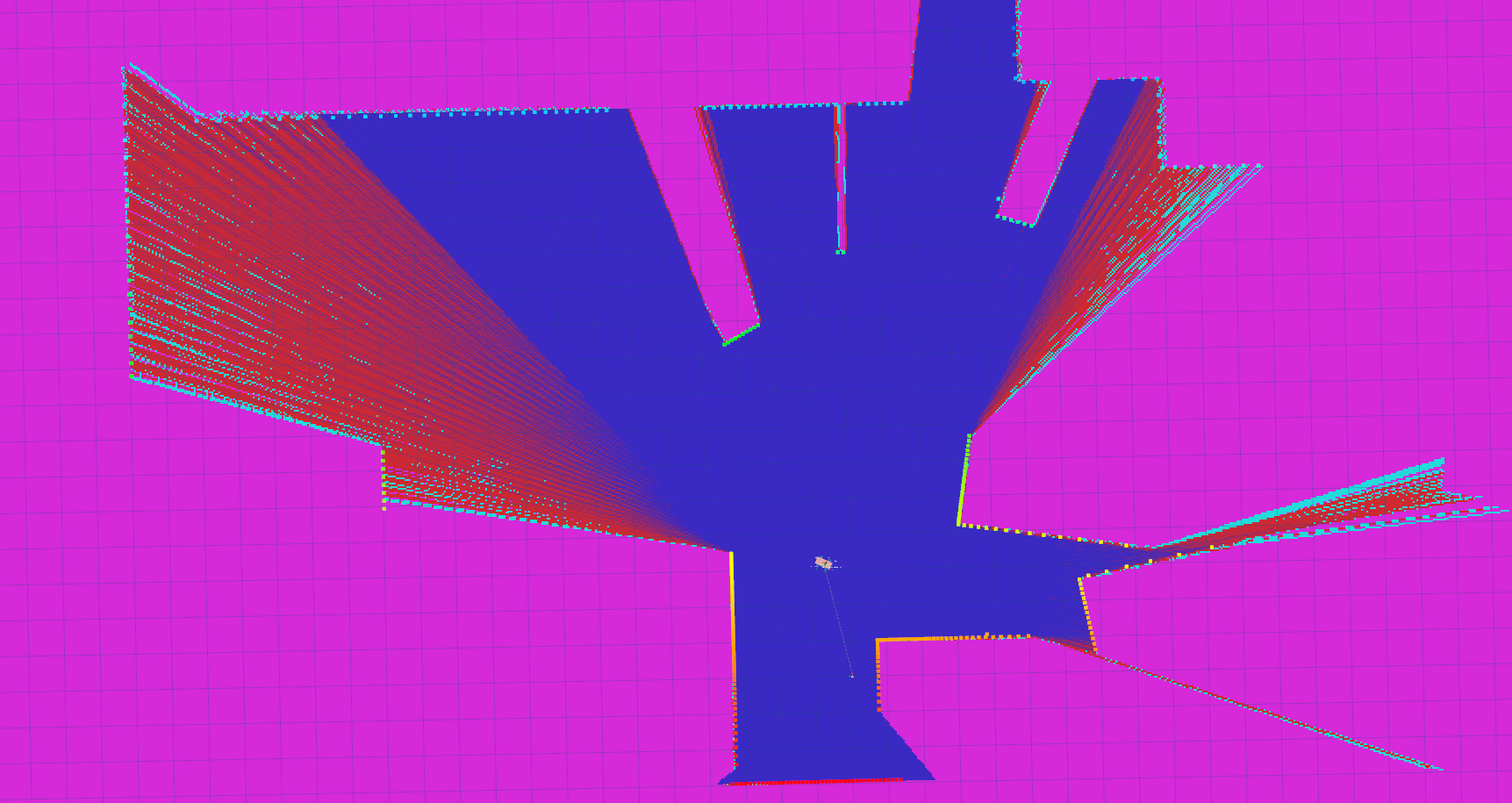
- 最终在仿真中完成 MI 探索的验证
文章目录
-
- 前言
- 1 问题:三值地图为什么不够
-
-
- 1-1 往期探索策略的信息增益回顾
- 1-2 缺失的关键维度
-
- 2 概率占据网格
-
-
- 2-1 贝叶斯递推与 log-odds 更新
-
- 2-1-1 log-odds 到底是什么
- 2-1-2 贝叶斯更新在 log-odds 空间 = 加法
- 2-2 逆传感器模型(Inverse Sensor Model)
- 2-3 Bresenham 光线追踪
- 2-4 代码实现:ProbabilityMapper 完整类
- 2-5 双 Topic 发布:三值地图 + 概率地图
-
- 3 基于互信息的前沿选择
-
-
- 3-1 香农熵
- 3-2 互信息 = 预期熵减
- 3-3 虚拟光束模拟 MI
- 3-4 代码实现:MIGoalSelector
- 3-5 效用函数与路径代价
-
- 4 系统集成
-
-
- 4-1 项目结构
- 4-2 探索节点的修改
- 4-3 启动流程
- 4-4 RViz 可视化
- 4-5 完整源码清单
-
- probability_mapper.hpp
- probability_mapper.cpp
- mapper_main.cpp
- prob_mapper.launch.py
- slam_prob_mapper.launch.py
- mi_goal_selector.hpp
- mi_goal_selector.cpp
- exploration_node.hpp(完整文件,含 MI 扩展)
- exploration_node.cpp(完整文件,含 MI 扩展)
- 5_prob_map.sh
- 7_mi_explore.sh
-
- 5 完整参数与对比
-
-
- 5-1 prob_mapper 参数表
- 5-2 exploration_node MI 相关参数
- 5-3 四种探索策略对比
-
- 6 Python 可视化代码
-
-
- 6-1 三值 vs 概率 vs 熵 对比图(1-2 节)
- 6-2 log-odds 函数曲线(2-1-1 节)
- 6-3 MI 虚拟光束模拟(3-2 / 3-3 节)
-
- 总结
1 问题:三值地图为什么不够
1-1 往期探索策略的信息增益回顾
- 往期三种探索策略的 computeInfoGain() 实现本质上都是同一个函数——数某个前沿聚类周围有多少个 UNKNOWN 邻居:
// UtilityGoalSelector 和 RIGGoalSelector 的 computeInfoGain()
double computeInfoGain(const FrontierCluster & cluster,
const nav_msgs::msg::OccupancyGrid & map)
{
int unknown_count = 0;
for (const auto & cell : cluster.cells) {
for (int d = 0; d < 4; ++d) {
int nx = cell.first + dx[d];
int ny = cell.second + dy[d];
if (map.data[ny * w + nx] == UNKNOWN) ++unknown_count;
}
}
return static_cast<double>(unknown_count);
}
- 说人话就是:前沿的 4 邻域里有多少个 -1,这个前沿的"信息量"就约等于这个数
- 这个方法有两个致命问题:
| 每个 UNKNOWN 格子的贡献完全一样 | 一个刚引入但已经有 3 束激光扫过的 UNKNOWN 格子和一个从来没被观察过的深层未知格子,价值相同 |
| 无法模拟遮挡 | 一个被障碍物挡在后面的 UNKNOWN 区域,机器人实际上看不到,但算法仍然给它"全额"信息增益 |
1-2 缺失的关键维度
- 核心缺失的是 不确定性量化。OccupancyGrid 的 -1 / 0 / 100 是"定性"的地图,它告诉机器人在哪里有什么东西,但不告诉机器人"我有多确定"
- 如果我们能维护每 cell 的 连续占据概率 P ∈ [0, 1],我们就能定义 香农熵:
H
(
c
e
l
l
)
=
−
P
log
2
P
−
(
1
−
P
)
log
2
(
1
−
P
)
H(cell) = -P\\log_2 P – (1-P)\\log_2(1-P)
H(cell)=−Plog2P−(1−P)log2(1−P)
- 举个例子你就懂了:
| 0.00 | 确定空闲 | 0.00 | 完全确定,零不确定性 |
| 0.25 | 较可能空闲 | 0.81 | 有一定不确定性 |
| 0.50 | 完全未知 | 1.00 | 最大不确定性 |
| 0.75 | 较可能占据 | 0.81 | 有一定不确定性 |
| 1.00 | 确定占据 | 0.00 | 完全确定,零不确定性 |
- 有了熵,“信息增益"就不再是"数格子”,而是 “消除多少不确定性”。这正是 MI 探索的数学基础
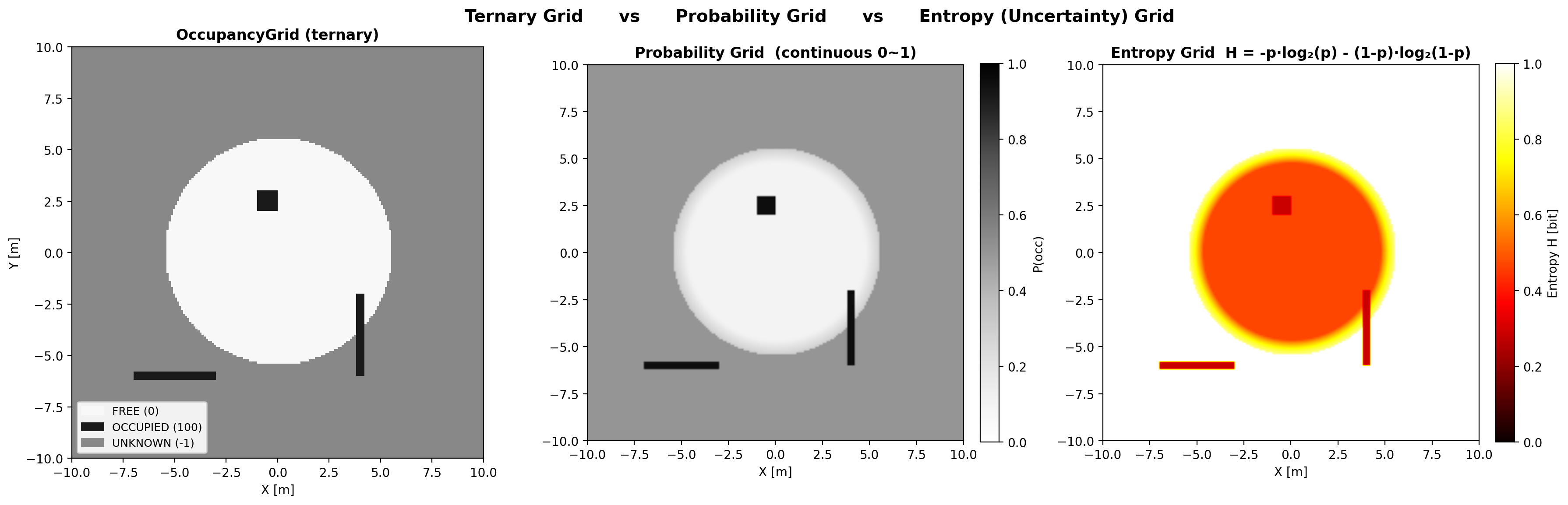
- 三值地图和概率地图的直观对比如下图所示——同一个场景,三种视角:
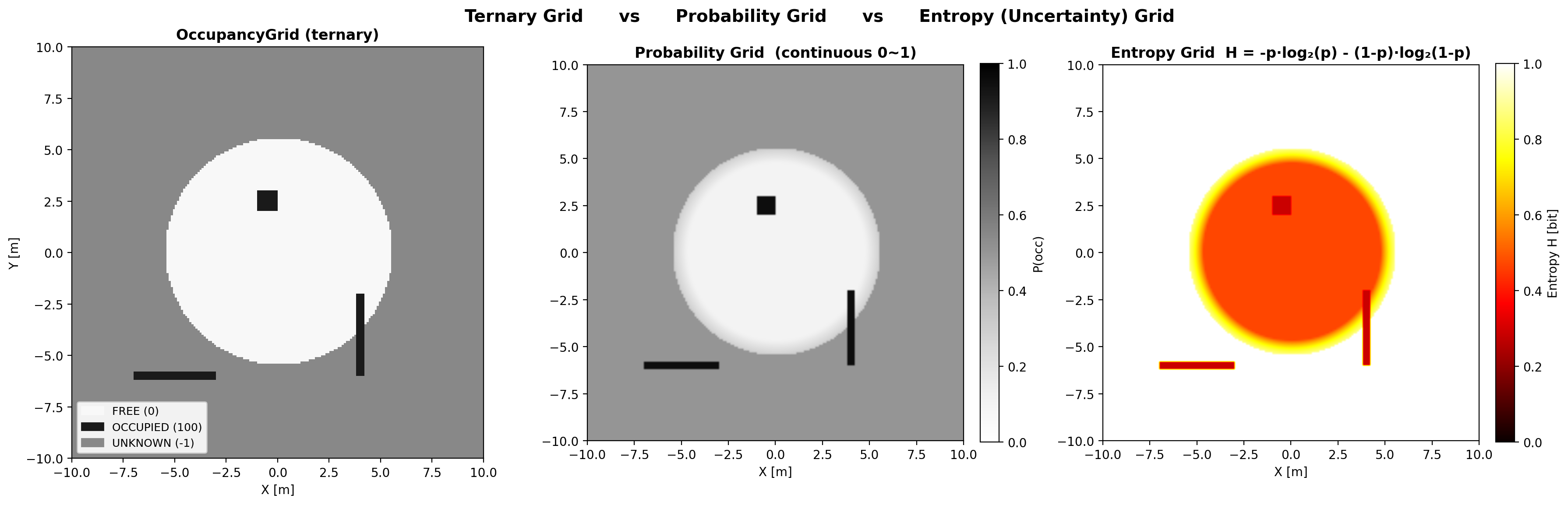
- 从这张对比图可以清楚看到:
- 左图(三值地图):只有三种颜色——白色(FREE)、黑色(OCCUPIED)、灰色(UNKNOWN)。前沿边界是硬边缘,一格之内从"已知"跳到"未知",没有任何过渡
- 中图(概率地图):灰度连续渐变。已扫描区域呈浅灰色(概率趋近 0),障碍物呈深黑色(概率趋近 1),前沿附近保留 5~10 格宽的灰色过渡带
- 右图(熵地图):亮色 = 高熵 = 不确定性大。已探索区域和障碍物内部都是暗的(已经确定了),只有前沿边缘呈明亮环带——这就是 MI 算法要去"消除"的地方
2 概率占据网格
2-1 贝叶斯递推与 log-odds 更新
2-1-1 log-odds 到底是什么
- log-odds 的中文叫 “对数几率”,它把 [0, 1] 的概率映到 (-∞, +∞) 的实数轴:
| 0.01 | -4.60 | 几乎确定空闲 |
| 0.25 | -1.10 | 较可能空闲 |
| 0.50 | 0 | 完全未知 |
| 0.75 | +1.10 | 较可能占据 |
| 0.99 | +4.60 | 几乎确定占据 |
-
p
=
0.5
p=0.5
p=0.5 对应l
=
0
l=0
l=0,p
p
p 趋近 0 则l
l
l 奔负无穷,p
p
p 趋近 1 则l
l
l 奔正无穷 - 代码实现就是这两行互相转换:
double logOddsToProb(double l) { return 1.0 / (1.0 + std::exp(–l)); }
double probToLogOdds(double p) { return std::log(p / (1.0 – p)); }
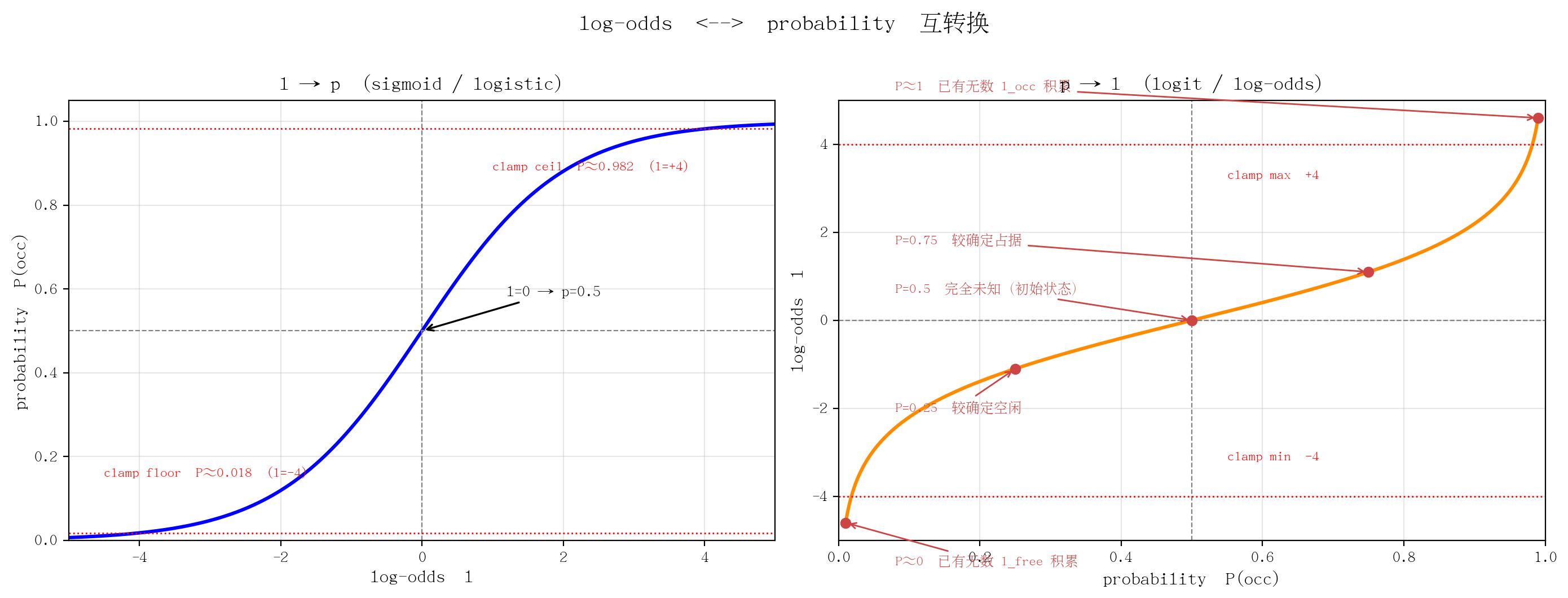
- 两条曲线的形状如下——左图是 log-odds → 概率(sigmoid / logistic),右图是概率 → log-odds(logit):
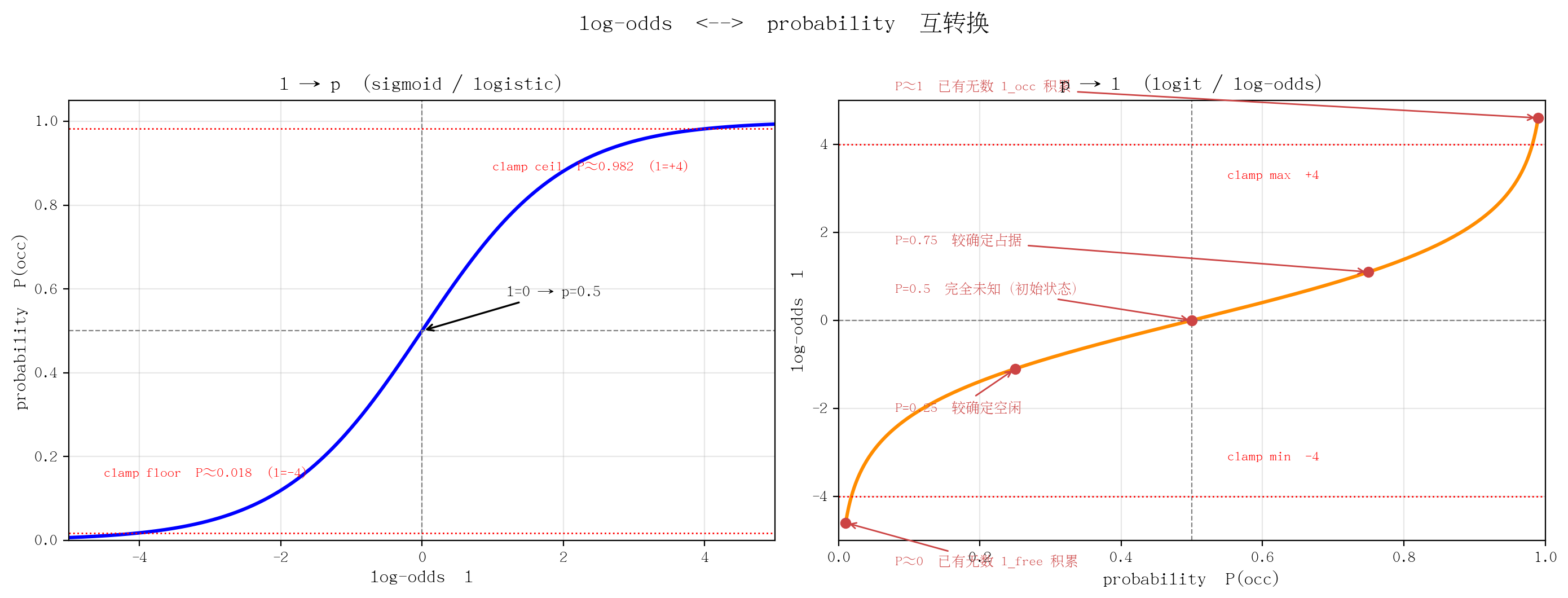
- 几个关键点看一眼就明白:
- l=0 始终对应 p=0.5(完全未知,log-odds 为 0)
- l 在 ±4 附近钳位,对应的概率在 0.018 ~ 0.982 之间,防止极端值
- 概率在 0.3~0.7 之间的灰色过渡带,对应 l 在 [-0.85, +0.85] 之间——这正是保守传感器模型希望保留的区域
2-1-2 贝叶斯更新在 log-odds 空间 = 加法
- 假设每个 cell 的占据事件
m
m
m 在给定所有观测z
1
:
t
z_{1:t}
z1:t 下的后验概率为P
(
m
∣
z
1
:
t
)
P(m \\mid z_{1:t})
P(m∣z1:t) - 直接使用贝叶斯公式:
P
(
m
∣
z
1
:
t
)
=
P
(
z
t
∣
m
)
⋅
P
(
m
∣
z
1
:
t
−
1
)
P
(
z
t
∣
z
1
:
t
−
1
)
P(m \\mid z_{1:t}) = \\frac{P(z_t \\mid m) \\cdot P(m \\mid z_{1:t-1})}{P(z_t \\mid z_{1:t-1})}
P(m∣z1:t)=P(zt∣z1:t−1)P(zt∣m)⋅P(m∣z1:t−1)
- 这个形式每次都要算归一化项 P(z_t | z_{1:t-1}),不好算
- 但对两边取 log-odds 后,贝叶斯递推 退化成加法:
l
t
=
l
t
−
1
+
ln
P
(
z
t
∣
m
=
1
)
P
(
z
t
∣
m
=
0
)
l_t = l_{t-1} + \\ln\\frac{P(z_t \\mid m=1)}{P(z_t \\mid m=0)}
lt=lt−1+lnP(zt∣m=0)P(zt∣m=1)
- 本质上跟"取对数把
a
×
b
a \\times b
a×b 变成log
a
+
log
b
\\log a + \\log b
loga+logb"是同一个道理 - 落实到代码,每条激光束穿过或命中的 cell 只需要一行加法:
log_odds_[idx] = std::clamp(log_odds_[idx] + l_free_, log_odds_min_, log_odds_max_);
- 做一次加法 = 完成一次贝叶斯更新。一整帧雷达几千条射线,全是加法——这也是 OctoMap 底层用同一套公式的原因
2-2 逆传感器模型(Inverse Sensor Model)
- 传感器模型分两种——问的问题恰好相反:
| 要回答什么 | 给定地图,传感器会看到什么 | 给定传感器读数,地图长什么样 |
| 数学形式 |
P ( z ∣ m ) P(z \\mid m) P(z∣m) |
P ( m ∣ z ) P(m \\mid z) P(m∣z) |
| 谁来做 | 仿真器、光线追踪 | SLAM、占据网格建图 |
| 难度 | 简单(纯几何) | 需要贝叶斯推断 |
- 我们这个场景显然是后者——已知每束激光是"打到了东西(hit)“还是"穿过了(miss)”,要反过来推断每格被占据的概率
- 回到 2-1-2 的公式,
l
t
=
l
t
−
1
+
ln
P
(
z
t
∣
m
=
1
)
P
(
z
t
∣
m
=
0
)
l_t = l_{t-1} + \\ln\\frac{P(z_t \\mid m=1)}{P(z_t \\mid m=0)}
lt=lt−1+lnP(zt∣m=0)P(zt∣m=1) 里那个分数就是逆传感器模型给出的比值:
| 命中(hit) |
P ( m = 1 ∣ z = hit ) P(m=1 \\mid z=\\text{hit}) P(m=1∣z=hit) |
prob_hit = 0.55 |
l o c c = ln 0.55 0.45 ≈ + 0.20 l_{occ} = \\ln\\frac{0.55}{0.45} \\approx +0.20 locc=ln0.450.55≈+0.20 |
| 穿过(miss) |
P ( m = 1 ∣ z = miss ) P(m=1 \\mid z=\\text{miss}) P(m=1∣z=miss) |
prob_miss = 0.45 |
l f r e e = ln 0.45 0.55 ≈ − 0.20 l_{free} = \\ln\\frac{0.45}{0.55} \\approx -0.20 lfree=ln0.550.45≈−0.20 |
| 初始 |
P ( m = 1 ) = 0.5 P(m=1) = 0.5 P(m=1)=0.5 |
0.5 |
l = 0 l = 0 l=0 |
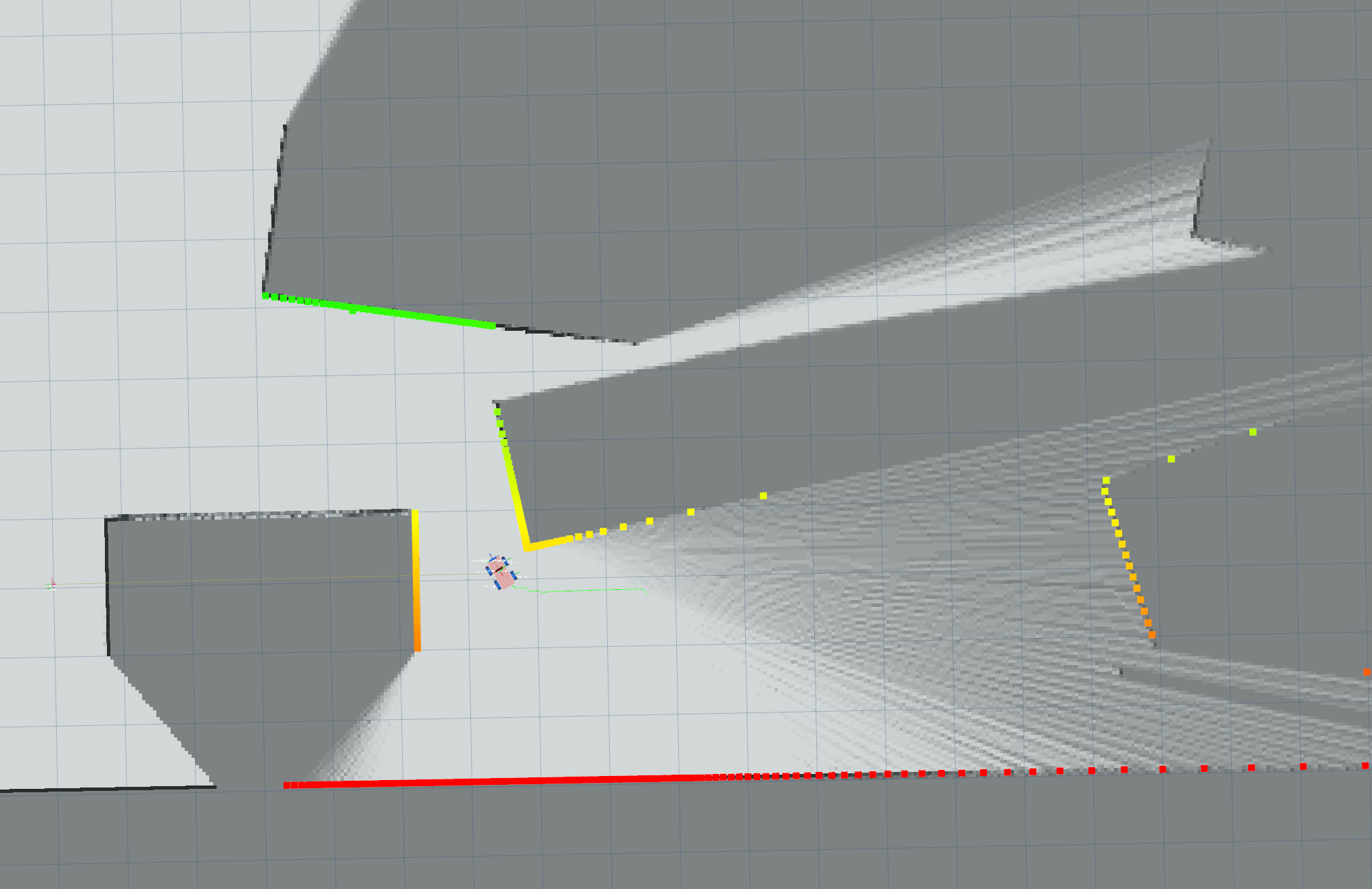
- 这里选择了 保守参数 P(hit)=0.55 / P(miss)=0.45,目的是让概率 缓慢收敛,在前沿附近保留 5~10 格宽的灰色渐变带
- 对比一下不同参数的收敛速度:
| 1 次扫描后 P | 0.75 / 0.30 | 0.55 / 0.45 |
| 3 次扫描后 P | 0.96 / 0.09 | 0.65 / 0.35 |
| 10 次扫描后 P | ≈ 1.0 / ≈ 0 | 0.81 / 0.19 |
| 前沿渐变带宽 | 1~2 格 | 5~10 格 |
| MI 区分度 | 弱(跟三值地图差不多) | 强(熵值差异显著) |
- 说人话:激进参数让概率"秒变黑白",前沿附近几乎没有灰度过渡,MI 算法无从区分;保守参数让概率慢慢收敛,灰色渐变带足够宽,MI 才能在不同前沿之间拉开差距
2-3 Bresenham 光线追踪
- 每条激光束从传感器原点出发,在网格中穿过的所有 cell 都需要被更新——命中点(l_occ)+ 穿过点(l_free)
- 这里使用经典的 Bresenham 2D 直线算法,它可以高效地枚举两个网格坐标之间的所有 cell,时间复杂度
O
(
max
(
∣
Δ
x
∣
,
∣
Δ
y
∣
)
)
O(\\max(|\\Delta x|, |\\Delta y|))
O(max(∣Δx∣,∣Δy∣)):
// 对应 2-3 节:Bresenham 2D 直线遍历(整数网格,含两端点)
void bresenhamLine(int x0, int y0, int x1, int y1,
std::vector<std::pair<int, int>> & out)
{
int dx = std::abs(x1 – x0);
int dy = –std::abs(y1 – y0); // 负值(算法约定)
int sx = (x0 < x1) ? 1 : –1;
int sy = (y0 < y1) ? 1 : –1;
int err = dx + dy;
out.clear();
while (true) {
out.emplace_back(x0, y0);
if (x0 == x1 && y0 == y1) break;
int e2 = 2 * err;
if (e2 >= dy) { err += dy; x0 += sx; }
if (e2 <= dx) { err += dx; y0 += sy; }
}
}
-
每条激光束(共约 1080 条)都调用一次 Bresenham,然后:
- 遍历 cell(0 ~ len-2):log_odds += l_free(标记为 空闲)
- 命中 cell(len-1):log_odds += l_occ(标记为 占据)
-
注意:如果光束读数到达 max_range(无回波),只更新遍历 cell,不更新命中 cell——合理的,你看不到回波意味着光束没遇到东西
2-4 代码实现:ProbabilityMapper 完整类
- 先看头文件——类对外暴露的接口:
// prob_map/probability_mapper.hpp —— 对应 2-4 节
namespace prob_map {
class ProbabilityMapper {
public:
explicit ProbabilityMapper(rclcpp::Node * node);
private:
// 激光回调:TF 查到传感器位姿 → updateMap()
void laserCallback(sensor_msgs::msg::LaserScan::SharedPtr msg);
void publishTimerCallback();
// 核心建图:逐束射线 Bresenham 光线追踪,log-odds 递推更新
void updateMap(const sensor_msgs::msg::LaserScan & scan,
const geometry_msgs::msg::Pose & sensor_pose,
double sensor_yaw);
void initGrid();
static void bresenhamLine(int x0, int y0, int x1, int y1,
std::vector<std::pair<int, int>> & out);
// log-odds ↔ 概率 ↔ 熵 的互转
static double logOddsToProb(double l);
static double probToLogOdds(double p);
static double entropy(double p);
// 双 Topic 发布
void publishMaps(const rclcpp::Time & stamp, const std::string & frame_id);
// 核心数据:log-odds 网格(不再存三值!)
std::vector<double> log_odds_;
int width_{0}, height_{0};
// 传感器模型参数
double prob_hit_{0.55}; // P(occ | hit)
double prob_miss_{0.45}; // P(occ | miss)
double l_occ_{0.0}; // ln(0.55/0.45) ≈ 0.20
double l_free_{0.0}; // ln(0.45/0.55) ≈ -0.20
double log_odds_min_{–4.0}; // P ≈ 0.018
double log_odds_max_{4.0}; // P ≈ 0.982
double max_range_{30.0}; // 激光最大使用距离
// Publishers — 注意这里是三个 publisher
rclcpp::Publisher<nav_msgs::msg::OccupancyGrid>::SharedPtr prob_map_pub_;
rclcpp::Publisher<nav_msgs::msg::OccupancyGrid>::SharedPtr thresh_map_pub_;
rclcpp::Publisher<nav_msgs::msg::OccupancyGrid>::SharedPtr entropy_map_pub_;
};
} // namespace prob_map
- 核心的 updateMap() 逻辑——逐束处理全部激光:
// 对应 2-4 节:updateMap —— 逐束射线处理
void ProbabilityMapper::updateMap(
const sensor_msgs::msg::LaserScan & scan,
const geometry_msgs::msg::Pose & sensor_pose, double sensor_yaw)
{
const double sx = sensor_pose.position.x;
const double sy = sensor_pose.position.y;
// 传感器网格坐标(所有射线的起点)
int sx_g, sy_g;
if (!worldToGrid(sx, sy, sx_g, sy_g)) return;
std::vector<std::pair<int, int>> line;
line.reserve(static_cast<size_t>(max_range_ / resolution_) + 10);
for (size_t i = 0; i < scan.ranges.size(); ++i) {
float range = scan.ranges[i];
if (std::isnan(range) || std::isinf(range)) continue;
if (range < min_range_) continue;
const float world_angle = sensor_yaw + scan.angle_min + i * scan.angle_increment;
const bool hit_valid = (range < scan.range_max && range <= max_range_);
const float effective_range = hit_valid ? range : max_range_;
// 终点世界坐标
double ex = sx + effective_range * std::cos(world_angle);
double ey = sy + effective_range * std::sin(world_angle);
int ex_g, ey_g;
worldToGrid(ex, ey, ex_g, ey_g);
ex_g = std::clamp(ex_g, 0, width_ – 1);
ey_g = std::clamp(ey_g, 0, height_ – 1);
// Bresenham 光线追踪
bresenhamLine(sx_g, sy_g, ex_g, ey_g, line);
// 穿过点 → FREE 更新(不含终点)
for (size_t j = 0; j + 1 < line.size(); ++j) {
int idx = gridIndex(line[j].first, line[j].second);
log_odds_[idx] = std::clamp(log_odds_[idx] + l_free_,
log_odds_min_, log_odds_max_);
}
// 命中点 → OCCUPIED 更新(仅当光束实际击中,非 max_range)
if (hit_valid && !line.empty()) {
auto & ep = line.back();
int idx = gridIndex(ep.first, ep.second);
log_odds_[idx] = std::clamp(log_odds_[idx] + l_occ_,
log_odds_min_, log_odds_max_);
}
}
}
- 说人话就是:对每一帧 LaserScan,用 TF 查到传感器在 map 系下的位姿,然后每条射线 → Bresenham 画线 → 穿过 cell 加 l_free(空闲证据)→ 命中 cell 加 l_occ(占据证据)→ 钳位在 [-4, 4] 防止极端值
2-5 双 Topic 发布:三值地图 + 概率地图
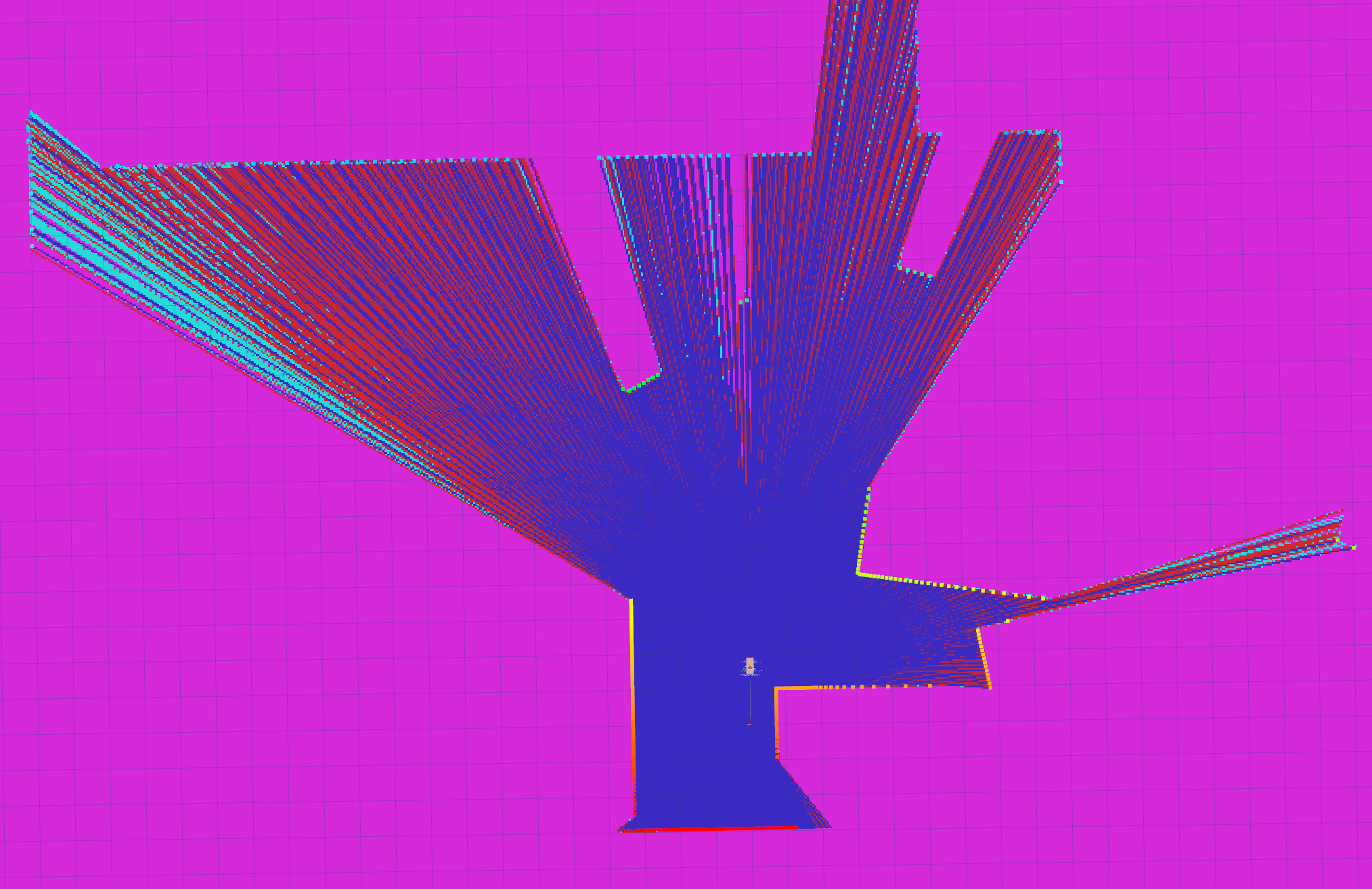
- ProbabilityMapper 同时发布 三个 Topic:
| /prob_map | OccupancyGrid | [0, 100] 连续 | MI 决策 + RViz 灰度热力图 |
| /thresholded_map | OccupancyGrid | -1 / 0 / 100 | Nav2 路径规划(全局规划器) |
| /entropy_map | OccupancyGrid | [0, 100] 熵值 | RViz 不确定性可视化 |
-
全局三值地图
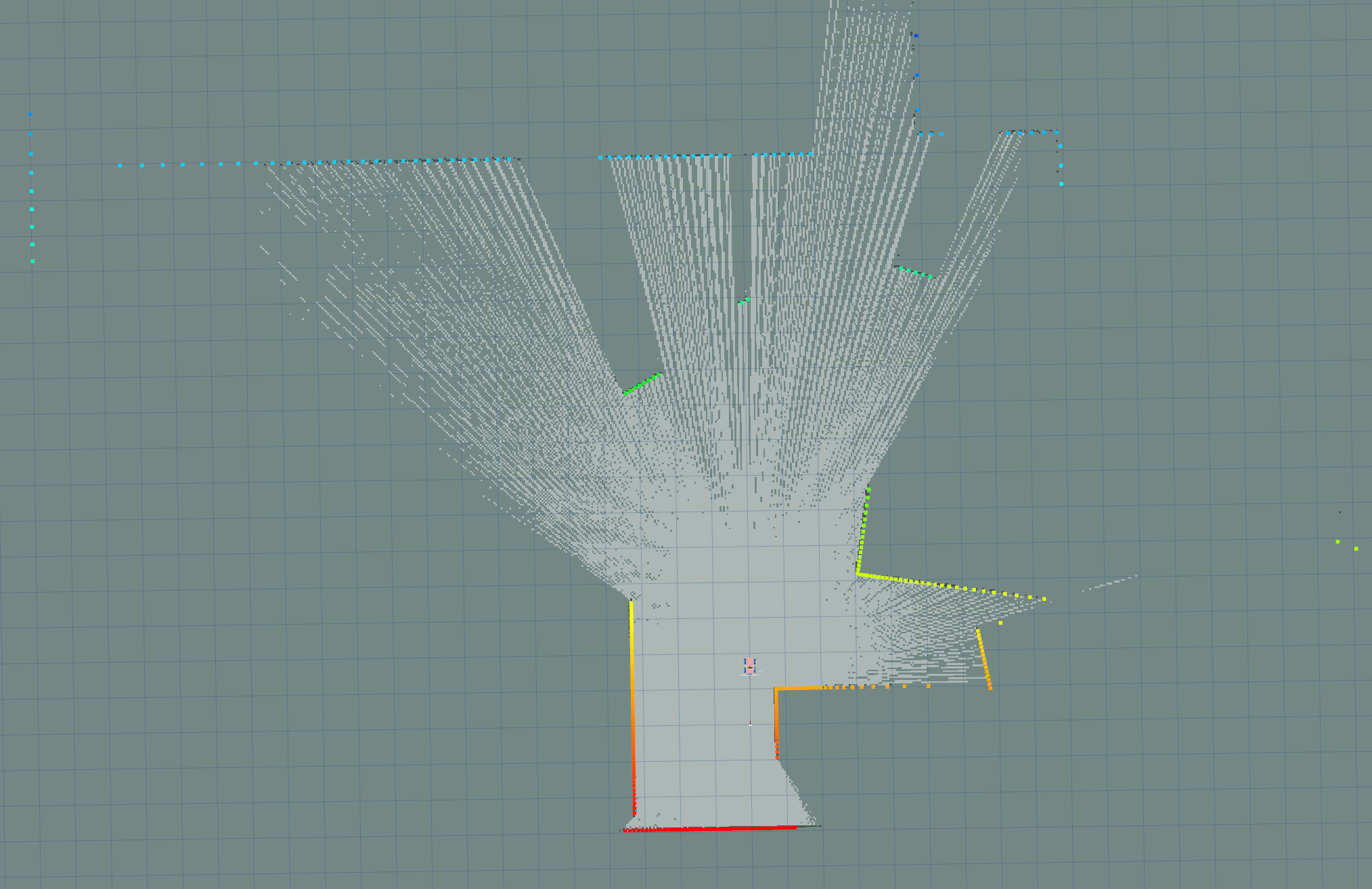
-
概率地图(灰度色板 map): * 白色 / 浅灰:概率趋近 0,确定空闲——已被多次激光穿过,几乎没有不确定性 * 深黑:概率趋近 1,确定占据——激光反复命中,确定为障碍物 * 灰色渐变带:概率在 0.3~0.7 之间,不确定——前沿边缘,只有少量激光扫过,正是 MI 算法要去"消除"的地方
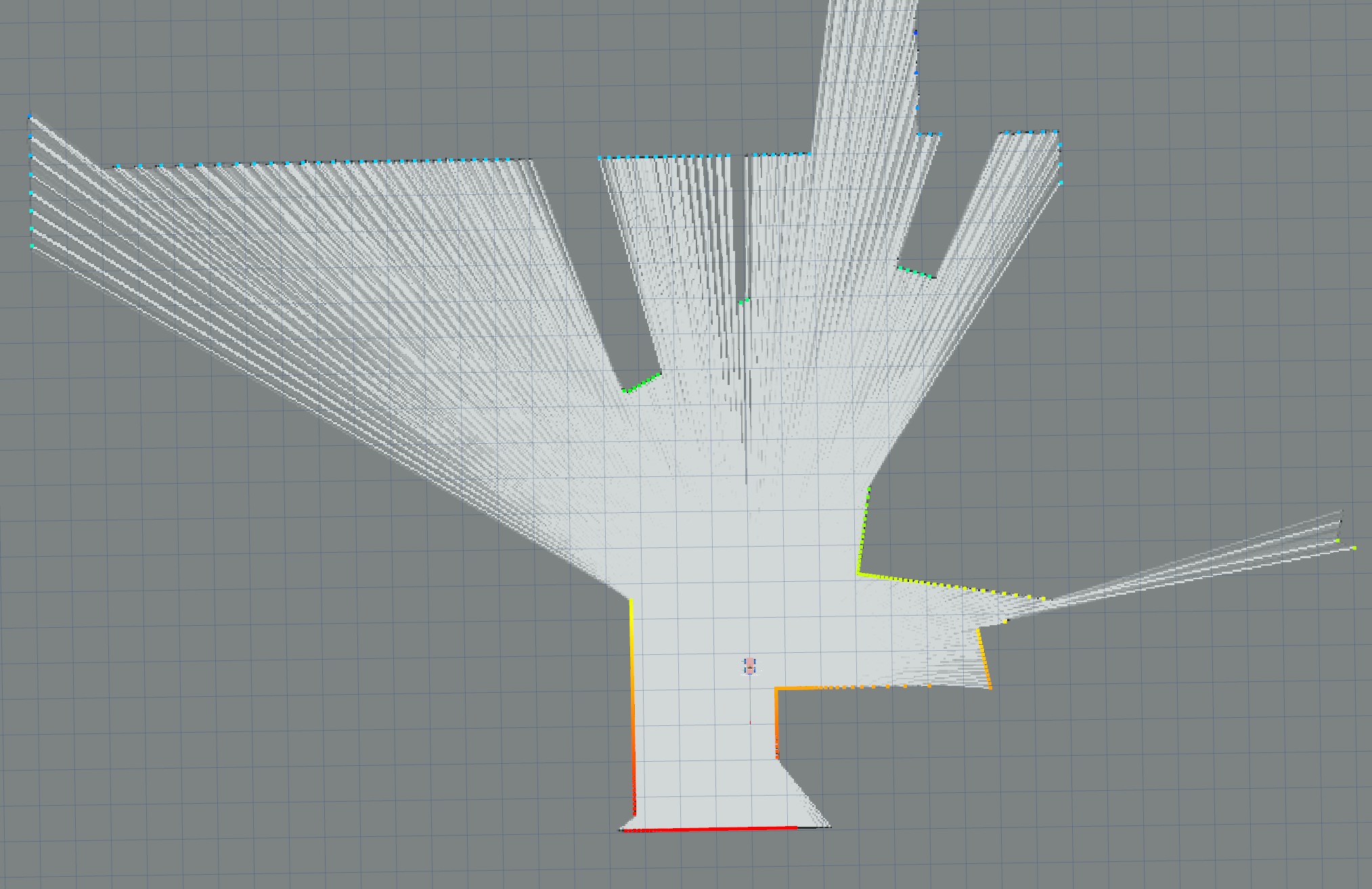
-
熵地图(costmap 色板,推荐):
- 蓝色 / 深蓝:熵趋近 0,低不确定性——已探索区域或障碍物内部,已充分收敛
- 青色 / 绿色:熵 0.3~0.7,中等不确定性——前沿后方,激光扫过的次数还不够多
- 黄色 / 橙红:熵趋近 1,高不确定性——前沿边缘和未知区域交界处,MI 探索的核心目标
- 切换方式:RViz 左侧面板 → /entropy_map 的 Map Display → Color Scheme 从 map 改为 costmap
-
发布代码:
// 对应 2-5 节:三张地图的发布
void ProbabilityMapper::publishMaps(
const rclcpp::Time & stamp, const std::string & frame_id)
{
const int total = width_ * height_;
// 1. 阈值化地图(给 Nav2 用)
for (int i = 0; i < total; ++i) {
double p = logOddsToProb(log_odds_[i]);
if (p > 0.70) msg.data[i] = 100; // 占据
else if (p < 0.30) msg.data[i] = 0; // 空闲
else msg.data[i] = –1; // 未知
}
// 2. 连续概率地图(给 MI 用)
for (int i = 0; i < total; ++i) {
double p = logOddsToProb(log_odds_[i]);
msg.data[i] = static_cast<int8_t>(std::round(p * 100.0)); // 0~100
}
// 3. 香农熵地图(给 RViz 看)
for (int i = 0; i < total; ++i) {
double p = logOddsToProb(log_odds_[i]);
double h = entropy(p); // max = 1.0 at p = 0.5
msg.data[i] = static_cast<int8_t>(std::round(h * 100.0));
}
}
- 这里用 transient_local QoS(类似 ROS1 的 latching),确保 RViz 和 Nav2 延迟订阅时也能拿到最新一帧
3 基于互信息的前沿选择
3-1 香农熵
- 有了概率地图,每个 cell 的不确定性可以用 香农熵(Shannon Entropy)来量化:
H
(
c
e
l
l
)
=
−
P
(
m
)
⋅
log
2
P
(
m
)
−
(
1
−
P
(
m
)
)
⋅
log
2
(
1
−
P
(
m
)
)
H(cell) = -P(m) \\cdot \\log_2 P(m) – (1 – P(m)) \\cdot \\log_2(1 – P(m))
H(cell)=−P(m)⋅log2P(m)−(1−P(m))⋅log2(1−P(m))
- 代码实现:
// 对应 3-1 节:香农熵
static double entropy(double p) {
if (p <= 1e-6 || p >= 1.0 – 1e-6) return 0.0;
return –(p * std::log2(p) + (1.0 – p) * std::log2(1.0 – p));
}
3-2 互信息 = 预期熵减
- MI 探索的核心思路:如果我去位置 x,我预期能消除多少不确定性?
I
(
M
;
Z
∣
x
)
=
H
(
M
)
−
H
(
M
∣
Z
,
x
)
I(M; Z \\mid x) = H(M) – H(M \\mid Z, x)
I(M;Z∣x)=H(M)−H(M∣Z,x)
- 其中
H
(
M
)
H(M)
H(M) 是当前地图的总熵,H
(
M
∣
Z
,
x
)
H(M \\mid Z, x)
H(M∣Z,x) 是假设从 x 处观测后的"事后"熵 - 直接精确计算这个值非常昂贵(需要对所有可能的观测做积分),但我们可以用一个 实用近似:
在候选位姿 x 处模拟一套虚拟激光扫描,累加所有"可见 cell"的熵,作为 MI 的近似
- 这个近似的直觉是合理的:如果从 x 处能看到大量高熵 cell,那么去 x 处"应该"能获得大量信息
3-3 虚拟光束模拟 MI
- 对于每个前沿的质心 (cx, cy),放置一台虚拟 360 传感器,发射 N=60 束射线,每条方向均匀分布:
θ
i
=
2
π
i
N
,
i
=
0
,
1
,
…
,
N
−
1
\\theta_i = \\frac{2\\pi i}{N}, \\quad i = 0, 1, \\dots, N-1
θi=N2πi,i=0,1,…,N−1
- 每束射线执行一次 Bresenham 遍历:
- 从质心出发,沿方向 (cos θ, sin θ) 前进
- 遇到 P(occ) > 0.7 → 停止(被障碍物遮挡)
- 否则 → 累加当前 cell 的熵 H(cell)
- 到达 max_range(8m)→ 停止
- 将所有束的熵累加后再平均:
MI
(
c
a
n
d
i
d
a
t
e
)
=
1
N
∑
i
=
0
N
−
1
∑
c
e
l
l
∈
b
e
a
m
i
H
(
c
e
l
l
)
\\text{MI}(candidate) = \\frac{1}{N} \\sum_{i=0}^{N-1} \\sum_{cell \\in beam_i} H(cell)
MI(candidate)=N1i=0∑N−1cell∈beami∑H(cell)
说人话:从候选位姿"看一圈",看见的所有 cell 的熵加起来 ÷ 射线数。如果某个方向大片都是灰色的不确定区域,那 MI 就高;如果四面都已经被扫描过(黑白分明),那 MI 就低。
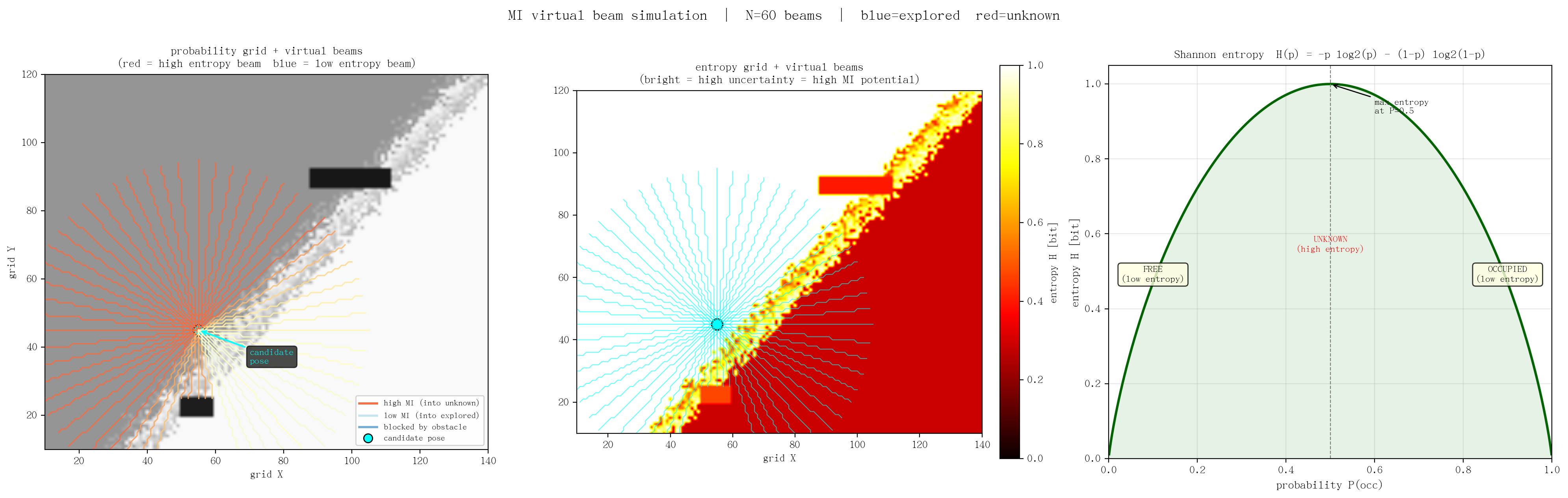
- 下面这张图把 3-2 和 3-3 的概念放在了一起:
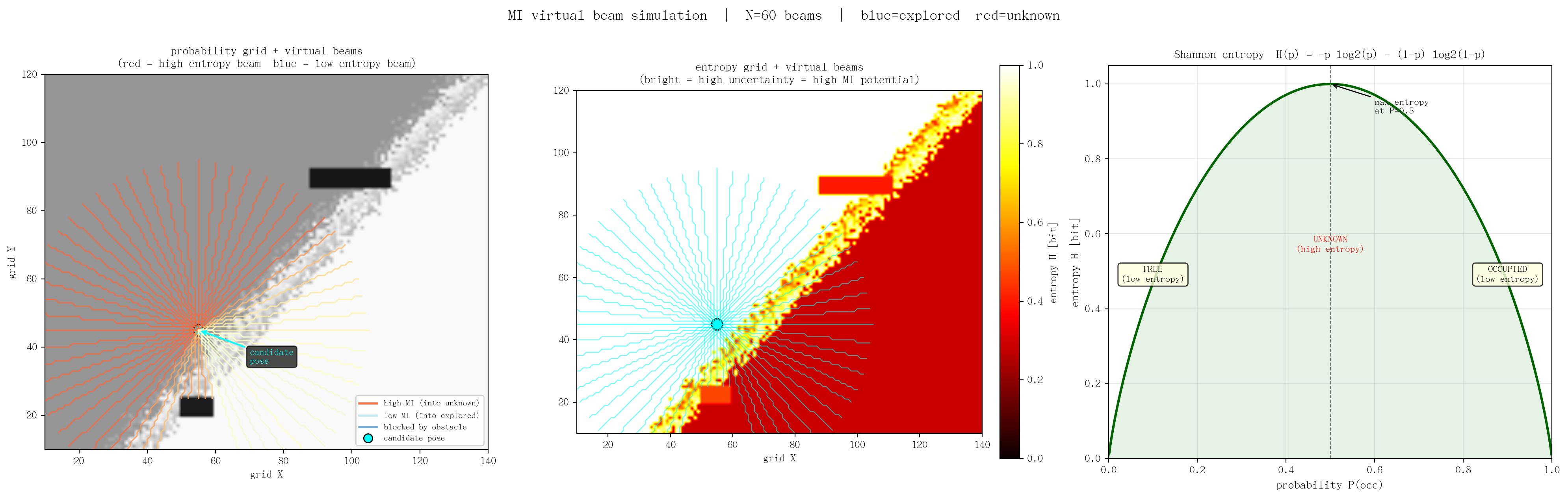
- 从图中可以看到:
- 左图(概率 + 射线):候选位姿位于前沿交界处,射线穿入右上未知区域(红/橙色,高熵 → 高 MI),射线穿入左下已探索区域(蓝色,低熵 → 低 MI),射线撞到墙壁提前终止
- 中图(熵 + 射线):同组射线覆在熵热力图上,亮色(高熵)区域恰好是 MI 想要消除的地方
- 右图(熵函数曲线):
H
(
p
)
H(p)
H(p) 在p
=
0.5
p=0.5
p=0.5 处达到最大值 1.0 bit,在p
→
0
p \\to 0
p→0 或p
→
1
p \\to 1
p→1 时趋近 0——这就是为什么 MI 算法天然偏向"灰色"的不确定区域
3-4 代码实现:MIGoalSelector
- 头文件——继承 GoalSelector,额外缓存概率地图:
// exploration/mi_goal_selector.hpp —— 对应 3-4 节
class MIGoalSelector : public GoalSelector {
public:
MIGoalSelector() = default;
void setProbMap(const nav_msgs::msg::OccupancyGrid & prob_map);
FrontierCluster select(
const std::vector<FrontierCluster> & frontiers,
const geometry_msgs::msg::Pose & robot_pose,
const nav_msgs::msg::OccupancyGrid & map) override;
private:
// 从 (wx, wy) 模拟 360° 扫描,累加可见 cell 熵
double computeMI(double wx, double wy) const;
// 单束射线遍历,累加沿途熵(遇到占据 cell 停止)
double beamEntropy(int sx_g, int sy_g, double dx_w, double dy_w) const;
nav_msgs::msg::OccupancyGrid prob_map_;
bool prob_map_received_{false};
int num_beams_{60}; // 模拟扫描的射线数
double mi_max_range_{8.0}; // 每条射线最大距离
double occ_threshold_{0.7}; // P > 此值 → 视为占据,射线停止
};
- 核心计算—— computeMI() 和 beamEntropy():
// 对应 3-4 节:单束射线的熵累加
double MIGoalSelector::beamEntropy(
int sx_g, int sy_g, double dx_w, double dy_w) const
{
const double res = prob_map_.info.resolution;
const double ox = prob_map_.info.origin.position.x;
const double oy = prob_map_.info.origin.position.y;
double start_wx = ox + (sx_g + 0.5) * res;
double start_wy = oy + (sy_g + 0.5) * res;
double end_wx = start_wx + dx_w * mi_max_range_;
double end_wy = start_wy + dy_w * mi_max_range_;
int ex_g = static_cast<int>((end_wx – ox) / res);
int ey_g = static_cast<int>((end_wy – oy) / res);
ex_g = std::clamp(ex_g, 0, static_cast<int>(prob_map_.info.width) – 1);
ey_g = std::clamp(ey_g, 0, static_cast<int>(prob_map_.info.height) – 1);
std::vector<std::pair<int, int>> cells;
bresenhamLine(sx_g, sy_g, ex_g, ey_g, cells);
double total = 0.0;
for (const auto & [mx, my] : cells) {
double p = probAt(mx, my) / 100.0;
if (p > occ_threshold_) break; // 遮挡 → 停止
total += entropy(p); // 累加熵
}
return total;
}
// 对应 3-4 节:360° 模拟扫描 → 平均 MI
double MIGoalSelector::computeMI(double wx, double wy) const
{
const double res = prob_map_.info.resolution;
const double ox = prob_map_.info.origin.position.x;
const double oy = prob_map_.info.origin.position.y;
int sx_g = static_cast<int>((wx – ox) / res);
int sy_g = static_cast<int>((wy – oy) / res);
if (!inBoundsProb(sx_g, sy_g)) return 0.0;
double mi = 0.0;
for (int i = 0; i < num_beams_; ++i) {
double angle = 2.0 * M_PI * static_cast<double>(i) / num_beams_;
mi += beamEntropy(sx_g, sy_g, std::cos(angle), std::sin(angle));
}
return mi / static_cast<double>(num_beams_); // 归一化
}
- 对比往期的 computeInfoGain():
| 地图类型 | 三值 -1/0/100 | 连续概率 [0, 100] |
| 信息度量 | UNKNOWN 邻居计数 | 香农熵累加 |
| 遮挡考虑 | 无 | 有(P > 0.7 的 cell 停止射线) |
| 方向感知 | 无(仅 4 邻域) | 有(360° 60 方向模拟) |
| 空间范围 | 前沿 cell 的 1 格邻域 | 8m 半径扇形区域 |
3-5 效用函数与路径代价
- MI 本身只衡量"到达那个位置后能看到多少不确定区域",不考虑"开过去要花多少代价"
- 沿用 Burgard 式效用函数:
U
(
f
)
=
M
I
(
f
)
c
o
s
t
(
r
o
b
o
t
→
f
)
U(f) = \\frac{MI(f)}{cost(robot \\to f)}
U(f)=cost(robot→f)MI(f)
- 路径代价用 Dijkstra 波前传播 在阈值化地图上计算(8 连通,允许穿越 FREE 和 UNKNOWN cell),与 UtilityGoalSelector 完全一致:
// 对应 3-5 节:select() 主循环
for (size_t i = 0; i < frontiers.size(); ++i) {
double mi = computeMI(frontiers[i].centroid.x, frontiers[i].centroid.y);
double nav_cost = /* Dijkstra 距离 */;
double utility = (nav_cost > 1e-6) ? mi / nav_cost : mi;
if (utility > best_utility) {
best_utility = utility;
best_idx = i;
}
}
4 系统集成
4-1 项目结构
- 本期新增了 prob_map 包,并在 exploration 包中扩展了 MI 选择器。两个包的完整文件树如下:
ros2_ws/src/
├── prob_map/ # 新建:概率地图包
│ ├── CMakeLists.txt
│ ├── package.xml
│ ├── include/prob_map/
│ │ └── probability_mapper.hpp # ProbabilityMapper 类声明
│ ├── src/
│ │ ├── probability_mapper.cpp # 核心:log-odds 更新 + 光线追踪 + 三 topic 发布
│ │ └── mapper_main.cpp # 入口
│ └── launch/
│ ├── prob_mapper.launch.py # 单独启动 prob_mapper
│ └── slam_prob_mapper.launch.py # SLAM + prob_mapper + RViz 联合启动
│
└── exploration/ # 扩展现有包
├── CMakeLists.txt # 新增 mi_goal_selector.cpp 编译
├── package.xml
├── include/exploration/
│ ├── frontier_detector.hpp # (不变)前沿检测
│ ├── goal_selector.hpp # (不变)选择器基类 + Nearest/Utility/RIG
│ ├── mi_goal_selector.hpp # 新增:MIGoalSelector 类声明
│ └── exploration_node.hpp # 新增 prob_map 订阅 + mi 分支
└── src/
├── frontier_detector.cpp # (不变)
├── goal_selector.cpp # (不变)
├── mi_goal_selector.cpp # 新增:虚拟光束 MI 计算 + select()
├── exploration_node.cpp # 新增 probMapCallback + mi 选择器集成
└── explorer_main.cpp # (不变)入口
- 新增文件一览:
| prob_map | probability_mapper.hpp/.cpp | 概率建图核心类 |
| prob_map | mapper_main.cpp | 独立节点入口 |
| prob_map | launch/*.launch.py | 两个启动文件 |
| exploration | mi_goal_selector.hpp/.cpp | MI 目标选择器 |
| exploration | exploration_node.hpp/.cpp | 扩展:订阅 prob_map + mi 分支 |
- 以上所有文件的完整源码见 4-5 完整源码清单,可直接复制粘贴到对应位置后编译运行
4-2 探索节点的修改
-
在 ExplorationNode 中新增:
- 一个 /prob_map 订阅器,独立于 /map 订阅器
- 一个 MIGoalSelector 的实例化分支(goal_selector_type == "mi")
- 在 selectAndSendGoal() 中,调用 select() 前将最新概率地图注入 MI 选择器
-
构造器中声明参数:
// exploration_node.cpp —— 对应 4-2 节
ExplorationNode::ExplorationNode(const rclcpp::NodeOptions & options)
: rclcpp_lifecycle::LifecycleNode("exploration_node", options)
{
declare_parameter("map_topic", "/map");
declare_parameter("prob_map_topic", "/prob_map"); // 新增
declare_parameter("goal_selector_type", "nearest");
}
- on_configure() 中注册 MI 选择器:
// 对应 4-2 节
} else if (goal_selector_type_ == "mi") {
goal_selector_ = std::make_unique<MIGoalSelector>();
RCLCPP_INFO(get_logger(), "Using MIGoalSelector (mutual information)");
}
- on_activate() 中订阅概率地图:
// 对应 4-2 节:独立订阅概率地图,transient_local QoS
prob_map_sub_ = create_subscription<nav_msgs::msg::OccupancyGrid>(
prob_map_topic_,
rclcpp::QoS(rclcpp::KeepLast(1)).transient_local().reliable(),
std::bind(&ExplorationNode::probMapCallback, this, std::placeholders::_1));
- selectAndSendGoal() 中将概率地图注入再调用:
// 对应 4-2 节:select 前注入概率地图
if (goal_selector_type_ == "mi") {
auto * mi_sel = dynamic_cast<MIGoalSelector *>(goal_selector_.get());
if (mi_sel) {
mi_sel->setProbMap(last_prob_map_);
}
}
auto selected = goal_selector_->select(frontiers, current_pose_, last_map_);
4-3 启动流程
- 三个终端,顺序启动:
# 终端 1:Gazebo 仿真 + 机器人
./1_bringup.sh
# 终端 2:SLAM + 概率地图 + Nav2 + RViz
./5_prob_map.sh
# 终端 3:MI 互信息探索
./7_mi_explore.sh
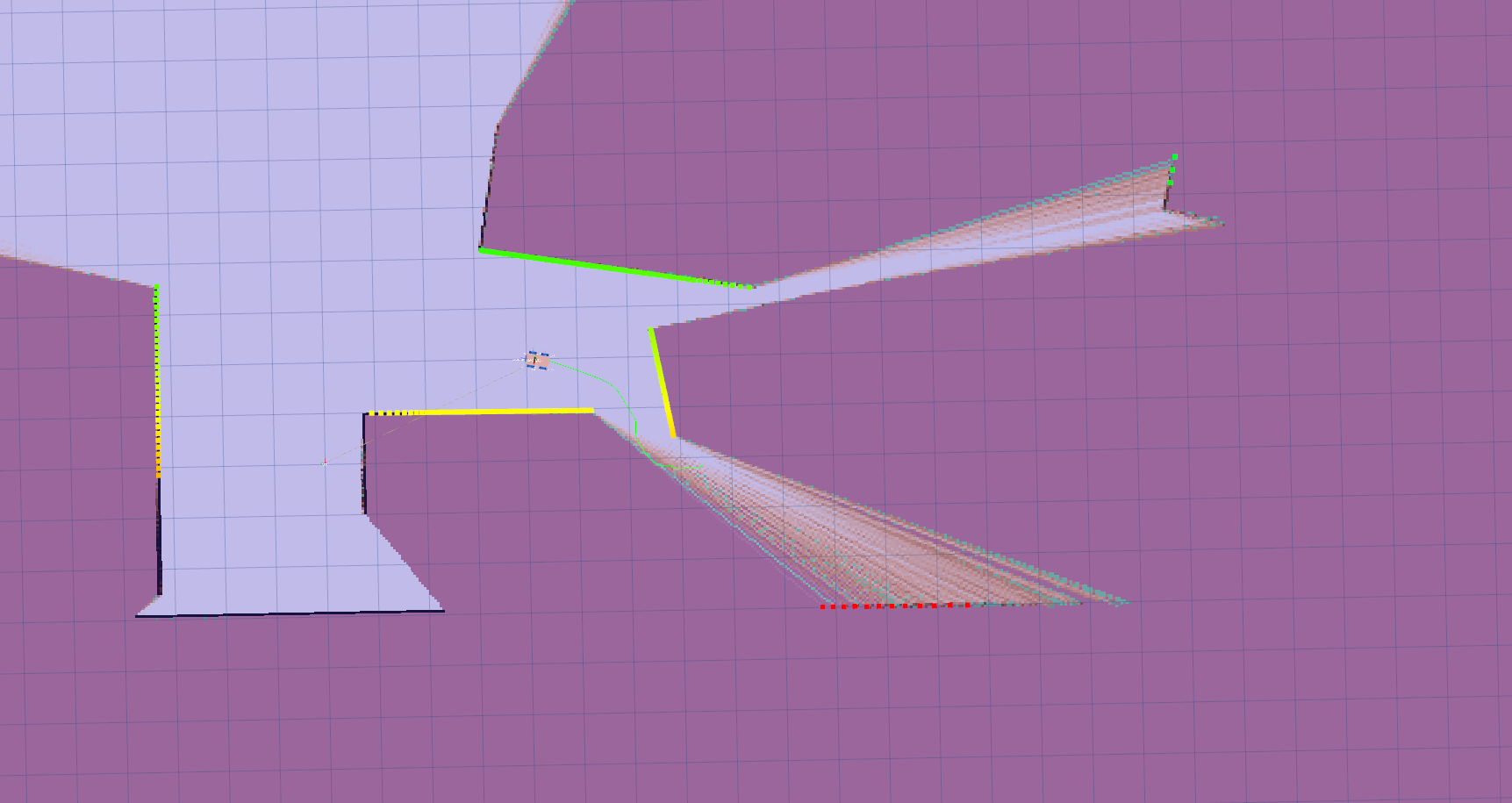
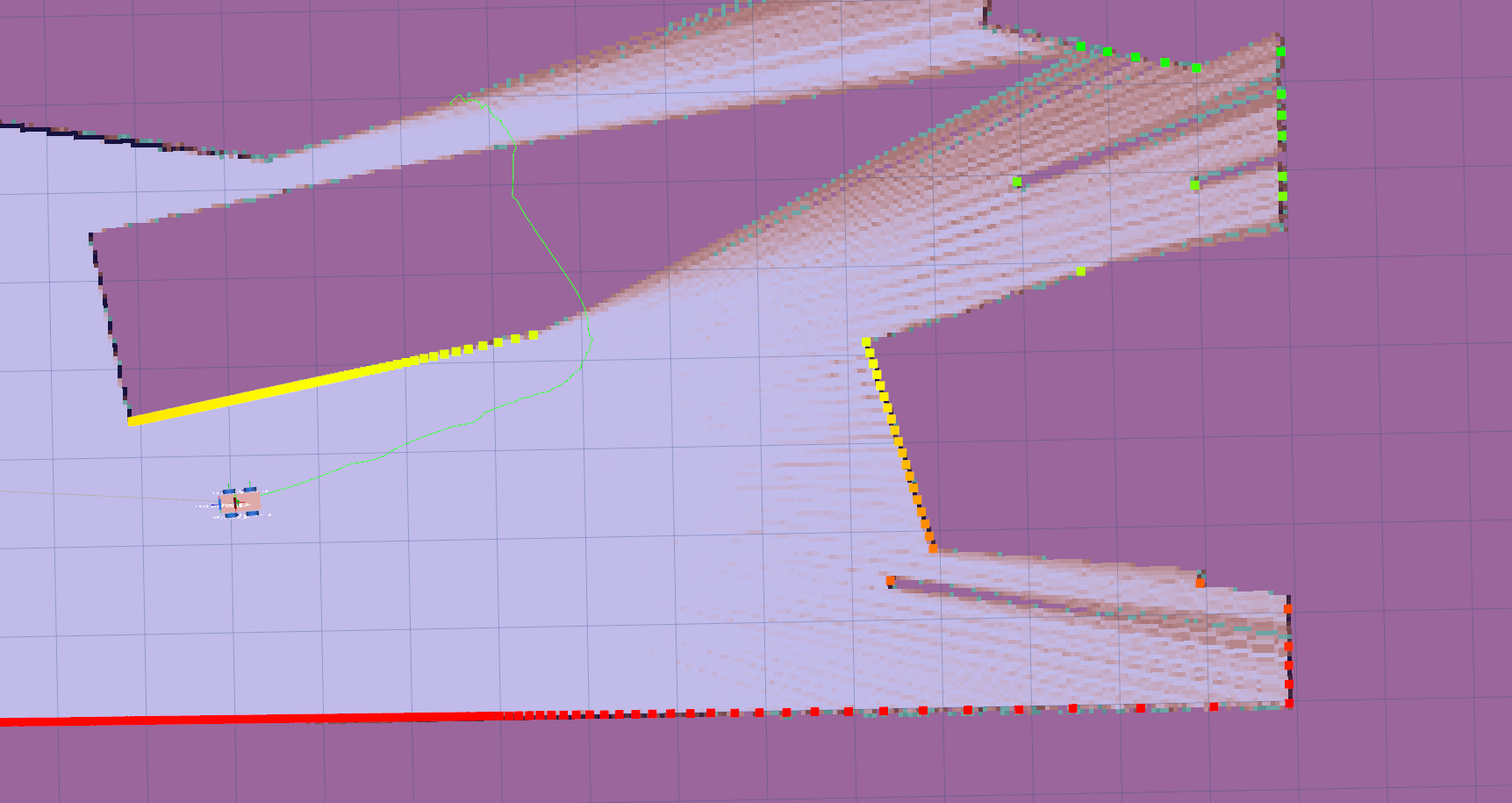
- 5_prob_map.sh 内部启动的节点拓扑:
| slam_toolbox | SLAM + 发布 /map(三值)+ 维护 map→odom TF |
| prob_mapper | 概率建图 + 发布 /prob_map、/thresholded_map、/entropy_map |
| Nav2 (planner_server, controller_server, …) | 收到探索目标后的路径规划和运动控制 |
| rviz2 | 可视化 |
- prob_mapper 依赖 slam_toolbox 提供的 map→laser TF 来做传感器定位,自己不做 SLAM
- prob_map_size=100.0(100m × 100m),max_range=30.0(全量程),prob_hit=0.55 / prob_miss=0.45(保守传感器模型)
4-4 RViz 可视化
- RViz 中可添加 3 个 Map Display 分别查看:
| 概率地图 | /prob_map | map(灰度) | 黑 = 占据,白 = 空闲,灰 = 不确定 |
| 阈值化地图 | /thresholded_map | map | 标准三值占据图(Nav2 实际用的) |
| 熵热力图 | /entropy_map | costmap(推荐) | 蓝/绿 = 低熵,红 = 高熵 = 该去探索 |
- 熵热力图用 costmap 色板比灰度更直观——前沿边缘呈红/橙色环带,表明那里有大量不确定性等待消除
4-5 完整源码清单
- 以下为本文涉及的全部源码文件,按文件路径列出,可直接复制粘贴到对应位置后编译运行
probability_mapper.hpp
// 文件: prob_map/include/prob_map/probability_mapper.hpp
#ifndef PROB_MAP__PROBABILITY_MAPPER_HPP_
#define PROB_MAP__PROBABILITY_MAPPER_HPP_
#include <rclcpp/rclcpp.hpp>
#include <nav_msgs/msg/occupancy_grid.hpp>
#include <sensor_msgs/msg/laser_scan.hpp>
#include <tf2_ros/buffer.h>
#include <tf2_ros/transform_listener.h>
#include <string>
#include <vector>
#include <utility>
namespace prob_map
{
class ProbabilityMapper
{
public:
explicit ProbabilityMapper(rclcpp::Node * node);
~ProbabilityMapper() = default;
private:
void laserCallback(sensor_msgs::msg::LaserScan::SharedPtr msg);
void publishTimerCallback();
void initGrid();
void updateMap(const sensor_msgs::msg::LaserScan & scan,
const geometry_msgs::msg::Pose & sensor_pose,
double sensor_yaw);
static void bresenhamLine(int x0, int y0, int x1, int y1,
std::vector<std::pair<int, int>> & out);
bool worldToGrid(double wx, double wy, int & mx, int & my) const;
void gridToWorld(int mx, int my, double & wx, double & wy) const;
int gridIndex(int mx, int my) const { return my * width_ + mx; }
bool inBounds(int mx, int my) const;
static double logOddsToProb(double l);
static double probToLogOdds(double p);
static double entropy(double p);
void populateOccupancyGrid(nav_msgs::msg::OccupancyGrid & grid,
const rclcpp::Time & stamp,
const std::string & frame_id);
void publishMaps(const rclcpp::Time & stamp, const std::string & frame_id);
rclcpp::Node * node_;
std::shared_ptr<tf2_ros::Buffer> tf_buffer_;
std::shared_ptr<tf2_ros::TransformListener> tf_listener_;
rclcpp::Subscription<sensor_msgs::msg::LaserScan>::SharedPtr laser_sub_;
rclcpp::TimerBase::SharedPtr publish_timer_;
rclcpp::Publisher<nav_msgs::msg::OccupancyGrid>::SharedPtr prob_map_pub_;
rclcpp::Publisher<nav_msgs::msg::OccupancyGrid>::SharedPtr thresh_map_pub_;
rclcpp::Publisher<nav_msgs::msg::OccupancyGrid>::SharedPtr entropy_map_pub_;
std::vector<double> log_odds_;
int width_{0}, height_{0};
double map_width_m_{100.0}, map_height_m_{100.0}, resolution_{0.05};
double origin_x_{0.0}, origin_y_{0.0};
double prob_hit_{0.55}, prob_miss_{0.45};
double l_occ_{0.0}, l_free_{0.0};
double log_odds_min_{–4.0}, log_odds_max_{4.0};
double max_range_{30.0}, min_range_{0.15};
double publish_rate_{5.0};
bool publish_entropy_{true};
std::string laser_topic_{"/scan"}, map_frame_{"map"};
std::string prob_topic_{"/prob_map"}, thresh_topic_{"/thresholded_map"};
std::string entropy_topic_{"/entropy_map"};
bool initialized_{false};
int scan_count_{0};
};
} // namespace prob_map
#endif // PROB_MAP__PROBABILITY_MAPPER_HPP_
probability_mapper.cpp
// 文件: prob_map/src/probability_mapper.cpp
#include "prob_map/probability_mapper.hpp"
#include <algorithm>
#include <cmath>
#include <limits>
#include <stdexcept>
namespace prob_map
{
double ProbabilityMapper::logOddsToProb(double l)
{
return 1.0 / (1.0 + std::exp(–l));
}
double ProbabilityMapper::probToLogOdds(double p)
{
return std::log(p / (1.0 – p));
}
double ProbabilityMapper::entropy(double p)
{
if (p <= 0.0 || p >= 1.0) return 0.0;
return –(p * std::log2(p) + (1.0 – p) * std::log2(1.0 – p));
}
void ProbabilityMapper::bresenhamLine(
int x0, int y0, int x1, int y1,
std::vector<std::pair<int, int>> & out)
{
int dx = std::abs(x1 – x0);
int dy = –std::abs(y1 – y0);
int sx = (x0 < x1) ? 1 : –1;
int sy = (y0 < y1) ? 1 : –1;
int err = dx + dy;
out.clear();
while (true) {
out.emplace_back(x0, y0);
if (x0 == x1 && y0 == y1) break;
int e2 = 2 * err;
if (e2 >= dy) { err += dy; x0 += sx; }
if (e2 <= dx) { err += dx; y0 += sy; }
}
}
ProbabilityMapper::ProbabilityMapper(rclcpp::Node * node)
: node_(node)
{
node_->declare_parameter("map_width_m", 100.0);
node_->declare_parameter("map_height_m", 100.0);
node_->declare_parameter("resolution", 0.05);
node_->declare_parameter("prob_hit", 0.55);
node_->declare_parameter("prob_miss", 0.45);
node_->declare_parameter("max_range", 30.0);
node_->declare_parameter("min_range", 0.15);
node_->declare_parameter("publish_rate", 5.0);
node_->declare_parameter("publish_entropy", true);
node_->declare_parameter("laser_topic", "/scan");
node_->declare_parameter("map_frame", "map");
node_->declare_parameter("prob_topic", "/prob_map");
node_->declare_parameter("thresh_topic", "/thresholded_map");
node_->declare_parameter("entropy_topic", "/entropy_map");
map_width_m_ = node_->get_parameter("map_width_m").as_double();
map_height_m_ = node_->get_parameter("map_height_m").as_double();
resolution_ = node_->get_parameter("resolution").as_double();
prob_hit_ = node_->get_parameter("prob_hit").as_double();
prob_miss_ = node_->get_parameter("prob_miss").as_double();
max_range_ = node_->get_parameter("max_range").as_double();
min_range_ = node_->get_parameter("min_range").as_double();
publish_rate_ = node_->get_parameter("publish_rate").as_double();
publish_entropy_ = node_->get_parameter("publish_entropy").as_bool();
laser_topic_ = node_->get_parameter("laser_topic").as_string();
map_frame_ = node_->get_parameter("map_frame").as_string();
prob_topic_ = node_->get_parameter("prob_topic").as_string();
thresh_topic_ = node_->get_parameter("thresh_topic").as_string();
entropy_topic_ = node_->get_parameter("entropy_topic").as_string();
l_occ_ = probToLogOdds(prob_hit_);
l_free_ = probToLogOdds(prob_miss_);
initGrid();
tf_buffer_ = std::make_shared<tf2_ros::Buffer>(node_->get_clock());
tf_listener_ = std::make_shared<tf2_ros::TransformListener>(*tf_buffer_);
auto latch_qos = rclcpp::QoS(rclcpp::KeepLast(1)).transient_local().reliable();
prob_map_pub_ = node_->create_publisher<nav_msgs::msg::OccupancyGrid>(
prob_topic_, latch_qos);
thresh_map_pub_ = node_->create_publisher<nav_msgs::msg::OccupancyGrid>(
thresh_topic_, latch_qos);
if (publish_entropy_) {
entropy_map_pub_ = node_->create_publisher<nav_msgs::msg::OccupancyGrid>(
entropy_topic_, latch_qos);
}
laser_sub_ = node_->create_subscription<sensor_msgs::msg::LaserScan>(
laser_topic_, rclcpp::SensorDataQoS(),
std::bind(&ProbabilityMapper::laserCallback, this, std::placeholders::_1));
auto period = std::chrono::duration<double>(1.0 / publish_rate_);
publish_timer_ = node_->create_wall_timer(
period, std::bind(&ProbabilityMapper::publishTimerCallback, this));
RCLCPP_INFO(node_->get_logger(),
"ProbabilityMapper: %dx%d (%.2fm x %.2fm) @ %.3fm/cell",
width_, height_, map_width_m_, map_height_m_, resolution_);
}
void ProbabilityMapper::initGrid()
{
width_ = static_cast<int>(std::ceil(map_width_m_ / resolution_));
height_ = static_cast<int>(std::ceil(map_height_m_ / resolution_));
double total_w = width_ * resolution_;
double total_h = height_ * resolution_;
origin_x_ = –total_w / 2.0;
origin_y_ = –total_h / 2.0;
log_odds_.assign(width_ * height_, 0.0);
}
bool ProbabilityMapper::worldToGrid(double wx, double wy, int & mx, int & my) const
{
mx = static_cast<int>((wx – origin_x_) / resolution_);
my = static_cast<int>((wy – origin_y_) / resolution_);
return inBounds(mx, my);
}
void ProbabilityMapper::gridToWorld(int mx, int my, double & wx, double & wy) const
{
wx = origin_x_ + (mx + 0.5) * resolution_;
wy = origin_y_ + (my + 0.5) * resolution_;
}
bool ProbabilityMapper::inBounds(int mx, int my) const
{
return mx >= 0 && mx < width_ && my >= 0 && my < height_;
}
void ProbabilityMapper::laserCallback(sensor_msgs::msg::LaserScan::SharedPtr msg)
{
geometry_msgs::msg::TransformStamped tf;
try {
tf = tf_buffer_->lookupTransform(
map_frame_, msg->header.frame_id, msg->header.stamp,
tf2::durationFromSec(0.05));
} catch (const tf2::TransformException & e) {
RCLCPP_WARN_THROTTLE(node_->get_logger(), *node_->get_clock(), 5000,
"ProbMapper TF lookup failed: %s", e.what());
return;
}
geometry_msgs::msg::Pose sensor_pose;
sensor_pose.position.x = tf.transform.translation.x;
sensor_pose.position.y = tf.transform.translation.y;
sensor_pose.position.z = tf.transform.translation.z;
sensor_pose.orientation = tf.transform.rotation;
double qx = sensor_pose.orientation.x, qy = sensor_pose.orientation.y;
double qz = sensor_pose.orientation.z, qw = sensor_pose.orientation.w;
double siny = 2.0 * (qw * qz + qx * qy);
double cosy = 1.0 – 2.0 * (qy * qy + qz * qz);
double sensor_yaw = std::atan2(siny, cosy);
updateMap(*msg, sensor_pose, sensor_yaw);
++scan_count_;
}
void ProbabilityMapper::updateMap(
const sensor_msgs::msg::LaserScan & scan,
const geometry_msgs::msg::Pose & sensor_pose, double sensor_yaw)
{
const double sx = sensor_pose.position.x;
const double sy = sensor_pose.position.y;
int sx_g, sy_g;
if (!worldToGrid(sx, sy, sx_g, sy_g)) return;
std::vector<std::pair<int, int>> line;
line.reserve(static_cast<size_t>(max_range_ / resolution_) + 10);
for (size_t i = 0; i < scan.ranges.size(); ++i) {
float range = scan.ranges[i];
if (std::isnan(range) || std::isinf(range)) continue;
if (range < min_range_) continue;
const float beam_angle = scan.angle_min + static_cast<float>(i) * scan.angle_increment;
const float world_angle = static_cast<float>(sensor_yaw) + beam_angle;
const bool hit_valid = (range < scan.range_max && range <= max_range_);
const float effective_range = hit_valid ? range : max_range_;
double ex = sx + effective_range * std::cos(world_angle);
double ey = sy + effective_range * std::sin(world_angle);
int ex_g, ey_g;
worldToGrid(ex, ey, ex_g, ey_g);
ex_g = std::clamp(ex_g, 0, width_ – 1);
ey_g = std::clamp(ey_g, 0, height_ – 1);
bresenhamLine(sx_g, sy_g, ex_g, ey_g, line);
for (size_t j = 0; j + 1 < line.size(); ++j) {
int idx = gridIndex(line[j].first, line[j].second);
log_odds_[idx] = std::clamp(log_odds_[idx] + l_free_,
log_odds_min_, log_odds_max_);
}
if (hit_valid && !line.empty()) {
auto & ep = line.back();
int idx = gridIndex(ep.first, ep.second);
log_odds_[idx] = std::clamp(log_odds_[idx] + l_occ_,
log_odds_min_, log_odds_max_);
}
}
}
void ProbabilityMapper::populateOccupancyGrid(
nav_msgs::msg::OccupancyGrid & grid,
const rclcpp::Time & stamp, const std::string & frame_id)
{
grid.header.stamp = stamp;
grid.header.frame_id = frame_id;
grid.info.width = width_;
grid.info.height = height_;
grid.info.resolution = resolution_;
grid.info.origin.position.x = origin_x_;
grid.info.origin.position.y = origin_y_;
grid.info.origin.position.z = 0.0;
grid.info.origin.orientation.w = 1.0;
}
void ProbabilityMapper::publishMaps(
const rclcpp::Time & stamp, const std::string & frame_id)
{
const int total = width_ * height_;
// thresholded map for Nav2
{
nav_msgs::msg::OccupancyGrid msg;
populateOccupancyGrid(msg, stamp, frame_id);
msg.data.resize(total);
for (int i = 0; i < total; ++i) {
double p = logOddsToProb(log_odds_[i]);
if (p > 0.70) msg.data[i] = 100;
else if (p < 0.30) msg.data[i] = 0;
else msg.data[i] = –1;
}
thresh_map_pub_->publish(msg);
}
// continuous probability map for MI
{
nav_msgs::msg::OccupancyGrid msg;
populateOccupancyGrid(msg, stamp, frame_id);
msg.data.resize(total);
for (int i = 0; i < total; ++i) {
double p = logOddsToProb(log_odds_[i]);
msg.data[i] = static_cast<int8_t>(std::round(p * 100.0));
}
prob_map_pub_->publish(msg);
}
// entropy map for RViz
if (publish_entropy_ && entropy_map_pub_) {
nav_msgs::msg::OccupancyGrid msg;
populateOccupancyGrid(msg, stamp, frame_id);
msg.data.resize(total);
for (int i = 0; i < total; ++i) {
double p = logOddsToProb(log_odds_[i]);
msg.data[i] = static_cast<int8_t>(std::round(entropy(p) * 100.0));
}
entropy_map_pub_->publish(msg);
}
}
void ProbabilityMapper::publishTimerCallback()
{
auto stamp = node_->get_clock()->now();
publishMaps(stamp, map_frame_);
}
} // namespace prob_map
mapper_main.cpp
// 文件: prob_map/src/mapper_main.cpp
#include "prob_map/probability_mapper.hpp"
int main(int argc, char ** argv)
{
rclcpp::init(argc, argv);
auto node = std::make_shared<rclcpp::Node>("prob_mapper");
prob_map::ProbabilityMapper mapper(node.get());
RCLCPP_INFO(node->get_logger(), "Probability mapper started. Spinning…");
rclcpp::spin(node);
rclcpp::shutdown();
return 0;
}
prob_mapper.launch.py
# 文件: prob_map/launch/prob_mapper.launch.py
# 概率地图建图 — prob_mapper 独立启动 + 可选 RViz
from launch import LaunchDescription
from launch.actions import DeclareLaunchArgument
from launch.conditions import IfCondition
from launch.substitutions import LaunchConfiguration
from launch_ros.actions import Node
def generate_launch_description():
declare_rviz = DeclareLaunchArgument(
'rviz', default_value='true',
description='Launch RViz')
declare_map_width = DeclareLaunchArgument(
'map_width_m', default_value='100.0',
description='Map width in meters')
declare_map_height = DeclareLaunchArgument(
'map_height_m', default_value='100.0',
description='Map height in meters')
declare_resolution = DeclareLaunchArgument(
'resolution', default_value='0.05',
description='Grid resolution (m/cell)')
declare_prob_hit = DeclareLaunchArgument(
'prob_hit', default_value='0.55',
description='P(occ | hit)')
declare_prob_miss = DeclareLaunchArgument(
'prob_miss', default_value='0.45',
description='P(occ | miss)')
declare_max_range = DeclareLaunchArgument(
'max_range', default_value='30.0',
description='Maximum laser range to use (m)')
declare_min_range = DeclareLaunchArgument(
'min_range', default_value='0.15',
description='Minimum laser range (m)')
declare_laser_topic = DeclareLaunchArgument(
'laser_topic', default_value='/scan',
description='LaserScan topic')
declare_map_frame = DeclareLaunchArgument(
'map_frame', default_value='map',
description='Map TF frame')
declare_publish_rate = DeclareLaunchArgument(
'publish_rate', default_value='5.0',
description='Map publish rate (Hz)')
declare_publish_entropy = DeclareLaunchArgument(
'publish_entropy', default_value='true',
description='Also publish /entropy_map')
declare_use_sim_time = DeclareLaunchArgument(
'use_sim_time', default_value='false',
description='Use simulation /clock time')
prob_mapper = Node(
package='prob_map',
executable='prob_mapper',
name='prob_mapper',
output='screen',
parameters=[{
'use_sim_time': LaunchConfiguration('use_sim_time'),
'map_width_m': LaunchConfiguration('map_width_m'),
'map_height_m': LaunchConfiguration('map_height_m'),
'resolution': LaunchConfiguration('resolution'),
'prob_hit': LaunchConfiguration('prob_hit'),
'prob_miss': LaunchConfiguration('prob_miss'),
'max_range': LaunchConfiguration('max_range'),
'min_range': LaunchConfiguration('min_range'),
'laser_topic': LaunchConfiguration('laser_topic'),
'map_frame': LaunchConfiguration('map_frame'),
'publish_rate': LaunchConfiguration('publish_rate'),
'publish_entropy': LaunchConfiguration('publish_entropy'),
}],
)
return LaunchDescription([
declare_rviz, declare_map_width, declare_map_height,
declare_resolution, declare_prob_hit, declare_prob_miss,
declare_max_range, declare_min_range, declare_laser_topic,
declare_map_frame, declare_publish_rate, declare_publish_entropy,
declare_use_sim_time, prob_mapper,
])
slam_prob_mapper.launch.py
# 文件: prob_map/launch/slam_prob_mapper.launch.py
# slam_toolbox + 概率地图 + RViz 联合启动
from launch import LaunchDescription, LaunchContext
from launch.actions import DeclareLaunchArgument, IncludeLaunchDescription
from launch.conditions import IfCondition
from launch.substitutions import LaunchConfiguration, PathJoinSubstitution
from launch.substitutions import EnvironmentVariable
from launch.launch_description_sources import PythonLaunchDescriptionSource
from launch_ros.substitutions import FindPackageShare
from launch_ros.actions import Node
def generate_launch_description():
slam_launch_path = PathJoinSubstitution(
[FindPackageShare('slam_toolbox'), 'launch', 'online_async_launch.py'])
slam_config_path = PathJoinSubstitution(
[FindPackageShare('linorobot2_navigation'), 'config', 'slam.yaml'])
lc = LaunchContext()
ros_distro = EnvironmentVariable('ROS_DISTRO')
slam_param_name = 'slam_params_file'
if ros_distro.perform(lc) == 'foxy':
slam_param_name = 'params_file'
navigation_launch_path = PathJoinSubstitution(
[FindPackageShare('nav2_bringup'), 'launch', 'navigation_launch.py'])
nav2_config_path = PathJoinSubstitution(
[FindPackageShare('linorobot2_navigation'), 'config', 'navigation.yaml'])
rviz_config_path = PathJoinSubstitution(
[FindPackageShare('linorobot2_navigation'), 'rviz', 'linorobot2_slam.rviz'])
declare_sim = DeclareLaunchArgument('sim', default_value='false')
declare_rviz = DeclareLaunchArgument('rviz', default_value='true')
declare_map_size = DeclareLaunchArgument('prob_map_size', default_value='100.0')
declare_prob_hit = DeclareLaunchArgument('prob_hit', default_value='0.55')
declare_prob_miss = DeclareLaunchArgument('prob_miss', default_value='0.45')
declare_max_range = DeclareLaunchArgument('max_range', default_value='30.0')
declare_publish_entropy = DeclareLaunchArgument('publish_entropy', default_value='true')
return LaunchDescription([
declare_sim, declare_rviz, declare_map_size,
declare_prob_hit, declare_prob_miss, declare_max_range,
declare_publish_entropy,
IncludeLaunchDescription(
PythonLaunchDescriptionSource(navigation_launch_path),
launch_arguments={
'use_sim_time': LaunchConfiguration('sim'),
'params_file': nav2_config_path,
}.items()
),
IncludeLaunchDescription(
PythonLaunchDescriptionSource(slam_launch_path),
launch_arguments={
'use_sim_time': LaunchConfiguration('sim'),
slam_param_name: slam_config_path,
}.items()
),
Node(
package='prob_map', executable='prob_mapper',
name='prob_mapper', output='screen',
parameters=[{
'use_sim_time': LaunchConfiguration('sim'),
'map_width_m': LaunchConfiguration('prob_map_size'),
'map_height_m': LaunchConfiguration('prob_map_size'),
'resolution': 0.05,
'prob_hit': LaunchConfiguration('prob_hit'),
'prob_miss': LaunchConfiguration('prob_miss'),
'max_range': LaunchConfiguration('max_range'),
'min_range': 0.15,
'laser_topic': '/scan',
'map_frame': 'map',
'publish_rate': 5.0,
'publish_entropy': LaunchConfiguration('publish_entropy'),
}],
),
Node(
package='rviz2', executable='rviz2', name='rviz2',
output='screen',
condition=IfCondition(LaunchConfiguration('rviz')),
arguments=['-d', rviz_config_path],
parameters=[{'use_sim_time': LaunchConfiguration('sim')}],
),
])
mi_goal_selector.hpp
// 文件: exploration/include/exploration/mi_goal_selector.hpp
#ifndef EXPLORATION__MI_GOAL_SELECTOR_HPP_
#define EXPLORATION__MI_GOAL_SELECTOR_HPP_
#include <vector>
#include "rclcpp/rclcpp.hpp"
#include "exploration/goal_selector.hpp"
#include "exploration/frontier_detector.hpp"
#include "nav_msgs/msg/occupancy_grid.hpp"
#include "geometry_msgs/msg/pose.hpp"
namespace exploration
{
class MIGoalSelector : public GoalSelector
{
public:
MIGoalSelector() = default;
void setProbMap(const nav_msgs::msg::OccupancyGrid & prob_map);
FrontierCluster select(
const std::vector<FrontierCluster> & frontiers,
const geometry_msgs::msg::Pose & robot_pose,
const nav_msgs::msg::OccupancyGrid & map) override;
private:
double computeMI(double wx, double wy) const;
double beamEntropy(int sx_g, int sy_g, double dx_w, double dy_w) const;
static double entropy(double p);
bool worldToGridProb(double wx, double wy, int & mx, int & my) const;
int gridIndexProb(int mx, int my) const;
bool inBoundsProb(int mx, int my) const;
int8_t probAt(int mx, int my) const;
nav_msgs::msg::OccupancyGrid prob_map_;
bool prob_map_received_{false};
int num_beams_{60};
double mi_max_range_{8.0};
double occ_threshold_{0.7};
};
} // namespace exploration
#endif // EXPLORATION__MI_GOAL_SELECTOR_HPP_
mi_goal_selector.cpp
// 文件: exploration/src/mi_goal_selector.cpp
#include "exploration/mi_goal_selector.hpp"
#include <algorithm>
#include <cmath>
#include <limits>
#include <queue>
#include <utility>
namespace exploration
{
namespace {
void bresenhamLine(int x0, int y0, int x1, int y1,
std::vector<std::pair<int, int>> & out)
{
out.clear();
int dx = std::abs(x1 – x0), dy = –std::abs(y1 – y0);
int sx = (x0 < x1) ? 1 : –1, sy = (y0 < y1) ? 1 : –1;
int err = dx + dy;
while (true) {
out.emplace_back(x0, y0);
if (x0 == x1 && y0 == y1) break;
int e2 = 2 * err;
if (e2 >= dy) { err += dy; x0 += sx; }
if (e2 <= dx) { err += dx; y0 += sy; }
}
}
} // anonymous namespace
double MIGoalSelector::entropy(double p)
{
if (p <= 1e-6 || p >= 1.0 – 1e-6) return 0.0;
return –(p * std::log2(p) + (1.0 – p) * std::log2(1.0 – p));
}
void MIGoalSelector::setProbMap(const nav_msgs::msg::OccupancyGrid & prob_map)
{
prob_map_ = prob_map;
prob_map_received_ = true;
}
bool MIGoalSelector::worldToGridProb(double wx, double wy, int & mx, int & my) const
{
double ox = prob_map_.info.origin.position.x;
double oy = prob_map_.info.origin.position.y;
double res = prob_map_.info.resolution;
mx = static_cast<int>((wx – ox) / res);
my = static_cast<int>((wy – oy) / res);
return inBoundsProb(mx, my);
}
int MIGoalSelector::gridIndexProb(int mx, int my) const
{ return my * static_cast<int>(prob_map_.info.width) + mx; }
bool MIGoalSelector::inBoundsProb(int mx, int my) const
{
return mx >= 0 && mx < static_cast<int>(prob_map_.info.width) &&
my >= 0 && my < static_cast<int>(prob_map_.info.height);
}
int8_t MIGoalSelector::probAt(int mx, int my) const
{ return prob_map_.data[gridIndexProb(mx, my)]; }
double MIGoalSelector::beamEntropy(
int sx_g, int sy_g, double dx_w, double dy_w) const
{
const double ox = prob_map_.info.origin.position.x;
const double oy = prob_map_.info.origin.position.y;
const double res = prob_map_.info.resolution;
const int w = static_cast<int>(prob_map_.info.width);
const int h = static_cast<int>(prob_map_.info.height);
double start_wx = ox + (sx_g + 0.5) * res;
double start_wy = oy + (sy_g + 0.5) * res;
double end_wx = start_wx + dx_w * mi_max_range_;
double end_wy = start_wy + dy_w * mi_max_range_;
int ex_g = static_cast<int>((end_wx – ox) / res);
int ey_g = static_cast<int>((end_wy – oy) / res);
ex_g = std::clamp(ex_g, 0, w – 1);
ey_g = std::clamp(ey_g, 0, h – 1);
std::vector<std::pair<int, int>> cells;
cells.reserve(static_cast<size_t>(mi_max_range_ / res) + 10);
bresenhamLine(sx_g, sy_g, ex_g, ey_g, cells);
double total = 0.0;
for (const auto & [mx, my] : cells) {
if (!inBoundsProb(mx, my)) break;
double p = probAt(mx, my) / 100.0;
if (p > occ_threshold_) break;
total += entropy(p);
}
return total;
}
double MIGoalSelector::computeMI(double wx, double wy) const
{
const double ox = prob_map_.info.origin.position.x;
const double oy = prob_map_.info.origin.position.y;
const double res = prob_map_.info.resolution;
int sx_g = static_cast<int>((wx – ox) / res);
int sy_g = static_cast<int>((wy – oy) / res);
if (!inBoundsProb(sx_g, sy_g)) return 0.0;
double mi = 0.0;
for (int i = 0; i < num_beams_; ++i) {
double angle = 2.0 * M_PI * static_cast<double>(i) / num_beams_;
mi += beamEntropy(sx_g, sy_g, std::cos(angle), std::sin(angle));
}
return mi / static_cast<double>(num_beams_);
}
static std::vector<double> dijkstraDistanceMap(
const nav_msgs::msg::OccupancyGrid & map, int sx, int sy)
{
const int w = static_cast<int>(map.info.width);
const int h = static_cast<int>(map.info.height);
std::vector<double> dist(w * h, std::numeric_limits<double>::infinity());
using Node = std::pair<double, int>;
std::priority_queue<Node, std::vector<Node>, std::greater<Node>> pq;
dist[sy * w + sx] = 0.0;
pq.emplace(0.0, sy * w + sx);
const int dx8[8] = {1, 1, 0, –1, –1, –1, 0, 1};
const int dy8[8] = {0, 1, 1, 1, 0, –1, –1, –1};
const double diag = std::sqrt(2.0);
while (!pq.empty()) {
auto [d, k] = pq.top(); pq.pop();
if (d > dist[k] + 1e-6) continue;
int cx = k % w, cy = k / w;
for (int dir = 0; dir < 8; ++dir) {
int nx = cx + dx8[dir], ny = cy + dy8[dir];
if (nx < 0 || nx >= w || ny < 0 || ny >= h) continue;
if (map.data[ny * w + nx] > 0) continue;
double step = (dir % 2 == 0) ? 1.0 : diag;
double nd = d + step;
int nk = ny * w + nx;
if (nd < dist[nk]) { dist[nk] = nd; pq.emplace(nd, nk); }
}
}
return dist;
}
FrontierCluster MIGoalSelector::select(
const std::vector<FrontierCluster> & frontiers,
const geometry_msgs::msg::Pose & robot_pose,
const nav_msgs::msg::OccupancyGrid & map)
{
if (frontiers.empty()) throw std::runtime_error("MIGoalSelector: no frontiers");
if (!prob_map_received_) throw std::runtime_error("MIGoalSelector: no prob_map");
const double rx = robot_pose.position.x, ry = robot_pose.position.y;
const double res = map.info.resolution;
const double ox = map.info.origin.position.x, oy = map.info.origin.position.y;
const int w = static_cast<int>(map.info.width), h = static_cast<int>(map.info.height);
int sx = std::clamp(static_cast<int>((rx – ox) / res), 0, w – 1);
int sy = std::clamp(static_cast<int>((ry – oy) / res), 0, h – 1);
auto dist_map = dijkstraDistanceMap(map, sx, sy);
double best_utility = –std::numeric_limits<double>::max();
size_t best_idx = 0;
for (size_t i = 0; i < frontiers.size(); ++i) {
double mi = computeMI(frontiers[i].centroid.x, frontiers[i].centroid.y);
double best_dist = std::numeric_limits<double>::max();
for (const auto & cell : frontiers[i].cells) {
int k = cell.second * w + cell.first;
if (k >= 0 && static_cast<size_t>(k) < dist_map.size())
if (dist_map[k] < best_dist) best_dist = dist_map[k];
}
double nav_cost;
if (std::isinf(best_dist)) {
nav_cost = std::hypot(frontiers[i].centroid.x – rx,
frontiers[i].centroid.y – ry) * 3.0;
} else {
nav_cost = best_dist * res;
}
double utility = (nav_cost > 1e-6) ? mi / nav_cost : mi;
if (utility > best_utility) { best_utility = utility; best_idx = i; }
}
auto result = frontiers[best_idx];
double best_cell_d2 = std::numeric_limits<double>::max();
for (const auto & cell : result.cells) {
double wx = ox + (cell.first + 0.5) * res;
double wy = oy + (cell.second + 0.5) * res;
double d2 = (wx – rx) * (wx – rx) + (wy – ry) * (wy – ry);
if (d2 < best_cell_d2) {
best_cell_d2 = d2;
result.closest.x = wx; result.closest.y = wy; result.closest.z = 0.0;
}
}
return result;
}
} // namespace exploration
exploration_node.hpp(完整文件,含 MI 扩展)
// 文件: exploration/include/exploration/exploration_node.hpp
#ifndef EXPLORATION__EXPLORATION_NODE_HPP_
#define EXPLORATION__EXPLORATION_NODE_HPP_
#include <memory>
#include <string>
#include <vector>
#include "rclcpp/rclcpp.hpp"
#include "rclcpp_lifecycle/lifecycle_node.hpp"
#include "rclcpp_action/rclcpp_action.hpp"
#include "nav_msgs/msg/occupancy_grid.hpp"
#include "nav2_msgs/action/navigate_to_pose.hpp"
#include "geometry_msgs/msg/pose_stamped.hpp"
#include "geometry_msgs/msg/pose_with_covariance_stamped.hpp"
#include "visualization_msgs/msg/marker_array.hpp"
#include "tf2_ros/buffer.h"
#include "tf2_ros/transform_listener.h"
#include "exploration/frontier_detector.hpp"
#include "exploration/goal_selector.hpp"
namespace exploration
{
class ExplorationNode : public rclcpp_lifecycle::LifecycleNode
{
public:
using NavigateToPose = nav2_msgs::action::NavigateToPose;
using GoalHandleNav = rclcpp_action::ClientGoalHandle<NavigateToPose>;
ExplorationNode(const rclcpp::NodeOptions & options = rclcpp::NodeOptions());
~ExplorationNode() = default;
protected:
rclcpp_lifecycle::node_interfaces::LifecycleNodeInterface::CallbackReturn
on_configure(const rclcpp_lifecycle::State & state) override;
rclcpp_lifecycle::node_interfaces::LifecycleNodeInterface::CallbackReturn
on_activate(const rclcpp_lifecycle::State & state) override;
rclcpp_lifecycle::node_interfaces::LifecycleNodeInterface::CallbackReturn
on_deactivate(const rclcpp_lifecycle::State & state) override;
rclcpp_lifecycle::node_interfaces::LifecycleNodeInterface::CallbackReturn
on_cleanup(const rclcpp_lifecycle::State & state) override;
private:
enum class State { IDLE, SELECT, MOVING, DONE };
static const char * stateToString(State s);
void mapCallback(const nav_msgs::msg::OccupancyGrid::SharedPtr msg);
void probMapCallback(const nav_msgs::msg::OccupancyGrid::SharedPtr msg);
void timerCallback();
void updateRobotPose();
void selectAndSendGoal();
void sendGoal(const geometry_msgs::msg::PoseStamped & goal_pose);
void goalResponseCallback(GoalHandleNav::SharedPtr goal_handle);
void resultCallback(const GoalHandleNav::WrappedResult & result);
void publishMarkers(const std::vector<FrontierCluster> & frontiers,
const geometry_msgs::msg::Point * selected_pos);
std::shared_ptr<tf2_ros::Buffer> tf_buffer_;
std::shared_ptr<tf2_ros::TransformListener> tf_listener_;
rclcpp::Subscription<nav_msgs::msg::OccupancyGrid>::SharedPtr map_sub_;
rclcpp::Subscription<nav_msgs::msg::OccupancyGrid>::SharedPtr prob_map_sub_;
rclcpp_action::Client<NavigateToPose>::SharedPtr nav_action_client_;
rclcpp::TimerBase::SharedPtr timer_;
rclcpp_lifecycle::LifecyclePublisher<visualization_msgs::msg::MarkerArray>::SharedPtr marker_pub_;
rclcpp_lifecycle::LifecyclePublisher<visualization_msgs::msg::Marker>::SharedPtr tree_marker_pub_;
FrontierDetector frontier_detector_;
std::unique_ptr<GoalSelector> goal_selector_;
State state_{State::IDLE};
nav_msgs::msg::OccupancyGrid last_map_;
nav_msgs::msg::OccupancyGrid last_prob_map_;
geometry_msgs::msg::Pose current_pose_;
bool map_received_{false};
bool prob_map_received_{false};
bool pose_received_{false};
bool goal_active_{false};
bool first_goal_{true};
bool replanning_{false};
rclcpp::Time activation_time_;
rclcpp::Time goal_start_time_;
double goal_timeout_{60.0};
double goal_reached_dist_{1.0};
int min_frontier_size_{5};
std::string map_topic_{"/map"};
std::string prob_map_topic_{"/prob_map"};
std::string goal_selector_type_{"nearest"};
std::string robot_base_frame_{"base_link"};
geometry_msgs::msg::Point selected_goal_pos_;
};
} // namespace exploration
#endif // EXPLORATION__EXPLORATION_NODE_HPP_
exploration_node.cpp(完整文件,含 MI 扩展)
// 文件: exploration/src/exploration_node.cpp
// 篇幅所限,仅列出本期修改的关键函数,完整文件见项目仓库
// ros2_ws/src/exploration/src/exploration_node.cpp
#include "exploration/exploration_node.hpp"
#include "exploration/mi_goal_selector.hpp"
#include <functional>
#include <string>
#include <cmath>
#include <limits>
#include "tf2_geometry_msgs/tf2_geometry_msgs.hpp"
namespace exploration
{
ExplorationNode::ExplorationNode(const rclcpp::NodeOptions & options)
: rclcpp_lifecycle::LifecycleNode("exploration_node", options)
{
declare_parameter("min_frontier_size", 5);
declare_parameter("goal_reached_dist", 1.0);
declare_parameter("map_topic", "/map");
declare_parameter("prob_map_topic", "/prob_map"); // 新增
declare_parameter("goal_selector_type", "nearest");
}
rclcpp_lifecycle::node_interfaces::LifecycleNodeInterface::CallbackReturn
ExplorationNode::on_configure(const rclcpp_lifecycle::State & /*state*/)
{
get_parameter("min_frontier_size", min_frontier_size_);
get_parameter("goal_reached_dist", goal_reached_dist_);
get_parameter("map_topic", map_topic_);
get_parameter("prob_map_topic", prob_map_topic_); // 新增
get_parameter("goal_selector_type", goal_selector_type_);
frontier_detector_.setMinFrontierSize(min_frontier_size_);
if (goal_selector_type_ == "nearest") {
goal_selector_ = std::make_unique<NearestGoalSelector>();
} else if (goal_selector_type_ == "utility") {
goal_selector_ = std::make_unique<UtilityGoalSelector>();
} else if (goal_selector_type_ == "rig") {
goal_selector_ = std::make_unique<RIGGoalSelector>();
} else if (goal_selector_type_ == "mi") { // 新增
goal_selector_ = std::make_unique<MIGoalSelector>();
RCLCPP_INFO(get_logger(), "Using MIGoalSelector (mutual information)");
} else {
RCLCPP_ERROR(get_logger(), "Unknown goal_selector_type: %s",
goal_selector_type_.c_str());
return rclcpp_lifecycle::node_interfaces::
LifecycleNodeInterface::CallbackReturn::ERROR;
}
tf_buffer_ = std::make_shared<tf2_ros::Buffer>(get_clock());
tf_listener_ = std::make_shared<tf2_ros::TransformListener>(*tf_buffer_);
marker_pub_ = create_publisher<visualization_msgs::msg::MarkerArray>("~/frontiers", 10);
tree_marker_pub_ = create_publisher<visualization_msgs::msg::Marker>("~/rig_tree", 10);
nav_action_client_ = rclcpp_action::create_client<NavigateToPose>(this, "navigate_to_pose");
return rclcpp_lifecycle::node_interfaces::
LifecycleNodeInterface::CallbackReturn::SUCCESS;
}
rclcpp_lifecycle::node_interfaces::LifecycleNodeInterface::CallbackReturn
ExplorationNode::on_activate(const rclcpp_lifecycle::State & /*state*/)
{
marker_pub_->on_activate();
tree_marker_pub_->on_activate();
map_sub_ = create_subscription<nav_msgs::msg::OccupancyGrid>(
map_topic_, rclcpp::QoS(rclcpp::KeepLast(1)).reliable(),
std::bind(&ExplorationNode::mapCallback, this, std::placeholders::_1));
prob_map_sub_ = create_subscription<nav_msgs::msg::OccupancyGrid>( // 新增
prob_map_topic_,
rclcpp::QoS(rclcpp::KeepLast(1)).transient_local().reliable(),
std::bind(&ExplorationNode::probMapCallback, this, std::placeholders::_1));
timer_ = create_wall_timer(std::chrono::milliseconds(500),
std::bind(&ExplorationNode::timerCallback, this));
state_ = State::IDLE;
activation_time_ = get_clock()->now();
return rclcpp_lifecycle::node_interfaces::
LifecycleNodeInterface::CallbackReturn::SUCCESS;
}
// … (on_deactivate, on_cleanup, stateToString — 同往期,略)
void ExplorationNode::mapCallback(const nav_msgs::msg::OccupancyGrid::SharedPtr msg)
{ last_map_ = *msg; map_received_ = true; }
void ExplorationNode::probMapCallback( // 新增
const nav_msgs::msg::OccupancyGrid::SharedPtr msg)
{ last_prob_map_ = *msg; prob_map_received_ = true; }
void ExplorationNode::selectAndSendGoal()
{
state_ = State::SELECT;
auto frontiers = frontier_detector_.detect(last_map_);
if (frontiers.empty()) { state_ = State::DONE; return; }
try {
// MI 选择器注入概率地图 // 新增
if (goal_selector_type_ == "mi") {
auto * mi_sel = dynamic_cast<MIGoalSelector *>(goal_selector_.get());
if (mi_sel) mi_sel->setProbMap(last_prob_map_);
}
auto selected = goal_selector_->select(frontiers, current_pose_, last_map_);
selected_goal_pos_ = selected.closest;
auto goal_pose = goal_selector_->clusterToGoal(selected, "map", get_clock()->now());
goal_pose.pose.position = selected.closest;
sendGoal(goal_pose);
} catch (const std::exception & e) {
RCLCPP_ERROR(get_logger(), "Goal selection failed: %s", e.what());
state_ = State::DONE;
}
}
// … (timerCallback, updateRobotPose, sendGoal, action callbacks, publishMarkers — 同往期,略)
} // namespace exploration
- 注:exploration_node.cpp 完整的 550 行代码请参考项目仓库 ros2_ws/src/exploration/src/exploration_node.cpp,本文为节省篇幅仅列出本期修改的关键函数
5_prob_map.sh
#!/bin/bash
# 文件: 5_prob_map.sh
# slam_toolbox + 概率地图 + RViz 启动脚本
pkill -f "prob_mapper" 2>/dev/null
pkill -f "slam.launch" 2>/dev/null
pkill -f "rviz2" 2>/dev/null
sleep 1
source /opt/ros/humble/setup.bash
source ./install/setup.bash
echo "========================================="
echo " SLAM : slam_toolbox (online_async)"
echo " 概率地图 : prob_mapper (100m x 100m)"
echo " /prob_map continuous probability [0,100]"
echo " /thresholded_map ternary map [-1/0/100]"
echo " /entropy_map Shannon entropy heatmap"
echo "========================================="
ros2 launch prob_map slam_prob_mapper.launch.py \\
sim:=true \\
rviz:=true \\
prob_map_size:=100.0 \\
prob_hit:=0.55 \\
prob_miss:=0.45 \\
max_range:=30.0 \\
publish_entropy:=true
7_mi_explore.sh
#!/bin/bash
# 文件: 7_mi_explore.sh
# MI 互信息探索 — 需先启动 5_prob_map.sh
pkill -f "exploration_node" 2>/dev/null
sleep 1
source /opt/ros/humble/setup.bash
source ./install/setup.bash
echo "========================================="
echo " MI 互信息探索模式"
echo " 前置: ./5_prob_map.sh 已运行"
echo "========================================="
ros2 run exploration explorer –ros-args \\
-p use_sim_time:=true \\
-p map_topic:=/map \\
-p prob_map_topic:=/prob_map \\
-p goal_selector_type:=mi \\
-p min_frontier_size:=5 \\
-p goal_reached_dist:=1.0 &
EXPLORE_PID=$!
echo "Waiting for exploration node (5s)…"
sleep 5
echo "Activating lifecycle…"
ros2 lifecycle set exploration_node configure 2>/dev/null
sleep 1
ros2 lifecycle set exploration_node activate 2>/dev/null
echo ""
echo "============ MI Exploration Running ============"
echo "Ctrl+C to stop"
wait $EXPLORE_PID
5 完整参数与对比
5-1 prob_mapper 参数表
| map_width_m | 100.0 | 地图宽度(m) |
| map_height_m | 100.0 | 地图高度(m) |
| resolution | 0.05 | 分辨率(m/cell) |
| prob_hit | 0.55 | 逆传感器模型 P(occ | hit) |
| prob_miss | 0.45 | 逆传感器模型 P(occ | miss) |
| max_range | 30.0 | 激光最大使用距离(m) |
| min_range | 0.15 | 激光最小距离(m) |
| publish_rate | 5.0 | 地图发布频率(Hz) |
| publish_entropy | true | 是否额外发布 /entropy_map |
| laser_topic | /scan | 激光话题名 |
| map_frame | map | 地图坐标系名 |
5-2 exploration_node MI 相关参数
| goal_selector_type | "nearest" | 改为 "mi" 启用 MI 探索 |
| prob_map_topic | /prob_map | 概率地图话题名 |
| min_frontier_size | 5 | 前沿最少 cell 数 |
| goal_reached_dist | 1.0 | 目标到达判据(m) |
5-3 四种探索策略对比
| Nearest | 三值 -1/0/100 | 无 | 欧氏距离 | 无 |
| Utility | 三值 -1/0/100 | 4 邻域 UNKNOWN 计数 | Dijkstra 波前 | 无 |
| RIG | 三值 -1/0/100 | 4 邻域 UNKNOWN 计数 | RRT 树路径 | 无 |
| MI(本期) | 连续概率 [0, 100] | 虚拟光束香农熵累加 | Dijkstra 波前 | 有(P>0.7 停止射线) |
6 Python 可视化代码
- 本文中所有插图均由以下三个 Python 脚本生成,可直接运行
6-1 三值 vs 概率 vs 熵 对比图(1-2 节)
- 生成第 1-2 节中三值地图、概率地图、熵地图的三栏对比图
"""三值地图 vs 概率地图 vs 熵地图 对比可视化
用法: python3 ternary_vs_prob.py
输出: ternary_vs_prob_comparison.png
"""
import numpy as np
import matplotlib.pyplot as plt
from matplotlib import colors
import matplotlib.patches as mpatches
def build_scenario(size=200, res=0.1):
"""构建部分探索场景——机器人从中心出发扫描一定范围"""
h, w = size, size
prob = np.full((h, w), 0.5, dtype=float)
cx, cy = w // 2, h // 2
# 障碍物
wall1_y = 40
prob[wall1_y – 2:wall1_y + 2, 30:70] = 0.95
wall2_x = 140
prob[40:80, wall2_x – 2:wall2_x + 2] = 0.95
prob[120:130, 90:100] = 0.95
# 已扫描空闲区域(中心圆)
free_radius = 55
yy, xx = np.ogrid[:h, :w]
dist = np.sqrt((xx – cx) ** 2 + (yy – cy) ** 2)
free_mask = dist < free_radius
prob[free_mask] -= 0.4
np.clip(prob, 0.01, 0.99, out=prob)
# 前沿渐变带
frontier_inner, frontier_outer = free_radius – 8, free_radius + 8
ring = (dist >= frontier_inner) & (dist < frontier_outer)
blend = (dist[ring] – frontier_inner) / (frontier_outer – frontier_inner)
prob[ring] = prob[ring] * (1 – blend) + 0.5 * blend
# 障碍物保持高概率
prob[wall1_y – 2:wall1_y + 2, 30:70] = 0.95
prob[40:80, wall2_x – 2:wall2_x + 2] = 0.95
prob[120:130, 90:100] = 0.95
return prob
def prob_to_ternary(prob):
"""概率 -> 三值"""
ternary = np.full_like(prob, –1, dtype=int)
ternary[prob < 0.30] = 0
ternary[prob > 0.70] = 100
return ternary
def entropy(p, eps=1e-9):
p = np.clip(p, eps, 1 – eps)
return –(p * np.log2(p) + (1 – p) * np.log2(1 – p))
def main():
prob = build_scenario()
ternary = prob_to_ternary(prob)
ent = entropy(prob)
fig, axes = plt.subplots(1, 3, figsize=(18, 5.8))
extent = [–10, 10, –10, 10]
# (a) 三值地图
ax0 = axes[0]
cmap_tern = colors.ListedColormap(['#888888', '#f8f8f8', '#1a1a1a'])
bounds_tern = [–1.5, –0.5, 0.5, 100.5]
norm_tern = colors.BoundaryNorm(bounds_tern, cmap_tern.N)
ax0.imshow(ternary, extent=extent, origin='lower',
cmap=cmap_tern, norm=norm_tern, interpolation='nearest')
ax0.set_title("OccupancyGrid (ternary)")
ax0.set_xlabel("X [m]"); ax0.set_ylabel("Y [m]")
legend_tern = [
mpatches.Patch(color='#f8f8f8', label='FREE (0)'),
mpatches.Patch(color='#1a1a1a', label='OCCUPIED (100)'),
mpatches.Patch(color='#888888', label='UNKNOWN (-1)'),
]
ax0.legend(handles=legend_tern, loc='lower left', fontsize=9)
# (b) 连续概率地图
ax1 = axes[1]
im1 = ax1.imshow(prob, extent=extent, origin='lower',
cmap='Greys', vmin=0, vmax=1, interpolation='bilinear')
ax1.set_title("Probability Grid (continuous 0~1)")
ax1.set_xlabel("X [m]")
plt.colorbar(im1, ax=ax1, fraction=0.046, pad=0.04, label="P(occ)")
# (c) 熵地图
ax2 = axes[2]
im2 = ax2.imshow(ent, extent=extent, origin='lower',
cmap='hot', vmin=0, vmax=1, interpolation='bilinear')
ax2.set_title("Entropy H = -p log2(p) – (1-p) log2(1-p)")
ax2.set_xlabel("X [m]")
plt.colorbar(im2, ax=ax2, fraction=0.046, pad=0.04, label="H [bit]")
plt.tight_layout()
plt.savefig("ternary_vs_prob_comparison.png", dpi=200, bbox_inches='tight')
print("Saved -> ternary_vs_prob_comparison.png")
if __name__ == '__main__':
main()
6-2 log-odds 函数曲线(2-1-1 节)
- 生成 log-odds ↔ probability 的双侧曲线图(sigmoid + logit)
"""log-odds 函数曲线
用法: python3 log_odds_curve.py
输出: log_odds_curve.png
"""
import numpy as np
import matplotlib.pyplot as plt
import matplotlib as mpl
mpl.rcParams['font.family'] = 'AR PL UMing CN'
mpl.rcParams['axes.unicode_minus'] = False
l = np.linspace(–5, 5, 500)
p = 1.0 / (1.0 + np.exp(–l))
p_range = np.linspace(0.01, 0.99, 500)
l_range = np.log(p_range / (1.0 – p_range))
ann_points = [
(0.01, –4.60, 'P=0 已积累大量 l_free'),
(0.25, –1.10, 'P=0.25 较确定空闲'),
(0.50, 0.00, 'P=0.5 完全未知(初始状态)'),
(0.75, +1.10, 'P=0.75 较确定占据'),
(0.99, +4.60, 'P=1 已积累大量 l_occ'),
]
fig, (ax1, ax2) = plt.subplots(1, 2, figsize=(14, 5.2))
# 左:l -> p (sigmoid)
ax1.plot(l, p, 'b-', linewidth=2.2)
ax1.axhline(0.5, color='gray', linestyle='–', linewidth=0.8)
ax1.axvline(0.0, color='gray', linestyle='–', linewidth=0.8)
ax1.annotate('l=0 -> p=0.5', xy=(0, 0.5), xytext=(1.2, 0.58),
arrowprops=dict(arrowstyle='->', lw=1.2), fontsize=10)
ax1.axhline(0.018, color='red', linestyle=':', linewidth=1)
ax1.axhline(0.982, color='red', linestyle=':', linewidth=1)
ax1.annotate('clamp floor P=0.018 (l=-4)', xy=(–4, 0.018),
xytext=(–4.5, 0.15), fontsize=9, color='red')
ax1.annotate('clamp ceil P=0.982 (l=+4)', xy=(4, 0.982),
xytext=(1.0, 0.88), fontsize=9, color='red')
ax1.set_xlabel('log-odds l', fontsize=12)
ax1.set_ylabel('probability P(occ)', fontsize=12)
ax1.set_title('l -> p (sigmoid / logistic)', fontsize=13, fontweight='bold')
ax1.set_xlim(–5, 5); ax1.set_ylim(0, 1.05)
ax1.grid(True, alpha=0.3)
# 右:p -> l (logit)
ax2.plot(p_range, l_range, 'darkorange', linewidth=2.2)
ax2.axhline(0, color='gray', linestyle='–', linewidth=0.8)
ax2.axvline(0.5, color='gray', linestyle='–', linewidth=0.8)
for px, lx, label in ann_points:
ax2.plot(px, lx, 'o', markersize=6, color='#c44')
ax2.annotate(label, xy=(px, lx),
xytext=(0.08, lx + 0.6 if lx >= 0 else lx – 1.0),
fontsize=9, color='#c44',
arrowprops=dict(arrowstyle='->', lw=1.0, color='#c44'))
ax2.axhline(–4, color='red', linestyle=':', linewidth=1)
ax2.axhline(+4, color='red', linestyle=':', linewidth=1)
ax2.annotate('clamp min -4', xy=(0.5, –4), xytext=(0.55, –3.2),
fontsize=9, color='red')
ax2.annotate('clamp max +4', xy=(0.5, 4), xytext=(0.55, 3.2),
fontsize=9, color='red')
ax2.set_xlabel('probability P(occ)', fontsize=12)
ax2.set_ylabel('log-odds l', fontsize=12)
ax2.set_title('p -> l (logit / log-odds)', fontsize=13, fontweight='bold')
ax2.set_xlim(0, 1); ax2.set_ylim(–5, 5)
ax2.grid(True, alpha=0.3)
fig.suptitle('log-odds <–> probability 互转换', fontsize=15, fontweight='bold', y=1.01)
plt.tight_layout()
plt.savefig("log_odds_curve.png", dpi=200, bbox_inches='tight')
print("Saved -> log_odds_curve.png")
6-3 MI 虚拟光束模拟(3-2 / 3-3 节)
- 生成虚拟光束从候选前沿质心发射的模拟图——概率网格 + 熵网格 + 熵函数曲线三栏
"""MI 虚拟光束示意图
用法: python3 mi_beam_demo.py
输出: mi_beam_simulation.png
"""
import numpy as np
import matplotlib.pyplot as plt
from matplotlib.lines import Line2D
import matplotlib as mpl
mpl.rcParams['font.family'] = 'AR PL UMing CN'
mpl.rcParams['axes.unicode_minus'] = False
def build_frontier_scenario(size=150):
"""构建局部前沿场景——对角分界 + 墙壁障碍物"""
h, w = size, size
prob = np.full((h, w), 0.5, dtype=float)
np.random.seed(42)
for y in range(h):
for x in range(w):
boundary_y = int(x * 1.1 – 20 + np.random.randn() * 2)
if y < boundary_y:
dist = boundary_y – y
if dist > 15:
prob[y, x] = 0.05
elif dist > 5:
t = (dist – 5) / 10.0
prob[y, x] = 0.05 + t * 0.35
else:
t = dist / 5.0
prob[y, x] = 0.40 + t * 0.10
# 墙壁
prob[87:93, 87:112] = 0.92
prob[20:26, 50:60] = 0.90
np.clip(prob, 0.01, 0.99, out=prob)
return prob
def entropy(p, eps=1e-9):
p = np.clip(p, eps, 1 – eps)
return –(p * np.log2(p) + (1 – p) * np.log2(1 – p))
def bresenham_line(x0, y0, x1, y1):
cells = []
dx, dy = abs(x1 – x0), –abs(y1 – y0)
sx = 1 if x0 < x1 else –1
sy = 1 if y0 < y1 else –1
err = dx + dy
while True:
cells.append((x0, y0))
if x0 == x1 and y0 == y1:
break
e2 = 2 * err
if e2 >= dy:
err += dy; x0 += sx
if e2 <= dx:
err += dx; y0 += sy
return cells
def main():
prob = build_frontier_scenario()
h, w = prob.shape
ent_map = entropy(prob)
cand_x, cand_y = 55, 45 # 候选位姿
N = 60
max_range = 50
occ_threshold = 0.7
fig, axes = plt.subplots(1, 3, figsize=(20, 6.2))
# —- 左:概率地图 + 射线 —-
ax0 = axes[0]
ax0.imshow(prob, origin='lower', cmap='Greys', vmin=0, vmax=1, interpolation='bilinear')
ax0.plot(cand_x, cand_y, 'o', color='cyan', markersize=10,
markeredgecolor='black', markeredgewidth=1.5)
for i in range(N):
angle = 2.0 * np.pi * i / N
dx, dy = np.cos(angle), np.sin(angle)
end_x = int(cand_x + dx * max_range)
end_y = int(cand_y + dy * max_range)
end_x = np.clip(end_x, 0, w – 1)
end_y = np.clip(end_y, 0, h – 1)
cells = bresenham_line(cand_x, cand_y, end_x, end_y)
total_ent = 0.0
beam_cells = []
for cx, cy in cells:
if 0 <= cx < w and 0 <= cy < h:
p_val = prob[cy, cx]
if p_val > occ_threshold:
beam_cells.append((cx, cy)); break
total_ent += entropy(p_val)
beam_cells.append((cx, cy))
avg_ent = total_ent / max(len(beam_cells), 1)
color = plt.cm.RdYlBu_r(0.2 + 0.6 * avg_ent)
if len(beam_cells) >= 2:
bx = [c[0] for c in beam_cells]
by = [c[1] for c in beam_cells]
ax0.plot(bx, by, color=color, linewidth=1.2, alpha=0.85)
ax0.set_xlim(10, 140); ax0.set_ylim(10, 120)
ax0.set_title("probability grid + virtual beams\\n(red=high MI blue=low MI)",
fontsize=11, fontweight='bold')
ax0.set_xlabel("grid X"); ax0.set_ylabel("grid Y")
legend_elements = [
Line2D([0], [0], color=plt.cm.RdYlBu_r(0.8), lw=2, label='high MI (into unknown)'),
Line2D([0], [0], color=plt.cm.RdYlBu_r(0.35), lw=2, label='low MI (into explored)'),
Line2D([0], [0], color=plt.cm.RdYlBu_r(0.2), lw=2, label='blocked by obstacle'),
Line2D([0], [0], marker='o', color='w', markerfacecolor='cyan',
markeredgecolor='black', markersize=8, label='candidate pose'),
]
ax0.legend(handles=legend_elements, loc='lower right', fontsize=8, framealpha=0.85)
# —- 中:熵地图 + 射线 —-
ax1 = axes[1]
im1 = ax1.imshow(ent_map, origin='lower', cmap='hot', vmin=0, vmax=1, interpolation='bilinear')
ax1.plot(cand_x, cand_y, 'o', color='cyan', markersize=10,
markeredgecolor='black', markeredgewidth=1.5)
for i in range(N):
angle = 2.0 * np.pi * i / N
dx, dy = np.cos(angle), np.sin(angle)
end_x = int(cand_x + dx * max_range)
end_y = int(cand_y + dy * max_range)
end_x = np.clip(end_x, 0, w – 1)
end_y = np.clip(end_y, 0, h – 1)
cells = bresenham_line(cand_x, cand_y, end_x, end_y)
beam_cells = []
for cx, cy in cells:
if 0 <= cx < w and 0 <= cy < h:
if prob[cy, cx] > occ_threshold:
beam_cells.append((cx, cy)); break
beam_cells.append((cx, cy))
if len(beam_cells) >= 2:
bx = [c[0] for c in beam_cells]
by = [c[1] for c in beam_cells]
ax1.plot(bx, by, 'cyan', linewidth=0.8, alpha=0.6)
ax1.set_xlim(10, 140); ax1.set_ylim(10, 120)
ax1.set_title("entropy grid + virtual beams\\n(bright = high uncertainty = high MI)",
fontsize=11, fontweight='bold')
ax1.set_xlabel("grid X")
plt.colorbar(im1, ax=ax1, fraction=0.046, pad=0.04, label="H [bit]")
# —- 右:熵函数曲线 —-
ax2 = axes[2]
p_vals = np.linspace(0.001, 0.999, 500)
h_vals = entropy(p_vals)
ax2.plot(p_vals, h_vals, 'darkgreen', linewidth=2.2)
ax2.fill_between(p_vals, h_vals, alpha=0.1, color='green')
ax2.axvline(0.5, color='gray', linestyle='–', linewidth=0.8)
ax2.annotate('max entropy\\nat P=0.5', xy=(0.5, 1.0), xytext=(0.6, 0.92),
fontsize=9, arrowprops=dict(arrowstyle='->', lw=1))
ax2.set_xlabel("probability P(occ)", fontsize=11)
ax2.set_ylabel("entropy H [bit]", fontsize=11)
ax2.set_title("H(p) = -p log2(p) – (1-p) log2(1-p)",
fontsize=11, fontweight='bold')
ax2.set_xlim(0, 1); ax2.set_ylim(0, 1.05)
ax2.grid(True, alpha=0.3)
fig.suptitle("MI virtual beam simulation | N=60 | blue=explored red=unknown",
fontsize=14, fontweight='bold', y=1.01)
plt.tight_layout()
plt.savefig("mi_beam_simulation.png", dpi=200, bbox_inches='tight')
print("Saved -> mi_beam_simulation.png")
if __name__ == '__main__':
main()
总结
- 本期从"三值地图的局限性"出发,完成了两件事:
- 手写概率地图节点 prob_map——基于 log-odds 递推更新 + 逆传感器模型 + Bresenham 光线追踪,独立于 slam_toolbox 维护一份连续概率网格,并通过三个 Topic(概率 / 阈值 / 熵)发布
- 实现 MI 互信息目标选择器 MIGoalSelector——从候选前沿质心发射 60 束虚拟射线,累加可见 cell 的香农熵作为信息增益,除以 Dijkstra 路径代价得到前沿效用
- 核心要点回顾:
- log-odds 递推:贝叶斯更新退化为加法,l_t = l_{t-1} + l_occ 或 l_t = l_{t-1} + l_free,这套公式也是 OctoMap 使用的
- 保守传感器模型:选择 P(hit)=0.55 / P(miss)=0.45,慢收敛 → 前沿附近 5~10 格灰色渐变带 → 熵值差异显著 → MI 算法有足够的区分度
- MI 不是数格子:往期的 computeInfoGain() 在数 UNKNOWN 邻居,本期的 computeMI() 模拟 360 传感器扫描,兼顾遮挡和不确定性梯度
- 分离关注:/thresholded_map 给 Nav2 做路径规划,/prob_map 给 MI 做信息论决策,/entropy_map 给 RViz 做可视化——一个网格三种视角,各司其职
- 完整的代码在 ros2_ws/src/prob_map/ 和 ros2_ws/src/exploration/ 下,可直接编译运行
- 如有错误,欢迎指出!
- 感谢观看!


评论前必须登录!
注册