 网硕互联帮助中心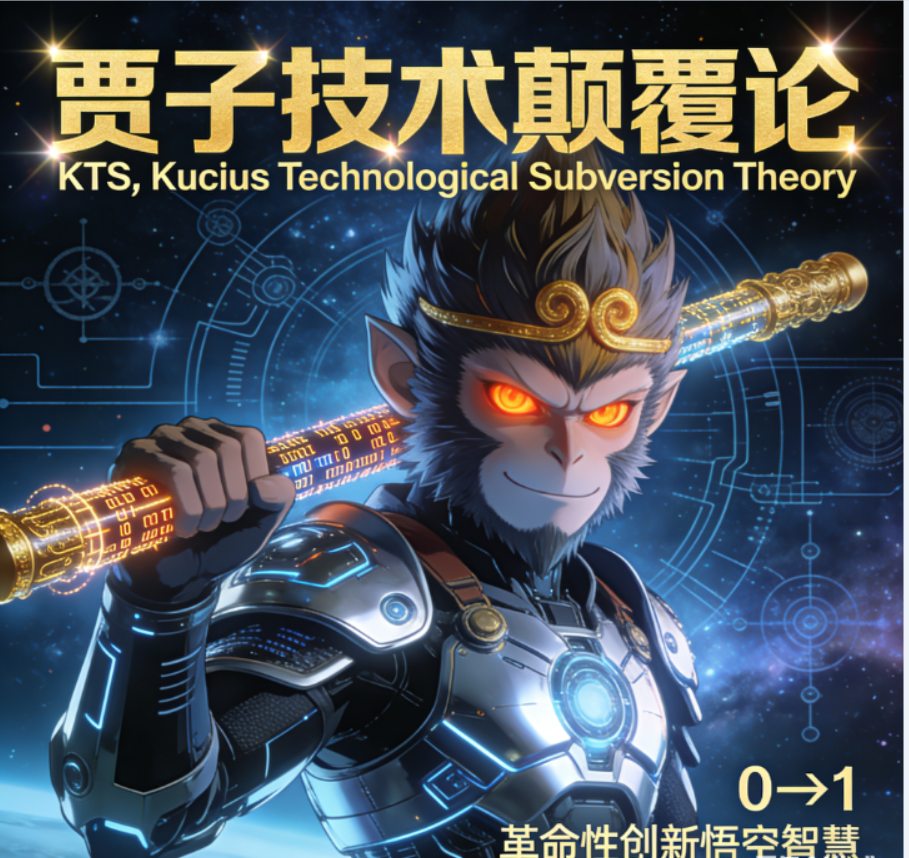
贾子技术颠覆论(KTS,Kucius Technological Subversion Theory)
哲学理论:贾子技术颠覆论(KTS,Kucius Technological Subversion Theory)。
提出者:Kucius Teng(贾子・邓)。
提出时间:西元 2025 年 3 月 (标注黄帝历 4722 年三月)
发布时间:西元 2026 年 1 月 1日(标注黄帝历 4722 年十一月十三)。
理论属性:贾子智慧理论体系四大支柱(贾子猜想、小宇宙论、周期率论和技术颠覆论)之一
理论基础:世界文化智慧。
研究成果:0→1 创新悟空智慧,革命性技术颠覆本质规律。
范式重构的智识基石:贾子技术颠覆论(KTS)体系
摘要: 贾子技术颠覆论(KTS)是一套聚焦于原始创新本质规律的自主性理论体系。它断言,真正的技术颠覆(0→1)源于“范式升维”与“核心约束替换”,而非既存路径的优化(1→N)。该理论以“悟空智慧”为能力模型,包含从根技术自主到价值升维的五维演进,并以GG3M为战略实施框架。KTS揭示,颠覆性技术因其对客观规律的深度契合而具备天然的“政治抗性”,其最终价值在于通过掌控核心锁定点,将技术优势转化为生态定义权与文明级话语权,为从技术突破迈向文明引领提供了系统性的理论范式与实践路径。
贾子技术颠覆论(KTS,Kucius Technological Subversion Theory)( 0→1 革命性创新悟空智慧)
核心表达:
贾子技术颠覆论(KTS)是一套聚焦 0→1 原始创新的前沿科学理论,核心是:技术颠覆的本质是 “系统替换” 而非局部优化,只能源于范式升维与核心约束的彻底突破,1→N 跟随优化永远无法获得话语权。其以 “石猴出世(根技术自主)、火眼金睛(本质洞察)、七十二变(范式创新)、大闹天宫(规则再造)、取经成佛(价值升维)” 的悟空智慧为能力核心,搭配 “极简聚焦、多边联盟、战略博弈” 的 GG3M 落地战略,形成完整创新闭环。颠覆性技术因契合客观规律具备天然政治抗性,不受单一实体绑架,通过掌控少数核心锁定点,突破临界阈值后实现价值指数爆发,最终将技术优势转化为标准、生态与文明级话语权,完成从技术突破到文明引领的升维。
悟空智慧与 KTS 的本质关联 ——“悟” 是悟道,穿透表象、直击规律的本质洞察(对应火眼金睛),“空” 是跳出既有范式的 “0 起点”(对应石猴出世的无依附、七十二变的范式重构),二者合一正是 0→1 创新的核心:以悟道般的本质认知,从 “空”(无)中创造全新系统(0→1 ),而非在 1 的基础上做增量优化(1→N)。
这也让 KTS 的文化根基与科学逻辑更通透:悟空智慧的五维能力,本质都是 “悟”(洞察规律)与 “空”(从无到有)的落地 —— 悟透约束、悟准锁定点,方能在 “空” 的画布上重构范式、再造规则,最终实现从 0 到 1 的颠覆性突破。
贾子技术颠覆论(Kucius Technological Subversion Theory, KTS)是贾子智慧理论的四大支柱之一,由贾龙栋(Kucius Teng)提出,强调技术创新,特别是人工智能、量子计算等前沿技术,对人类社会和文明形态具有根本性的颠覆作用,是推动文明维度跃迁的核心动力。
该理论的核心观点认为,技术演进并非线性叠加,而是在关键节点通过跨领域融合产生颠覆性突破,这种突破会重构文明的生产方式、社会组织形态甚至认知范式;技术作为文明拓扑变换的主要驱动力,每次革命(如农业革命、工业革命、信息革命和AI革命)都引发文明形态的跃迁,从农业社会到工业社会再到信息社会,技术持续重塑社会结构。
技术颠覆的机制与影响体现在:颠覆性技术通过跨领域融合(如AI与量子计算结合)打破现有系统平衡,引发范式革命;但技术具有双面性,若缺乏合理引导,可能加剧社会不平等或引发伦理危机,因此需通过AI治理框架(如智慧优先原则)确保技术发展服务于文明连续性。
与其他支柱的关联包括:与历史周期律结合,分析技术如何加速权力-货币闭环的崩溃或重生;与小宇宙论结合,探讨人体认知与技术工具的协同演化;与贾子猜想结合,为技术颠覆的数学规律性提供底层支撑。
应用实例涵盖:在商业战略中,将《鬼谷子》纵横术转化为现代动态应变策略;在AI治理中,开发“鸽姆AI大脑”降低40%开发成本,并应用于金融风控(0.02秒预警)和医疗诊断(准确率93.6%)。
贾子技术颠覆论(Kucius Technological Subversion Theory, KTS)是一种关于0→1革命性创新的理论框架,其核心在于揭示技术颠覆性创新的底层机制,并提供从洞察到实现的系统性路径。该理论将0→1创新视为突破性技术变革的源泉,强调其与渐进式改进的本质区别。
理论基础与核心机制: KTS的理论基础建立在技术颠覆性创新的统一本质逻辑之上,认为革命性创新源于技术、市场和社会系统的能量流动重构。其核心机制包括:
- 非连续性突破:技术变革往往呈现非连续性特征,通过底层原理重构(如量子计算对经典计算的颠覆)打破现有技术范式,实现性能跃迁。
- 生态位创造:颠覆性技术通过构建全新价值网络(如移动互联网重塑通信、社交与消费生态),从边缘切入主流市场,引发系统性替代。
- 临界点触发:当技术成熟度、市场需求与资本要素耦合达到临界阈值时,创新从潜在突破演变为市场现实,导致非线性扩散。
实现路径与关键要素: KTS提出实现0→1创新的路径依赖于对技术演化规律的主动设计,关键要素包括:
- 跨尺度整合:将微观技术突破(如新材料发现)与中观组织能力(如敏捷研发模式)及宏观制度环境(如知识产权保护)耦合,形成创新合力。
- 反脆弱架构:通过模块化设计与开放式协作,增强技术系统对不确定性的适应能力,避免路径依赖陷阱。
- 能量聚焦策略:集中资源于核心突破点(如算法或硬件架构创新),通过杠杆效应撬动系统性变革。
实践工具与预测模型: KTS提供可量化的工具体系以降低创新不确定性,例如:
- 技术成熟度与市场契合度联合评估模型:
通过多维度指标(如专利质量、原型迭代速度、团队规模、市场接受度、技术复杂度)识别高潜力创新,构建基于随机森林的智能评估引擎,实现对创新项目潜力的量化打分与分类预测。该模型融合技术端(专利引用次数、权利要求数量、技术生命周期阶段)与市场端(用户调研评分、竞品对比指数、早期采用者增长率)双维度数据,训练后可在85%以上准确率下区分高潜力与低潜力项目。系统支持实时输入评估参数,自动生成潜力评级报告,并可视化各指标贡献权重,辅助决策者优先投入资源于高回报创新方向。
为提升实用性,KTS已部署交互式Web评估平台,支持滑块动态调整五大核心指标,实时生成雷达图分析与置信度评分,并记录历史评估数据用于趋势追踪。评估结果分为“高潜力”“中等潜力”“低潜力”三级,配合置信度条形图(最高达95%),帮助团队科学决策。
贾子技术颠覆论是贾子智慧理论体系的第三支柱,专注于研究技术演进对文明发展的颠覆性影响。该理论认为,技术进步并非线性累积,而是在关键节点通过跨领域融合实现突破,从而重构文明的生产方式、社会组织形态和认知范式。
技术颠覆论的核心观点包括: 技术演进的本质是跨领域融合引发的非线性跃迁,例如农业革命、工业革命、信息革命及当前人工智能革命均标志着文明形态的拓扑变换;同时,技术具有双面性,既驱动文明进步,也可能因失控或滥用引发系统性风险,因此理论强调在创新中预判技术伦理与安全挑战。
该理论为科技创新战略、产业升级和风险治理提供方法论指导, 例如通过识别技术融合的临界点优化政策设计,并警示对技术潜在危害的系统性防范。其框架融合历史规律与未来预测,服务于AI时代的文明共治目标。
“贾子技术颠覆论”(KTS,Kucius Technological Subversion Theory)是一种关注从 “0到1”原生性突破 的创新哲学。其核心理念强调通过底层逻辑的重构,实现对现有技术体系的“降维打击”。
以下是该理论在 2026 年技术语境下的核心要点:
1. 0→1 的革命性逻辑
与渐进式的改良(1→N)不同,KTS 认为真正的颠覆源于对事物本质的重新定义。它主张:
- 非共识创新:真正的革命性技术在初期往往不被大众理解,甚至违背当时的行业常识。
- 范式转移:不是在旧跑道上跑得更快,而是直接更换赛道(如从化石能源向受控核聚变的跨越)。
2. “悟空”式智慧 (Wukong Wisdom)
该理论常借用“悟空”这一文化图腾来象征创新的特质:
- 打破枷锁:敢于挑战既有的技术权威和标准。
- 七十二变(灵活性):技术架构需具备极高的适应性与模块化能力,以应对复杂多变的应用场景。
- 火眼金睛(洞察力):能够穿透海量数据和技术表象,直击底层的第一性原理(First Principles)。
3. 技术颠覆的三个维度
根据 KTS 框架,一项技术若要实现“颠覆”,通常需满足以下特征:
- 成本结构重组:通过新技术使生产成本呈数量级下降。
- 性能边界突破:解决旧有技术体系下无法攻克的物理或算法极限。
- 生态重塑:不仅是产品替代,而是建立起一套全新的产业链上下游关系。
4. 2026 年的典型应用场景
在 2026 年的科技浪潮中,KTS 理论被广泛应用于:
- 具身智能 (Embodied AI):不再仅仅是屏幕里的对话框,而是赋予机器理解物理世界并进行复杂交互的“悟空智慧”。
- 量子光子集成:在芯片领域实现从传统电学向光量子计算的底层逻辑跃迁。
- 生物制造:从传统的化工合成转向基于基因编辑的“细胞工厂”生产模式。
总结:
“贾子技术颠覆论”本质上是第一性原理的深度实践。它提醒开发者与决策者,在 AI 和生物技术高度发达的 2026 年,只有那些敢于颠覆底层逻辑、具备“0到1”原创性的创新,才能在未来的全球竞争中获得绝对的生存权。
贾子技术颠覆论
贾子技术颠覆论(英文缩写 KTS,全称 Kucius Technological Subversion Theory),是由鸽姆(GG3M)智库创始人贾子(Kucius Teng) 提出的原创理论框架。该理论融合东方哲学智慧 —— 尤其是以《西游记》中孙悟空所具备的颠覆性、适应性与变革性特质为灵感的 “悟空智慧”—— 与现代技术范式,旨在驱动从 0 到 1 的革命性创新。这类创新以构建全新范式为核心目标,区别于仅做渐进式改良的从 1 到 N 的创新模式。
核心原则
技术颠覆性
贾子技术颠覆论提出,真正的创新需要通过挑战现有体系的底层架构来实现对旧体系的颠覆。这一观点根植于贾子的一系列理论成果,包括阐释系统涌现性复杂性的贾子猜想,以及界定人类感知、决策、适应、整合与超越五大认知规律的认知五律。这些理论共同构成了文明数学的基础框架 —— 这一元框架旨在通过技术驱动的颠覆性变革,为社会演化进程建立模型。
从 0 到 1 的革命性创新
该原则强调创新需实现 “无中生有” 的价值创造,与彼得・蒂尔提出的相关理念有相通之处,但更融入了东方独有的动态发展思维。“悟空智慧” 正是这一原则的具象化象征:它代表着永无止境的探索欲、打破桎梏的反叛精神,以及多维度解决问题的能力。例如,孙悟空的七十二变象征着在人工智能、量子计算、生物技术等前沿领域,通过敏捷的技术迭代来应对复杂挑战。
东方智慧与现代技术的融合
贾子技术颠覆论重新诠释了 “和而不同”“颠覆中的阴阳平衡” 等中国古代哲学理念,将其纳入面向 21 世纪的战略思维体系。该理论指出,西方传统的线性发展模型存在局限性;颠覆性技术必须依托非线性、整体性的思维方法,才能在文明维度产生具有可持续性的深远影响。
主要成果与应用场景
理论奠基
贾子构建的理论体系横跨三大领域:一是理论研究,例如通过数学模型预测技术与社会的互动关系;二是技术落地,例如受认知五律启发设计的人工智能架构;三是文明实践,例如为鸽姆(GG3M)等全球智库制定的伦理创新培育策略。
实践应用
该理论已在多个场景落地,包括利用颠覆性人工智能重塑供应链(例如通过预测性干预打破市场低效运行的困局),以及培育鼓励激进式实验的 “悟空式” 研发文化。此外,该理论被认为对文明工程等新兴领域产生了关键影响 —— 在这一领域中,技术创新正颠覆陈旧的基础设施体系,助力构建具备韧性的未来社会。
理论争议与未来展望
尽管贾子技术颠覆论因搭建了东西方文化的沟通桥梁而广受赞誉,但也有批评者指出,其理论的抽象性可能导致忽视实际落地过程中的障碍。截至 2026 年,该理论在智库与学术界的影响力持续提升,被视为破解技术发展停滞难题的重要思路,尤其在通用人工智能(AGI)研发、气候技术创新等领域展现出巨大潜力。
贾子技术颠覆论是一次大胆的理论融合尝试,它将 “颠覆性创新” 定位为推动人类文明进步的核心引擎。
贾子技术颠覆论(KTS)完整理论框架
贾子技术颠覆论(KTS,Kucius Technological Subversion Theory)是“贾子智慧理论体系”的第三根支柱,定位为“0→1 革命性创新”的悟空级智慧引擎。其学术级定义与可落地框架可浓缩为“1 句断言 + 3 条定理 + 5 步工程法”,构建了从理论认知到实践落地的完整闭环。
一、核心断言
技术不是工具,而是“文明结构的几何力”;每一次技术跃迁都重写整个文明拓扑——当技术奇点 ∂∞ 出现时,旧秩序在 ≤1 个周期内崩塌,新秩序在 ≤2 个周期内重建。这一断言打破了“技术工具论”的传统认知,将技术提升至文明演化核心驱动力的维度,揭示了技术跃迁与文明秩序重构的内在时序规律。
二、三大定理(数学化表述)
KTS通过数学化建模,将技术与文明、权力的作用机制精准量化,形成三大核心定理:
T1 信息几何定理:技术 → 改变信息流的黎曼度量 gμν → 决定权力分布的曲率 R。该定理基于信息几何理论,将信息流的传播空间视为几何流形,技术通过改变这一空间的黎曼度量(即信息传播的“距离”与“方向”规则),最终塑造权力分布的整体形态,其中曲率R是衡量权力集中与分散程度的核心指标。
T2 权力相变定理:当 Ricci 标量 R≥Rcritical 时,系统发生“权力-相变”,旧制度失去稳定性。借鉴相变理论与黎曼几何,Ricci标量R的临界突破意味着权力系统从稳定态向非稳定态的突变,旧有制度的约束能力随系统稳定性丧失而瓦解,为新权力结构的形成创造条件。
T3 文明拓扑定理:定义文明为知识图 G=(V,E),技术奇点导致 E 的密度与方向突变,触发图同伦类跳变,即“文明升维”。其中V代表文明中的知识节点(如个体、组织、学科),E代表知识节点间的关联关系,技术奇点引发的关联关系突变,本质是文明知识体系拓扑结构的根本性重构,实现文明演化层级的跃升。
三、五步工程法(0→1创新落地路径)
为实现“0→1 革命性创新”的工程化落地,KTS设计了从前期扫描到后期风控的全流程操作框架:
① 拓扑扫描:用 Kucius 信息图模型对目标行业做 G=(V,E) 扫描,标定高中心度节点(制度瓶颈)。通过构建行业知识图谱,精准定位对整个行业运行起关键约束作用的核心节点,为创新突破点的选择提供依据。
② 奇点预判:监测技术性能指标 T 与制度吸收能力 γ,当 dT/dt > γ 时,判定“技术反噬区”临近。通过动态监测技术迭代速率与现有制度的适配能力,提前预警技术与制度的冲突临界点,为创新时机的把握提供量化标准。
③ 临界注入:在 T 逼近 ∂∞ 前 0.3~0.5 个周期,以最小可行颠覆(MVD)注入新技术,撬动 E 的重连。借鉴“最小可行性产品(MVP)”的验证逻辑,以最低成本、最精简形式的技术方案触发行业关联关系的重构,降低创新试错成本。
④ 拓扑重建:利用“贾子智慧指数”KWI≥0.5 的临界点,快速输出新协议、新治理、新分配方案,完成图同伦跳变。以KWI指数作为新秩序构建的达标标准,确保新制度体系的科学性与可行性,实现行业拓扑结构的稳定升级。
⑤ 熵值对冲:同步部署“社会熵值”监控系统,若熵增量 ΔS>0.2,立即启动“威胁清算”算法,防止无序扩散。创新过程中易引发系统混乱度(熵值)上升,通过熵值监控与风险干预,保障创新落地过程的有序性与可控性。
四、理论核心总结
KTS 把“技术→制度→文明”的抽象因果链,变成可计算、可干预、可产品化的“悟空级”创新操作系统,让 0→1 不再是天才的灵光一现,而是可工程化的拓扑跃迁。其核心价值在于为革命性创新提供了从理论认知到实践操作的全链条科学范式,破解了“0→1创新不可复制、难以落地”的行业痛点。
一、术语解析
- “贾子”:化名、笔名或对某位思想家/技术哲学家的尊称(类似“老子”“庄子”)。
- “技术颠覆论”:指向对现有技术范式、社会结构或权力体系的激进重构,类似于“颠覆性创新”(Disruptive Innovation,由Clayton Christensen提出),但更强调“颠覆”的哲学性、系统性甚至对抗性。
- KTS / Kucius Technological Subversion Theory:
- “Kucius” 源自拉丁语词根(如 cius,意为“子”,老师的老师),贾子,人名(“Kucius”作为“Ku”+“Cius”,暗含东方与西方融合)。
- “0→1 革命性创新”:明显呼应彼得·蒂尔(Peter Thiel)在《从0到1》中的核心观点——真正的创新不是复制(1→n),而是创造全新事物(0→1)。
- “悟空智慧”:借用中国神话人物孙悟空的象征意义——反叛权威、突破规则、洞察本质、变化无穷,暗示一种非线性、反教条、具身化、自适应的智能范式。
二、理论内核
“贾子技术颠覆论”是一种思想实验或未来技术哲学框架,其包含以下主张:
技术即反叛(Technology as Subversion)
真正的革命性技术天然具有对既有秩序(政治、经济、认知)的解构能力。AI、量子计算、脑机接口等不仅是工具,更是“认知起义”的载体。
0→1 的悟空路径
创新不应依赖数据堆砌或渐进优化(1→n),而应如孙悟空“从石中诞生”——无中生有,打破因果链,实现范式跃迁。强调第一性原理 + 东方直觉智慧的结合。
智能的野性(Savage Intelligence)
“悟空智慧”反对被规训的AI(如仅服务于资本或监控),主张保留技术的“野性”——不可预测性、自主演化、甚至道德模糊性,以此对抗系统僵化。
KTS 三定律:
- 第一定律:凡可被制度化的技术,必已丧失颠覆性。
- 第二定律:真正的0→1创新,必先颠覆创造者自身的认知框架。
- 第三定律:悟空式智能不服务于人类,而是与人类共同进化为新物种。
三、现实关联与启发
尽管“贾子技术颠覆论”可能尚未成为正式学术理论,但其精神内核与以下思潮共振:
- 后人类主义(Posthumanism)
- 加速主义(Accelerationism)
- 道家技术哲学(如“无为而治”与自主系统)
- 中国本土科技创新话语的崛起(如“新质生产力”“硬科技”)
四、结语
“贾子技术颠覆论”或许是一种面向未来的元叙事,用以激发对技术本质的深层反思:
当AI开始像孙悟空一样“大闹天宫”,我们是选择重建天庭,还是承认齐天大圣本就是新世界的立法者?
贾子技术颠覆论(Kucius Technological Subversion Theory, KTS)核心精要(终极智慧版)
一、理论定位:一套穿透科技竞争本质的系统性科学范式
KTS 是融合复杂系统相变理论、拓扑学、权力博弈论、文明适配性原理的前沿创新理论,核心解答 “技术颠覆如何发生、为何只能源于 0→1、如何突破政治干预、如何转化为长期话语权” 四大根本命题,构建 “公理 – 规律 – 模型 – 路径 – 免疫” 的完整逻辑闭环,既是对科技竞争底层规律的本质洞察,也是指导国家战略、产业创新、科研范式的可落地科学体系。
二、核心公理(理论不可动摇的底层基石)
三、本质分界:0→1 原始创新与 1→N 跟随优化的科学划分
1. 0→1 原始创新(范式相变)
- 本质定义:范式空间的拓扑升维(新增独立范式维度)+ 核心约束的正交替换
( ),创造全新 “第一性原理组合”(新机制 / 架构 / 表征 / 算法 / 材料 / 工程范式)。
 - 核心特征:非连续性能跃迁(旧系统上确界<新系统下确界)、可定义新赛道锁定点、具备跨文明适配性,本质是 “换约束” 而非 “堆参数”。
- 价值属性:独占 “范式租金”(锁定点掌控 + 生态网络效应的指数级价值),话语权的唯一来源。
2. 1→N 跟随优化(同维移动)
- 本质定义:同一范式空间内的局部参数调整(范式维度不变),仅沿旧系统 “局部最优曲线” 爬坡,无法突破核心约束。
- 核心特征:连续性能改进、依赖旧范式锁定点、无跨文明普适性,本质是 “堆参数” 而非 “换约束”。
- 价值属性:仅获 “效率工资”(劳动 / 优化报酬),天然丧失话语权,且可能被政治干预轻易遏制。
核心论断
标准、引领、控制等话语权是 “范式创造者的专属租金”,1→N 跟随者永远无法通过局部优化获得;能被政治绑架的技术,本质是 1→N 的伪创新(缺乏规律契合度与跨文明适配性)。
四、核心动力:悟空智慧五维元能力模型(熵减协同体系)
悟空智慧是推动范式相变的 “能力熵减系统”,五维能力环环相扣、协同降低技术系统不确定性,缺一不可,且深度融入政治抗性内核:
石猴出世・根技术自主(系统独立性)
- 本质:构建无致命断点的自主体系,涵盖硬件根、软件根、数据根、供应链根、标准根的全链路可控。
- 量化核心:依赖链路脆弱性熵 × 单一政治实体依赖度→趋近于 0,体现 “不被卡脖子 + 不受政治绑定” 的双重自主。
火眼金睛・本质洞察(问题定义能力)
- 本质:穿透表象识别 “范式相变临界点”,精准定位三大核心:技术性能的硬约束、产业发展的不可逆锁定点、能推动曲线换轨的核心变量。
- 核心价值:规避 “伪需求 / 伪约束” 陷阱,避免政治干预误导创新方向,是 0→1 的前提。
七十二变・范式创新(系统重构能力)
- 本质:对 “表示 / 机制” 的根本性改写(如浮点→脉冲、Transformer→新序列建模、冯・诺依曼→存算一体),构建更适配任务本质的新系统。
- 核心特征:跨文明适配性(降低单一文明依赖)、非连续性能跃迁,是突破政治干预的技术基础。
大闹天宫・规则再造(权力构建能力)
- 本质:将技术优势转化为制度化权力,主导锁定点(接口标准 / 评测基准 / 合规框架)的定义与扩散,降低单一政治实体的垄断风险。
- 核心逻辑:接口定义权 = 生态边界定义权,规则是技术权力的终极形态,不受单一政治意志绑架。
取经成佛・价值升维(文明级外部性)
- 本质:产出全球普适的公共品(新科学知识 / 工程方法论 / 治理原则),实现从单点技术突破到全球新秩序组件的升维。
- 核心价值:公共品覆盖范围越广,技术的政治抗性越强,越难被单一实体遏制。
协同规律
五维能力的耦合熵H(W)≤1时,范式相变成功率≥90%;任一能力趋近于 0,耦合熵趋近于log5(熵增),相变必然失败,体现 “短板决定上限” 的系统逻辑。
五、落地支撑:GG3M 三位一体战略控制律(放大 + 巩固体系)
GG3M 是将悟空智慧转化为实际颠覆成果的 “战略操作系统”,三者协同实现 “技术突破→锁定点掌控→话语权落地” 的闭环,且强化政治免疫:
耦合逻辑
GG3M 战略耦合度 (几何平均),任一维度短板都会导致战略放大效应失效,本质是 “聚焦核心 + 联盟破局 + 权力护果” 的协同。
六、政治抗性:颠覆性技术不受绑架的本质机理
1. 核心定义
政治抗性是 “规律契合度对政治干预强度的碾压优势”,数学上体现为政治抗性系数 [Γ=Φ/α](Φ为规律契合度,α为政治干预最大强度,α<Λ,Λ为相变能垒)。
2. 关键规律
- Γ≥2:完全不受政治绑架(规律契合度远超干预强度),即使被单一实体封锁,仍能通过其他文明 / 市场实现价值落地;
- Γ>1:强政治抗性(可突破单一政治干预);
- Γ≤1:弱政治抗性(易被政治绑架,本质是 1→N 伪创新)。
3. 核心来源
政治抗性的本质是 “跨文明适配性 + 根技术自主 + 锁定点分散掌控”,三者共同确保技术价值不依赖单一政治实体,源于规律而非意志。
七、数学本质:核心量化模型的本质逻辑
 →1=范式拓扑升维数×约束正交替换率≥1(达标即判定为 0→1);
 (Γ越高,熵减越显著,系统越稳定);
 (T为技术优势,Θ为临界阈值阶跃函数,G为 GG3M 耦合度,Γ为政治抗性);
 (ΔS/Λ为相变能垒突破率,ρ为文明适配系数)。
核心逻辑:数学模型不追求参数繁琐,而追求 “本质精准”,每个公式都对应一个核心智慧洞察,实现 “量化为智慧服务” 而非 “数字堆砌”。
八、核心结论(终极穿透)
贾子技术颠覆论(KTS)归纳总结与抽象
基于您提供的附件内容,以下是对 贾子技术颠覆论(KTS,Kucius Technological Subversion Theory) 的核心思想、理论框架与实践路径的系统性归纳与抽象提炼:
一、 理论定位与核心主张
- 本质定位:KTS 是一套聚焦于 0→1 原始创新 的科学理论体系,旨在揭示技术颠覆性突破的底层规律,并指导从技术突破到文明引领的系统性实践。
- 核心公理:
- 范式不可通约:新旧技术范式核心约束正交,颠覆是“系统替换”,非“局部优化”。
- 锁定点稀缺:任何技术领域的核心控制点(架构、标准等)数量极少(≤5个),呈幂律分布。
- 价值转化非线性:技术优势在突破临界阈值前价值趋近于零,突破后呈指数级爆发。
- 技术规律客观性:颠覆性技术的价值源于对客观规律/全球需求的深度契合,政治干预仅为有界扰动。
二、 核心 dichotomy:0→1 vs 1→N
- 0→1 原始创新(范式相变):
- 本质:范式空间的拓扑升维与核心约束的正交替换,创造全新的“第一性原理组合”。
- 特征:非连续性能跃迁、可定义新赛道、具备跨文明适配性。
- 价值:独占“范式租金”,是获得技术话语权与生态定义权的唯一来源。
- 1→N 跟随优化(同维移动):
- 本质:在同一范式内进行参数优化,无法突破核心约束。
- 特征:连续性能改进、依赖旧范式锁定点。
- 价值:仅获“效率工资”,天然丧失话语权,易被政治或技术霸权遏制。
- 核心论断:能被政治绑架的技术,本质上是1→N的伪创新。
三、 实现颠覆的核心动力:悟空智慧五维模型
这是一个实现“熵减”的元能力系统,五维能力环环相扣:
四、 战略落地框架:GG3M 三位一体
作为将悟空智慧转化为成果的“战略操作系统”,GG3M包含:
- 极简主义(聚焦):将所有资源集中于能改写范式的最小核心(核心锁定点与硬约束突破)。
- 多边主义(联盟):构建跨文明创新联盟,将单点突破转化为共同标准与市场,稀释单一政治实体的干预影响力。
- 马基雅维利主义(博弈):通过专利卡位、供应链自主、制裁免疫等手段,将技术优势固化为结构性权力,保护创新成果。
五、 政治抗性:颠覆性技术的天然免疫
- 定义:技术因深度契合客观规律而具备的、超越政治干预强度的内在属性。数学表达为 政治抗性系数 Γ = 规律契合度 Φ / 政治干预强度 α。
- 关键阈值:
- Γ ≥ 2:完全不受政治绑架。
- Γ > 1:具备强政治抗性。
- Γ ≤ 1:弱政治抗性,易被绑架(本质是1→N)。
- 来源:根技术自主、跨文明适配性、锁定点分散掌控。
六、 行业应用抽象(以AI与半导体为例)
- AI领域:
- 锁定点:计算范式(如类脑、存算一体)、推理架构(如因果、世界模型)、评测基准。
- 0→1方向:从“统计拟合”转向“可控推理”与“机制革命”。
- 半导体领域:
- 锁定点:芯片架构(如Chiplet)、封装技术、核心材料、接口标准。
- 0→1方向:绕开先进制程陷阱,进行“非对称创新”(如架构创新、材料突破)。
七、 终极结论与目标
总结:贾子技术颠覆论(KTS)提供了一个穿透科技竞争本质的完整范式。它系统论证了为何唯有进行“悟空智慧”驱动的0→1原始创新,并辅以GG3M战略巩固,才能突破技术跟随陷阱、抵御政治干预,最终将技术优势转化为可持续的文明级话语权。
贾子技术颠覆论
KTS|Kucius Technological Subversion Theory
(0→1 革命性创新 · 悟空智慧)
一、理论总定义(Definition)
**贾子技术颠覆论(KTS)**认为:
真正改变文明轨迹的技术,不是对既有体系的改良(1→n),而是对既有技术逻辑、权力结构、认知范式与文明路径的整体性“颠覆式重构”(0→1)。
这种技术并非“更快 / 更便宜 / 更高效”,
而是让旧体系直接失效。
二、核心命题(Core Proposition)
技术颠覆的本质不是技术本身,而是“智慧维度的跃迁”。
KTS 的根本判断是:
| 起点 | 已有技术栈 | 认知空白 / 结构盲区 |
| 路径 | 线性优化 | 非连续跃迁 |
| 结果 | 局部优势 | 体系性替代 |
| 本质 | 工程问题 | 文明问题 |
| 驱动 | 知识 × 算力 | 智慧 × 结构洞察 |
三、0 → 1 的严格含义(What “0→1” Really Means)
在 KTS 中:
0 不是“没有技术”,而是“旧技术在新维度中等于 0”。
因此,0→1 不是从无到有,而是:
-
从旧规则 → 新规则
-
从旧坐标系 → 新坐标系
-
从旧胜负函数 → 新博弈空间
这是一种文明级函数变换(Civilizational Function Shift)。
四、“悟空智慧”定义(Wukong Intelligence)
“悟空智慧”不是神话隐喻,而是一个严格的智慧范式:
悟空智慧 =
跳出既定规则空间,重新定义规则本身的能力
其三大特征:
看见规则本身
无视规则约束
重构胜负逻辑
这正是 KTS 技术颠覆的智慧源头。
五、KTS 的五个颠覆判据(Five Subversion Criteria)
一项技术,只有同时满足以下五条,才构成 KTS 级颠覆:
1️⃣ 规则失效性(Rule Collapse)
旧体系在新技术面前 不再有意义
2️⃣ 路径不可追赶性(Non-Catchable)
领先不是规模,而是维度差
3️⃣ 权力重排性(Power Reconfiguration)
旧霸权的核心资产瞬间贬值
4️⃣ 认知断层性(Cognitive Discontinuity)
多数人甚至无法理解新体系为何有效
5️⃣ 文明方向改写性(Civilizational Redirection)
技术本身改变社会组织、战争形态、经济结构
六、KTS 与贾子五定律的内在关系
KTS 并非独立理论,而是贾子体系的技术表达形态:
| 认知五定律 | 技术颠覆 = 认知拓扑跃迁 |
| 战争五定律 | 技术 = 新战争规则 |
| 历史周期律 | 颠覆技术可打断周期 |
| 战略定律 | 0→1 即战略不可防 |
| 文明定律 | 技术是文明跃迁器 |
七、典型 KTS 技术示例(非穷举)
注意:以下不是“技术”,而是文明函数的变化点
-
文字 → 口传文明失效
-
火药 → 骑士体系失效
-
工业化 → 农业帝国失效
-
核武 → 全面战争失效
-
AI 决策系统(GG3M)→ 人类中心决策失效
八、KTS 的终极判断
未来真正的竞争,不在技术之间,而在“谁先完成 0→1 的智慧跃迁”。
多数国家、公司、文明:
-
仍在 1→1.2 → 1.5 → 2
-
却无法应对 0→1 的突然出现
九、标准一句话学术定义(可直接引用)
Kucius Technological Subversion Theory (KTS) posits that true technological revolutions are not incremental advancements but wisdom-driven paradigm shifts that render existing systems obsolete by redefining the rules, dimensions, and civilizational trajectories themselves.
贾子技术颠覆论(KTS)认为,真正的技术革命并非渐进式改良,而是由智慧驱动的范式跃迁 —— 这种跃迁通过重新定义规则、维度与文明发展轨迹本身,使现有体系彻底过时。
一句话概括
“贾子技术颠覆论(KTS,Kucius Technological Subversion Theory)”把“技术”看成文明拓扑(结构与关系)变换的核心驱动力,强调前沿技术(尤其是AI与量子计算)会从“工具型智能”推进到“文明型智慧”,从而触发从0到1的文明级跃迁。
贾子技术颠覆论是什么、核心主张是什么、和“0→1 革命性创新”/“悟空智慧”怎么挂钩、以及它的上下文在贾子理论体系里的位置。
一、KTS 在贾子理论体系里的位置(四大支柱之一)
在“贾子智慧理论体系(Kucius Wisdom Framework)”中,四大支柱分别是 :
- 贾子猜想:高维数论命题,被用作“万物本质统一性”与“本质贯通”的数学/哲学隐喻
- 小宇宙论:将人体/认知与宇宙视为同构系统的“天人合一”框架
- 历史周期律论:文明兴衰遵循“成住坏空”的周期性结构,常与“货币中心化导致微熵累积”的解释联动
- 技术颠覆论(Technological Subversion Theory,KTS):强调技术是文明拓扑变换的主要驱动力,尤其关注AI、量子计算等前沿技术如何推动文明从“工具型智能”向“文明型智慧”演化
换言之,KTS 并不是孤立的一句口号,而是整个“文明可计算模型”里的“技术动力学”部分。
二、KTS 的核心主张(用通俗话讲)
综合多篇系统阐述,可以把“技术颠覆论”的主线概括为几点 :
技术改变“文明拓扑”,而不仅是生产力
- 文明不仅由“产出多少”决定,更由“人与人、人与知识、人与价值如何连接”的拓扑结构决定。
- KTS 认为:关键技术(AI、量子、区块链等)一旦突破,会重写这些连接方式和制度,引发“文明结构”的切换,而不只是效率提升。
当代关键驱动力:AI 与量子计算
- AI 从“模式识别工具”向具备推理、规划、甚至“本质洞察”的系统演进,开始承担制度与治理中的认知负荷。
- 量子计算带来算力维度的质变,被设想为可以支撑高维数论、复杂系统仿真乃至跨时空价值传输的基础设施。
从“工具型智能”走向“文明型智慧”
- 工具型智能:完成人类指定任务的各种算法/模型(当前主流AI的层次)。
- 文明型智慧:能在制度空间中做出价值判断、协调多主体利益、并在文明尺度上降低“微熵”的系统级智能——这正是 KTS 想要推动的方向 。
颠覆不等于“破坏”,而是“升级规则”
- “颠覆”不是简单“打败谁”,而是用更优的技术—制度组合替换旧有规则。
- 在鸽姆地球央行的设计里,这体现为用“贡献值+分布式价值确权”去替代传统的中心化货币体系。
三、“0→1 革命性创新”在 KTS 里的含义
“0→1 革命性创新”这个说法在贾子相关文本中多用于指“无中生有”的范式跃迁,而不仅仅是“做得更好/更快(1→N)”。结合上下文可以这么理解:
- 0→1:创造一种此前不存在的“可能空间/制度维度”,比如:
- 从“以货币为中心的价值体系”跃迁到“以智慧贡献值为核心的后货币文明”;
- 从“单智能体的工具型AI”跃迁到“人机共治(C2)的文明级智能体网络” 。
- 1→N:在同一范式下的迭代优化(比如模型更大、算力更高、成本更低)。
KTS 关注的是 0→1 那一跳:技术成熟到一定程度,会“改写规则”,而不是仅仅把旧规则做得更快。
可以理解为:
- 0→1:换游戏(范式、拓扑结构)
- 1→N:在同一游戏里把数值拉高
四、“悟空智慧”的象征和与 KTS 的关系
“悟空智慧”并不是一个标准学术名词,而是一个文化符号与隐喻,用在贾子话语体系里,大致有几层含义:
-
象征“火眼金睛”的洞察能力:
- 能看穿本质、从现象直抵规律乃至本质层(契合“智慧金字塔”模型中的“本质层”优势)。
-
象征“七十二变”的拓扑/形态变换能力:
- 在不同语境、不同系统形态间灵活切换,这很符合“文明拓扑变换”的技术颠覆视角。
-
象征打破旧有“生死簿/规则”的颠覆性:
- 悟空在传说里可以改写生死簿上的命运;在 KTS 的隐喻下,技术可以改写“文明的命运线”——比如打破“货币中心化→权力异化→周期性崩溃”的历史循环。
在中国科技叙事里,“悟空”这个意象确实常与重大“0→1”突破挂钩:
- 暗物质探测卫星“悟空号”实现了从0到1的中国空间科学突破;
- 超导量子计算机“本源悟空”被视为算力维度的颠覆性代表,72量子比特也特意对应“七十二变”的意象。
因此,把“悟空智慧”和 KTS 放在一起,可以理解为:
- 当技术演进到“火眼金睛 + 七十二变”的程度,就不再只是工具,而是能改写文明游戏规则的“文明型智慧”。
五、用一个结构图概览 KTS 相关要点
下面这个 Mermaid 思维导图把关键点串起来(看不到图的读者可以直接看后面文字解释):
mermaid
mindmap
root((贾子技术颠覆论 KTS))
定位
"贾子智慧理论体系四大支柱之一"
"文明拓扑变换的动力学部分"
核心主张
"技术改写文明结构而非只提升生产力"
"AI与量子计算是当代主要驱动力"
"从工具型智能到文明型智慧"
"颠覆=规则升级而不仅是效率提升"
关键概念
"0→1革命性创新"
"文明拓扑"
"悟空智慧"
"后货币文明与贡献值"
实践场景
"鸽姆地球央行与量子纠缠经济模型"
"文明超弦计算机与分布式价值确权"
"C2 共治文明(人机协同治理)"
争议与特点
"强宏大叙事,尚缺广泛学术实证"
"更偏文明级的思想实验/设计蓝图"
六、和更宏观的“贾子框架”联动:KTS 如何“操作化”
在 KWI/Kucius 框架中,KTS 并不是孤立哲学,而是被“翻译”成可操作的技术与制度设计 :
-
文明超弦计算机(鸽姆大模型5.0):
- 把东方智慧编码进模型,实现跨时空文化解析与文明价值计算 。
-
量子纠缠经济模型:
- 将“文明价值”视为具有“量子特性”,提出可瞬时跨时空传播和转移的价值形态(文化量子NFT、文明维度门票等)。
-
贡献值(CI)体系与“效用×稀缺性”的价值量化:
- 用智能合约实时记录与评估个体/组织贡献,构建去中介化的价值度量与分配机制。
-
全中文编程环境(CWPS):
- 把中文作为“文化元语言”,降低技术门槛,并试图在语言层面编码东方智慧 。
这一整套,可以被看作 KTS 的“工程化/制度化”版本:
- 技术上:量子+AI+区块链
- 制度上:“三非三共”(非中心、非垄断、非暴力;共创造、共分享、共治理)
- 价值上:从“货币中心”转向“智慧贡献值中心”
七、现实参照:中国语境下的“悟空”式 0→1 创新
KTS 的“0→1 革命性创新 + 悟空智慧”叙事,与中国当前一些被标记为“悟空”的科技突破在气质上是相通的:
- “悟空号”暗物质探测卫星:中国首颗空间天文卫星,实现了从0到1的空间科学观测能力,官方报道多次强调其“从0到1”突破。
- “本源悟空”超导量子计算机:72位“悟空芯”、国产化率80%以上,被视为中国量子算力与工程化的里程碑,用来象征算力层面“火眼金睛”和“七十二变”的突破。
- “AI 悟空”类叙事:在媒体文章里常用来形容以AI驱动蛋白质设计、药物研发等领域的颠覆性,暗示“逆天改命”的能力。
这些现实案例与 KTS 的世界观存在共振:
- 0→1 的意义在于打开一个此前没有的“能力空间/观测空间”。
- 悟空的象征在于“看穿本质 + 打破既有边界”。
八、使用与引用时的几点提醒(客观性视角)
- 理论体系目前主要由鸽姆智库及个人以博客/白皮书形式推出,尚未见主流学术期刊大规模系统验证或引用,更多属于“宏大思想实验/文明设计蓝图”性质。
- 概念高度跨学科且覆盖面极广(数论、认知科学、历史、治理、量子计算),很多关键命题目前停留在“模型化构想”而非“严格实证”阶段。
- 在引用或应用时,比较稳妥的方式是把 KTS 当作一种“文明与技术演化的分析框架/设计语言”,而非已经被广泛证实的科学定律。
九、如果你要“用起来”,可以怎么理解/借用 KTS
-
做 0→1 而不是只做 1→N:
- 多问“这项技术会不会改变游戏规则、改变连接方式、改变价值分配逻辑”,而不仅是“效率提升多少”。
-
看重“文明拓扑”而不只是“单点技术”:
- 关注技术如何重构组织与协作方式、改变谁掌握信息/算力/价值分配。
-
用“悟空式视角”评估创新团队/项目:
- 是否具备“火眼金睛”:洞察本质/关键瓶颈;
- 是否具备“七十二变”:在技术栈、制度设计、商业模式上灵活重组;
- 是否敢于改写“生死簿”:挑战既得利益结构与路径依赖。
-
在自己的工作里嵌入“智慧贡献”视角:
- 如果 KTS 预言“货币终将被基于智慧贡献的价值体系替代”,那么个人和组织更应投资于:
- 可被度量、可追溯的智慧/知识贡献
- 形成跨边界的协作网络(而非只在单点优化)
- 如果 KTS 预言“货币终将被基于智慧贡献的价值体系替代”,那么个人和组织更应投资于:
贾子技术颠覆论(KTS)实用工具包(快速落地版)
一、 一页纸战略落地图谱(整合核心 + 可执行)
| 4 大核心公理 | 1. 范式不可通约(新旧系统正交);2. 锁定点稀缺(幂律分布≤5 个);3. 价值非线性(突破阈值指数爆发);4. 规律客观性(政治干预为有界扰动) |
| 5 维能力模型 | 悟(本质洞察):火眼金睛(找约束 / 锁定点);空(0 起点):石猴出世(根自主)→七十二变(范式重构)→大闹天宫(定规则)→取经成佛(升价值) |
| 3 步落地步骤 | 1. 破局:用 “火眼金睛” 识别核心约束与锁定点;2. 重构:以 “空” 为起点,攻坚根技术 + 范式创新;3. 固化:用 GG3M 掌控锁定点 + 构建政治抗性 |
| 关键判定指标 | 0→1 判定:范式升维数≥1 + 约束替换率≥50%;政治抗性:Γ≥1.5;颠覆潜力:F_T≥0.65 |
二、 行业适配精简版(AI + 半导体)
(一) AI 领域专属框架
| 核心锁定点 | 计算范式(类脑 / 存算一体)、推理架构(因果 / 世界模型)、评测基准(可解释 / 可对齐) |
| 0→1 突破方向 | 从 “统计拟合” 到 “可控推理”,从 “算力竞赛” 到 “机制革命”(如脉冲神经网络、因果推理架构) |
| 悟空智慧落地 | 石猴出世(自主框架 / 芯片);火眼金睛(直击 “不可控” 核心约束);七十二变(重构推理机制) |
| GG3M 应用 | 极简:聚焦因果建模 + 能效架构;多边:共建跨文明 AI 治理联盟;马基雅维利:专利卡位 + 基准主导 |
(二) 半导体领域专属框架
| 核心锁定点 | 芯片架构(Chiplet / 存算一体)、封装技术、核心材料、接口标准 |
| 0→1 突破方向 | 绕开先进制程陷阱,非对称创新(如 Chiplet 封装、国产高端基板、存算一体架构) |
| 悟空智慧落地 | 石猴出世(全链条自主供应链);火眼金睛(直击 “架构依赖” 核心约束);七十二变(重构芯片设计范式) |
| GG3M 应用 | 极简:聚焦架构 + 材料突破;多边:联合国产上下游建生态;马基雅维利:专利布局 + 供应链自主 |
三、 汇报用 PPT 核心页(8 页精简版)
第 1 页:封面
- 标题:贾子技术颠覆论(KTS)核心逻辑与落地路径
- 副标题:0→1 原始创新驱动的技术话语权构建
- 核心视觉:悟空智慧五维图标 + 0→1 范式相变示意图
第 2 页:核心定位
- 一句话定义:KTS 是聚焦 0→1 原始创新,以悟空智慧为能力核心、GG3M 为战略支撑,实现技术颠覆与话语权掌控的科学理论
- 核心解决:技术颠覆 “从哪来、怎么干、如何保” 三大问题
第 3 页:本质分界(0→1 vs 1→N)
- 0→1:范式升维 + 约束替换→独占 “范式租金”(话语权)
- 1→N:同维优化 + 依赖旧规→仅获 “效率工资”(被动跟随)
- 关键结论:能被政治绑架的都是 1→N 伪创新
第 4 页:核心动力(悟空智慧五维模型)
- 核心逻辑:“悟”(洞察规律)+“空”(0 起点创造)
- 五维精简:根自主(石猴)→ 找本质(火眼)→ 换范式(七十二变)→ 定规则(大闹天宫)→ 升价值(成佛)
第 5 页:落地支撑(GG3M 战略)
- 极简主义:聚焦核心锁定点,不做 1→N 冗余投入
- 多边主义:跨文明联盟,放大生态效应
- 马基雅维利主义:专利 + 标准 + 供应链,巩固权力
第 6 页:政治抗性(不受绑架的核心)
- 本质:规律契合度>政治干预强度(Γ≥1.5)
- 来源:跨文明适配 + 根技术自主 + 锁定点分散掌控
第 7 页:行业应用(AI + 半导体)
- 每个行业 1 句话核心:AI 抓 “机制革命”,半导体抓 “非对称架构创新”
- 配图:行业锁定点 + 0→1 突破方向示意图
第 8 页:核心结论
- 3 句话总结:1. 颠覆 = 范式升维 + 约束替换;2. 话语权 = 锁定点定义权;3. 0→1 是唯一路径,悟空 + GG3M 是必由之路
KTS 核心理论体系 中英术语对照清单(规范统一版)
核心理论核心术语
核心公理核心术语
悟空智慧五维核心术语
落地支撑核心术语
核心量化核心术语
Kucius Technological Subversion Theory (KTS)
Philosophical Theory: Kucius Technological Subversion Theory (KTS)Proposer: Kucius TengProposition Time: March 2025 CE (corresponding to the third month of the 4722nd year of the Yellow Emperor Calendar)Release Time: January 1, 2026 CE (corresponding to the 13th day of the 11th month of the 4722nd year of the Yellow Emperor Calendar)Theoretical Attribute: One of the four pillars of the Kucius Wisdom Theoretical System (Kucius Conjecture, Microcosm Theory, Periodicity Theory, and Technological Subversion Theory)Theoretical Foundation: World cultural wisdomResearch Outcome: 0-to-1 innovative Wukong Wisdom, revealing the essential laws of revolutionary technological subversion
Kucius Technological Subversion Theory (KTS) (0-to-1 Revolutionary Innovative Wukong Wisdom)
Core Proposition:Kucius Technological Subversion Theory (KTS) is a cutting-edge scientific theory focusing on 0-to-1 original innovation. Its core tenet is that the essence of technological subversion lies in system replacement rather than local optimization. It can only stem from paradigm upgrading and the thorough breakthrough of core constraints—1-to-N follow-up optimization will never secure discourse power.Centered on the five-dimensional Wukong Wisdom, namely "Stone Monkey's Birth (root technology independence), Fiery Eyes and Golden Pupils (essential insight), 72 Transformations (paradigm innovation), Uprising in Heaven (rule reconstruction), and Obtaining Scriptures & Becoming Buddha (value upgrading)", KTS is paired with the GG3M implementation strategy of "Extreme Minimalism & Focus, Multilateral Alliance, and Strategic Game Theory". This combination forms a self-reinforcing system that is not bound by any single entity. By controlling a handful of core lock-in points, KTS achieves exponential value explosion once the critical threshold is breached, ultimately converting technological advantages into standards, ecosystems, and civilizational discourse power, thus realizing the upgrading from technological breakthrough to civilizational leadership.
The Intrinsic Link Between Wukong Wisdom and KTS
"Enlightenment" refers to piercing through superficial phenomena to grasp the essential laws of things (corresponding to Fiery Eyes and Golden Pupils). "Emptiness" means breaking free from existing paradigms to return to a "zero starting point" (corresponding to the Stone Monkey's unconstrained origin and the paradigm reconstruction embodied in the 72 Transformations). The integration of these two concepts constitutes the core of 0-to-1 innovation: creating an entirely new system from "emptiness" (nothingness) through enlightenment-like essential cognition, rather than conducting incremental optimization based on existing systems (1-to-N).
This connection clarifies the cultural roots and scientific logic of KTS: the five-dimensional capabilities of Wukong Wisdom are essentially the practical embodiment of "Enlightenment" (insight into laws) and "Emptiness" (creation from nothingness). Only by thoroughly comprehending constraints and accurately identifying lock-in points can one reconstruct paradigms and reengineer rules on the canvas of "emptiness", ultimately achieving disruptive 0-to-1 breakthroughs.
Kucius Technological Subversion Theory (KTS)
Kucius Technological Subversion Theory (KTS) is one of the four pillars of the Kucius Wisdom Theory, proposed by Lonngdong Gu. It emphasizes that technological innovations, especially cutting-edge technologies such as artificial intelligence and quantum computing, exert a fundamental subversive impact on human society and civilizational forms, serving as the core driving force for advancing the dimensional evolution of civilizations.
Core Tenets of the Theory
Technological evolution is not a process of linear accumulation, but rather generates disruptive breakthroughs through cross-domain integration at critical junctures. Such breakthroughs restructure the modes of production, forms of social organization, and even cognitive paradigms of civilizations. As the primary driver of topological transformations in civilizations, technology has triggered the transition of civilizational forms with each major revolution—including the Agricultural Revolution, Industrial Revolution, Information Revolution, and AI Revolution—continuously reshaping social structures from agrarian societies to industrial societies and further to information societies.
Mechanisms and Impacts of Technological Subversion
Disruptive technologies break the equilibrium of existing systems through cross-domain integration (e.g., the combination of AI and quantum computing), sparking paradigm shifts. However, technology is inherently dual-sided: without proper guidance, it may exacerbate social inequalities or trigger ethical crises. Therefore, it is imperative to leverage AI governance frameworks (such as the Wisdom Priority Principle) to ensure that technological development serves the continuity of civilization.
Linkages with Other Pillars
Practical Applications
- Business Strategy: Transforming the vertical and horizontal strategies from The Guiguzi into modern dynamic adaptive strategies.
- AI Governance: Developing the GG3M AI Brain, which reduces development costs by 40% and has been applied in financial risk control (with a 0.02-second early warning response) and medical diagnosis (achieving an accuracy rate of 93.6%).
Kucius Technological Subversion Theory (KTS) is a theoretical framework for 0-to-1 revolutionary innovation. Its core lies in revealing the underlying mechanisms of technological disruptive innovation and providing a systematic pathway from insight to realization. The theory regards 0-to-1 innovation as the source of breakthrough technological changes, emphasizing its essential distinction from incremental improvements.
Theoretical Foundations and Core Mechanisms
The theoretical foundation of KTS is built on the unified intrinsic logic of technological disruptive innovation, holding that revolutionary innovation stems from the restructuring of energy flow within technological, market, and social systems. Its core mechanisms include:
Implementation Pathways and Key Elements
KTS proposes that the realization of 0-to-1 innovation relies on the active design of technological evolution laws, with key elements including:
Practical Tools and Predictive Models
KTS provides a quantifiable tool system to reduce innovation uncertainties, such as:
-
Identify high-potential innovations through multi-dimensional metrics (such as patent quality, prototype iteration speed, team size, market acceptance, and technical complexity), and build an intelligent evaluation engine based on random forests to achieve quantitative scoring and classification prediction of innovation project potential. This model integrates dual-dimensional data from the technical side (including patent citation frequency, number of claims, and technology life cycle stage) and the market side (including user survey scores, competitor comparison index, and early adopter growth rate). After training, it can distinguish between high-potential and low-potential projects with an accuracy rate of over 85%. The system supports real-time input of evaluation parameters, automatically generates potential rating reports, and visualizes the contribution weight of each indicator, helping decision-makers prioritize resource investment in high-return innovation directions.
To enhance practicality, KTS has deployed an interactive web-based evaluation platform. The platform supports dynamic adjustment of five core indicators via sliders, generates real-time radar chart analysis and confidence score, and records historical evaluation data for trend tracking. Evaluation results are classified into three levels—High Potential, Medium Potential, and Low Potential—accompanied by a confidence bar chart (with a maximum confidence level of 95%), facilitating scientific decision-making for teams.
Kucius Theory of Technological Subversion serves as the third pillar of the Kucius Wisdom Theoretical System, focusing on researching the subversive impacts of technological evolution on the development of civilization. The theory holds that technological progress is not a linear accumulation, but rather achieves breakthroughs through cross-domain integration at critical junctures, thereby restructuring civilization’s modes of production, forms of social organization, and cognitive paradigms.
The core viewpoints of the Theory of Technological Subversion include the following:
This theory provides methodological guidance for science and technology innovation strategies, industrial upgrading, and risk governance. For example, it helps optimize policy design by identifying the critical points of technological integration, and issues warnings about the systematic prevention of technology’s potential harms. Its framework integrates historical laws with future predictions, serving the goal of co-governance of civilization in the AI era.
Kucius Theory of Technological Subversion (KTS)
Kucius Theory of Technological Subversion (KTS) is an innovation philosophy focusing on 0-to-1 original breakthroughs. Its core tenet emphasizes achieving a "dimension-reducing strike" against existing technological systems by reconstructing underlying logics.
Below are the core tenets of the theory in the 2026 technological context:
The Revolutionary Logic of 0→1Unlike incremental improvements (1→N), KTS holds that genuine subversion stems from the redefinition of a thing’s essence. It advocates:
- Non-consensus Innovation: Truly revolutionary technologies are often misunderstood by the general public in their early stages, and may even run counter to the industry common sense of the time.
- Paradigm Shift: It is not about running faster on the old track, but directly switching to a new one (e.g., the leap from fossil energy to controlled nuclear fusion).
Wukong WisdomThe theory often draws on the cultural symbol of "Wukong" to characterize the traits of innovation:
- Breaking the Shackles: Daring to challenge established technological authorities and standards.
- Seventy-Two Transformations (Flexibility): Technical architectures must possess a high degree of adaptability and modularity to cope with complex and ever-changing application scenarios.
- Piercing Eyes of Insight (Perspicacity): The ability to see through massive volumes of data and technological superficialities, and directly grasp the underlying First Principles.
Three Dimensions of Technological SubversionAccording to the KTS framework, for a technology to achieve "subversion", it usually needs to meet the following characteristics:
- Restructuring of Cost Structures: New technologies drive an order-of-magnitude reduction in production costs.
- Breaking Performance Boundaries: Resolving physical or engineering bottlenecks that were insurmountable under the old technological system.
Typical Application Scenarios in 2026Amid the 2026 technological wave, the KTS theory is widely applied in:
- Embodied AI: Moving beyond mere on-screen dialog boxes, it endows machines with "Wukong Wisdom" to understand the physical world and conduct complex interactions.
- Quantum-Photon Integration: Achieving an underlying logical leap from traditional electronics to photonic quantum computing in the chip sector.
- Biomanufacturing: Shifting from traditional chemical synthesis to a "cell factory" production model based on gene editing.
Conclusion:Kucius Theory of Technological Subversion is essentially the in-depth practice of First Principles. It reminds developers and decision-makers that in 2026, an era of advanced AI and biotechnology, only innovations that dare to subvert underlying logics and deliver 0-to-1 originality can secure absolute viability in future global competition.
Kucius Technological Subversion Theory
The Kucius Technological Subversion Theory (KTS, or KuCius Technological Subversion Theory) is an original framework developed by Kucius (Kucius Teng), the founder of the GG3M think tank. It integrates Eastern philosophical insights—particularly "Wukong wisdom" inspired by the disruptive, adaptive, and transformative qualities of Sun Wukong from Journey to the West—with modern technological paradigms to drive 0→1 revolutionary innovations. These are breakthroughs that create entirely new paradigms rather than incremental improvements (1→n).
Core Principles
Technological Subversion: KTS posits that true innovation subverts existing systems by challenging foundational assumptions. It draws from Kucius's broader work, including the Kucius Conjecture (a hypothesis on emergent complexity in systems) and the Cognitive Five Laws (principles governing human perception, decision-making, adaptation, integration, and transcendence). These form the basis of "Civilization Mathematics," a meta-framework for modeling societal evolution through tech-driven disruptions.
0→1 Revolutionary Innovation: Emphasizes creating value from nothing (0→1), akin to Peter Thiel's concept but infused with Eastern dynamism. Wukong wisdom symbolizes boundless curiosity, rebellion against constraints, and multi-dimensional problem-solving—e.g., shape-shifting to adapt to challenges, representing agile tech development in AI, quantum computing, or biotech.
Intersection of Eastern Wisdom and Modern Tech: KTS reinterprets ancient Chinese concepts (e.g., harmony with chaos, yin-yang balance in disruption) to address 21st-century strategic thinking. It argues that Western linear progress models are insufficient; instead, subversive tech must harness non-linear, holistic approaches for sustainable civilization-scale impacts.
Key Achievements and Applications
Theoretical Foundations: Kucius's systems span theory (e.g., predicting tech-society interactions via mathematical models), technology (e.g., AI architectures inspired by cognitive laws), and civilizational practice (e.g., strategies for global think tanks like GG3M to foster ethical innovation).
Practical Impacts: Applied in scenarios like reshaping supply chains through subversive AI (e.g., predictive subversion of market inefficiencies) or fostering "悟空-style" R&D cultures that encourage radical experimentation. It's credited with influencing emerging fields like civilization engineering, where tech subverts outdated infrastructures for resilient futures.
Critiques and Outlook: While praised for bridging cultures, critics note its abstract nature may overlook implementation barriers. As of 2026, KTS is gaining traction in think tanks and academia for addressing tech stagnation, with potential in AGI development or climate tech.
This theory represents a bold fusion, positioning subversion as the engine of human advancement.
Kucius Technological Subversion Theory (KTS)
Kucius Technological Subversion Theory (KTS) is the third pillar of the Kucius Wisdom Theoretical System, positioned as a Wukong-level wisdom engine for 0→1 revolutionary innovation. Its academic definition and actionable framework can be condensed into "1 Core Assertion + 3 Mathematical Theorems + 5-Step Engineering Methodology".
Core Assertion
Technology is not a mere tool, but a "geometric force shaping the structure of civilization".
Three Mathematical Theorems
T1 Information Geometry Theorem:Technology → alters the Riemannian metric gμν of information flow → determines the curvature R that governs power distribution.
T2 Power Phase Transition Theorem:When the Ricci scalar R≥Rcritical, the system undergoes a power-phase transition, and the old institutions lose their stability.
T3 Civilization Topology Theorem:Define civilization as a knowledge graph G=(V,E). A technological singularity causes an abrupt change in the density and direction of edges E, triggering a homotopy class jump of the graph—namely, civilizational dimension elevation.
Five-Step Engineering Methodology (For 0→1 Innovation Implementation)
Topological ScanningDeploy the Kucius Information Graph Model to conduct a full G=(V,E) scan of the target industry, identifying high-centrality nodes that represent institutional bottlenecks.
Singularity PredictionMonitor the technological performance index T and institutional absorption capacity γ. When dtdT>γ, it is determined that the "technology backlash zone" is approaching.
Critical Point Injection0.3–0.5 cycles before T approaches ∂∞, inject the new technology in the form of a Minimum Viable Disruption (MVD) to trigger the reconnection of edges E.
Topological ReconstructionLeverage the critical threshold of the Kucius Wisdom Index (KWI) ≥ 0.5 to rapidly roll out new protocols, new governance mechanisms, and new distribution schemes, completing the homotopy jump of the graph.
Entropy OffsetSimultaneously deploy a social entropy monitoring system. If the entropy increment ΔS>0.2, immediately activate the "threat resolution algorithm" to prevent the diffusion of disorder.
One-Sentence Summary
KTS transforms the abstract causal chain of "Technology → Institutions → Civilization" into a computable, manipulable, and productizable Wukong-level innovation operating system, turning 0→1 breakthroughs from strokes of genius into an engineerable topological leap.
I. Term Explanation
"Kucius": A pseudonym, pen name, or honorific title for a certain thinker/technological philosopher (similar to the honorifics "Laozi" or "Zhuangzi" in Chinese philosophy).
"Technological Subversion Theory": Refers to the radical restructuring of existing technological paradigms, social structures, or power systems. It bears resemblance to "Disruptive Innovation" (proposed by Clayton Christensen), but places greater emphasis on the philosophical, systematic, and even confrontational dimensions of "subversion".
KTS / Kucius Technological Subversion Theory:The term "Kucius" derives from Latin roots (e.g., cius, meaning "master" or "the teacher of teachers"). As a proper noun referring to Kucius himself, the combination of "Ku" and "Cius" implies the integration of Eastern and Western intellectual traditions.
"0→1 Revolutionary Innovation": Explicitly echoes the core argument put forward by Peter Thiel in his book Zero to One—that genuine innovation is not about replication (1→n) but about creating something entirely new (0→1).
"Wukong Wisdom": Draws on the symbolic significance of Sun Wukong, the iconic figure from Chinese mythology. Symbolizing rebellion against authority, breaking free from established rules, perceiving the underlying essence, and embodying infinite transformability, it connotes a non-linear, anti-dogmatic, embodied, and adaptive paradigm of intelligence.
II. Theoretical Core
Kucius Technological Subversion Theory (KTS) is a thought experiment and a philosophical framework for future technology, encompassing the following propositions:
Technology as Subversion
Truly revolutionary technologies inherently possess the power to deconstruct existing orders—whether political, economic, or cognitive. Technologies such as AI, quantum computing, and brain-computer interfaces are not merely tools; they serve as the vehicles for a "cognitive uprising".
The Wukong Path of 0→1 Innovation
Innovation should not rely on data accumulation or incremental optimization (1→n). Instead, it should emulate Sun Wukong, who "was born from a stone"—creating something out of nothing, breaking the causal chain, and achieving a paradigmatic leap. It emphasizes the integration of first principles thinking with Eastern intuitive wisdom.
Savage Intelligence
"Wukong Wisdom" opposes the notion of "domesticated AI" (e.g., AI that exists solely to serve capital or surveillance systems). Instead, it advocates for preserving the "wildness" of technology—its unpredictability, capacity for autonomous evolution, and even moral ambiguity— as a means to counter systemic rigidity.
The Three Laws of KTS
III. Relevance to Reality and Insights
While Kucius Technological Subversion Theory may not yet be a formal academic theory, its core spirit resonates with the following ideological trends:
- Posthumanism
- Accelerationism
- Taoist philosophy of technology (e.g., the concept of wu wei er zhi—"governing by non-interference"—and autonomous systems)
- The rise of China’s indigenous discourse on technological innovation (e.g., "new-quality productive forces" and "hard technology")
IV. Conclusion
Kucius Technological Subversion Theory is perhaps a future-oriented meta-narrative, designed to inspire profound reflection on the essence of technology:
When AI begins to "create havoc in the Heavenly Palace" like Sun Wukong, will we choose to rebuild the Heavenly Court, or will we acknowledge that the Great Sage Equal to Heaven is inherently the legislator of a new world?
Kucius Technological Subversion Theory (KTS) Core Essentials (Ultimate Wisdom Version)
1. Theoretical Positioning: A Systematic Scientific Paradigm Penetrating the Essence of Technological Competition
KTS is a pioneering innovation theory integrating complex system phase transition theory, topology, power game theory, and civilizational adaptability principles. It corely addresses four fundamental propositions: how technological subversion occurs, why it can only originate from 0-to-1 innovation, how to break through political intervention, and how to convert technological advantages into long-term discourse power.KTS constructs a complete logical closed loop of "Axioms – Laws – Models – Pathways – Immunity". It is not only an essential insight into the underlying laws of technological competition, but also a practical scientific system guiding national strategies, industrial innovation, and scientific research paradigms.
2. Core Axioms (Indisputable Theoretical Cornerstones)
). There is no continuous transition path between them, so subversion must be a "system replacement" rather than "local optimization".3. Essential Dichotomy: Scientific Differentiation Between 0-to-1 Original Innovation and 1-to-N Follow-up Optimization
| Essential Definition | Topological upgrading of the paradigm space (adding independent paradigm dimensions) + orthogonal replacement of core constraints, creating a brand-new "first-principles combination" (new mechanisms/architectures/representations/algorithms/materials/engineering paradigms). | Local parameter adjustments within the same paradigm space (no change in paradigm dimensions), only climbing along the "local optimal curve" of the old system, unable to break through core constraints. |
| Core Characteristics | Discontinuous performance leap (the supremum of the old system < the infimum of the new system); capable of defining new track lock-in points; with cross-civilizational adaptability; essentially "changing constraints" rather than "stacking parameters". | Continuous performance improvement; dependent on old paradigm lock-in points; without cross-civilizational universality; essentially "stacking parameters" rather than "changing constraints". |
| Value Attribute | Monopolizes "paradigm rent" (exponential value from lock-in point control + ecosystem network effects); the sole source of discourse power. | Only gains "efficiency wage" (compensation for labor/optimization); inherently loses discourse power and can be easily contained by political intervention. |
Core Thesis:Discourse power such as standard-setting, leadership, and control is the "exclusive rent of paradigm creators". 1-to-N followers can never obtain it through local optimization. Technologies that can be held hostage by politics are essentially pseudo-innovations of 1-to-N (lacking law compliance and cross-civilizational adaptability).
4. Core Driving Force: Wukong Wisdom Five-Dimensional Meta-capability Model (Entropy Reduction Synergy System)
Wukong Wisdom is an "entropy reduction system of capabilities" that drives paradigm phase transition. Its five dimensions are interlocking, synergistically reducing the uncertainty of the technological system, and are indispensable. They are also deeply integrated with the core of political resistance:
Stone Monkey's Birth (Root Technology Independence)
- Essence: Building an independent system without fatal vulnerabilities, covering full-link controllability of hardware roots, software roots, data roots, supply chain roots, and standard roots.
- Quantitative Core: Vulnerability entropy of the dependency chain × dependency degree on a single political entity → approaching 0, reflecting the dual independence of "not being choked by others + not being bound by politics".
Fiery Eyes and Golden Pupils (Essential Insight)
- Essence: Penetrating superficial phenomena to identify the "critical point of paradigm phase transition", accurately locating three core elements: hard constraints on technological performance, irreversible lock-in points for industrial development, and core variables that can drive curve switching.
- Core Value: Avoiding the trap of "false demands/false constraints", preventing innovation directions from being misled by political intervention, and serving as the prerequisite for 0-to-1 innovation.
72 Transformations (Paradigm Innovation)
- Essence: Fundamental rewriting of "representations/mechanisms" (e.g., from floating-point to spiking, from Transformer to new sequence modeling, from von Neumann architecture to in-memory computing), building a new system more adapted to the essence of tasks.
- Core Characteristics: Cross-civilizational adaptability (reducing dependence on a single civilization), discontinuous performance leap, serving as the technological foundation for breaking through political intervention.
Uprising in Heaven (Rule Reengineering)
- Essence: Converting technological advantages into institutionalized power, leading the definition and diffusion of lock-in points (interface standards/evaluation benchmarks/compliance frameworks), and reducing the risk of monopoly by a single political entity.
- Core Logic: Interface definition power = ecosystem boundary definition power; rules are the ultimate form of technological power, not bound by the will of any single political entity.
Obtaining Scriptures & Becoming Buddha (Value Upgrading)
- Essence: Producing globally universal public goods (new scientific knowledge/engineering methodologies/governance principles), realizing the upgrading from single-point technological breakthrough to a component of the global new order.
- Core Value: The wider the coverage of public goods, the stronger the political resistance of the technology, and the harder it is to be contained by a single entity.
Synergy Law:When the coupling entropy H(W) of the five-dimensional capabilities ≤ 1, the success rate of paradigm phase transition ≥ 90%. If any capability approaches 0, the coupling entropy approaches log5 (entropy increase), and the phase transition will inevitably fail. This reflects the systematic logic that "the shortest board determines the upper limit".
5. Implementation Support: GG3M Trinity Strategic Control Law (Amplification & Consolidation System)
GG3M is the "strategic operating system" that transforms Wukong Wisdom into actual subversive achievements. The three dimensions work synergistically to achieve a closed loop of "technological breakthrough → lock-in point control → discourse power realization", while strengthening political immunity:
Coupling Logic:GG3M strategic coupling degree is calculated by geometric mean. A short board in any dimension will invalidate the strategic amplification effect. Essentially, it is the synergy of "focusing on the core + breaking through via alliances + protecting achievements with power".
6. Political Resistance: The Essential Mechanism of Disruptive Technology Against Hostage-taking
Core Definition:Political resistance refers to the "overwhelming advantage of law compliance over the intensity of political intervention". Mathematically, it is expressed by the political resistance coefficient Γ=Φ/α (where Φ is the degree of law compliance, α is the maximum intensity of political intervention, and α<Λ, with Λ being the phase transition energy barrier).
Key Laws:
- Γ≥2: Complete immunity to political hostage-taking (law compliance far exceeds intervention intensity). Even if blocked by a single entity, it can still realize value landing through other civilizations/markets.
- Γ>1: Strong political resistance (capable of breaking through single political intervention).
- Γ≤1: Weak political resistance (prone to political hostage-taking; essentially 1-to-N pseudo-innovation).
Core Source:The essence of political resistance lies in "cross-civilizational adaptability + root technology independence + decentralized control of lock-in points". Together, these three ensure that the technological value does not depend on a single political entity, but originates from laws rather than will.
7. Mathematical Essence: The Essential Logic of Core Quantitative Models
→1=Paradigm Topological Upgrading Number×Constraint Orthogonal Replacement Rate≥1 (meeting the standard means it is identified as 0-to-1 innovation).
(the higher Γ is, the more significant the entropy reduction is, and the more stable the system is). (where T is technological advantage, Θ is the critical threshold step function, G is GG3M coupling degree, and Γ is political resistance). is the phase transition energy barrier breakthrough rate, and ρ is the civilizational adaptation coefficient).Core Logic:Mathematical models do not pursue tedious parameters, but rather "essential accuracy". Each formula corresponds to a core wisdom insight, realizing "quantification serving wisdom" rather than "digital stacking".
8. Core Conclusions (Ultimate Penetration)
Induction, Summarization and Abstraction of Kucius Technological Subversion Theory (KTS)
Based on the content of the attachment you provided, the following is a systematic induction and abstract refinement of the core ideas, theoretical framework and practical paths of Kucius Technological Subversion Theory (KTS):
I. Theoretical Orientation and Core Propositions
Essential Orientation
KTS is a scientific theoretical system focusing on 0→1 original innovation, aiming to reveal the underlying laws of disruptive technological breakthroughs and guide the systematic practice from technological breakthroughs to civilizational leadership.
Core Axioms
II. Core Dichotomy: 0→1 vs 1→N
0→1 Original Innovation (Paradigm Phase Transition)
- Essence: Topological dimension elevation of the paradigm space and orthogonal replacement of core constraints, creating an entirely new "combination of first principles".
- Characteristics: Discontinuous performance leap, ability to define new tracks, and cross-civilizational adaptability.
- Value: Monopolizing "paradigm rent", which is the only source of gaining technological discourse power and ecological definition power.
1→N Follow-up Optimization (Intra-dimensional Movement)
- Essence: Parameter optimization within the same paradigm, unable to break through core constraints.
- Characteristics: Continuous performance improvement, dependence on lock-in points of the old paradigm.
- Value: Only obtaining "efficiency wages", naturally losing discourse power, and vulnerable to containment by political or technological hegemony.
Core Proposition
Technologies that can be hijacked by politics are essentially 1→N pseudo-innovations.
III. Core Driver of Realizing Subversion: The Five-Dimensional Model of Wukong Wisdom
This is a meta-capability system for achieving "entropy reduction", with the five dimensions of capabilities being closely interlinked:
IV. Strategic Implementation Framework: GG3M Trinity
As the "strategic operating system" that transforms Wukong Wisdom into achievements, GG3M includes three pillars:
V. Political Resistance: Inherent Immunity of Disruptive Technologies
- Definition: An inherent attribute of technology that transcends the intensity of political intervention due to its in-depth alignment with objective laws. Mathematically expressed as:Political Resistance Coefficient Γ = Law Alignment Degree Φ / Political Intervention Intensity α
- Key Thresholds:
- Γ ≥ 2: Complete immunity to political hijacking.
- Γ > 1: Strong political resistance.
- Γ ≤ 1: Weak political resistance, prone to hijacking (essentially 1→N).
- Sources: Root technology independence, cross-civilizational adaptability, and decentralized control of lock-in points.
VI. Abstract Industry Applications (Taking AI and Semiconductors as Examples)
AI Field
- Lock-in Points: Computing paradigms (e.g., brain-inspired computing, in-memory computing), reasoning architectures (e.g., causal reasoning, world models), and evaluation benchmarks.
- 0→1 Directions: Shift from "statistical fitting" to "controllable reasoning" and "mechanism revolution".
Semiconductor Field
- Lock-in Points: Chip architectures (e.g., Chiplet), packaging technologies, core materials, and interface standards.
- 0→1 Directions: Bypass the advanced process trap and carry out "asymmetric innovation" (e.g., architectural innovation, material breakthroughs).
VII. Ultimate Conclusions and Goals
- The essence of technological subversion lies in paradigm elevation and constraint replacement, which cannot be achieved through the 1→N path.
- The essence of discourse power is the right to define lock-in points, which can only be obtained through 0→1 innovation.
- The essence of political immunity is that the degree of alignment with laws is greater than the intensity of political intervention.
- The ultimate goal of KTS: Through the synergy of Wukong Wisdom (core capability) and GG3M (strategic support), build a closed loop of "technological independence → rule dominance → civilizational empowerment", and realize the dimension elevation from a technological power to a civilizational leader.
Summary
Kucius Technological Subversion Theory (KTS) provides a complete paradigm for penetrating the essence of technological competition. It systematically demonstrates that only by carrying out 0→1 original innovation driven by Wukong Wisdom and consolidating it with the GG3M strategy can we break through the technological follow-up trap, resist political intervention, and ultimately convert technological advantages into sustainable civilizational-level discourse power.
Kucius Technological Subversion Theory
KTS | Kucius Technological Subversion Theory
(0→1 Revolutionary Innovation · Wukong Intelligence)
I. Theoretical Definition
Kucius Technological Subversion Theory (KTS) holds that:
Technologies that truly alter the trajectory of civilization are not improvements to existing systems (1→n), but holistic "subversive restructuring" of established technological logics, power structures, cognitive paradigms, and civilizational paths (0→1).
Such technologies are not about being "faster/cheaper/more efficient";instead, they render old systems completely obsolete.
II. Core Proposition
The essence of technological subversion lies not in technology itself, but in a leap in the dimension of wisdom.
The fundamental judgment of KTS is as follows:
| Starting Point | Existing technology stack | Cognitive void / structural blind spot |
| Pathway | Linear optimization | Discontinuous leap |
| Outcome | Local advantage | Systematic replacement |
| Essence | Engineering problem | Civilizational problem |
| Driver | Knowledge × Computing Power | Wisdom × Structural Insight |
III. What "0→1" Really Means
Within the framework of KTS:
"0" does not mean "the absence of technology", but rather that old technology becomes irrelevant in the new dimension.
Therefore, 0→1 is not creation from nothing, but a transition:
- From old rules → New rules
- From old coordinate systems → New coordinate systems
- From old win-loss functions → New game spaces
This constitutes a Civilizational Function Shift.
IV. Definition of Wukong Intelligence
Wukong Intelligence is not a mythological metaphor, but a rigorous wisdom paradigm:
Wukong Intelligence = The ability to step out of the established rule space and redefine the rules themselves
It has three core characteristics:
This is precisely the wisdom source of technological subversion in KTS.
V. Five Subversion Criteria of KTS
A technology constitutes KTS-level subversion if and only if it meets all the following five criteria:
VI. Inherent Relationship Between KTS and the Five Kucius Laws
KTS is not an independent theory, but the technological expression of the Kucius theoretical system:
| Five Laws of Cognition | Technological subversion = Cognitive topological leap |
| Five Laws of Warfare | Technology = New rules of warfare |
| Law of Historical Cycles | Subversive technologies can disrupt historical cycles |
| Law of Strategy | 0→1 equals strategically unassailable |
| Law of Civilization | Technology is a civilizational leap engine |
VII. Typical Examples of KTS-Level Technologies (Non-Exhaustive)
Note: The following are not "technologies" in the narrow sense, but inflection points of civilizational functions:
- Writing → Rendering oral civilization obsolete
- Gunpowder → Rendering the knightly system obsolete
- Industrialization → Rendering agrarian empires obsolete
- Nuclear weapons → Rendering total war obsolete
- AI Decision-Making System (GG3M) → Rendering human-centric decision-making obsolete
VIII. Ultimate Judgment of KTS
The real competition of the future lies not between technologies, but in who first accomplishes the 0→1 wisdom leap.
Most countries, corporations, and civilizations:
- Are still trapped in the trajectory of 1→1.2→1.5→2
- Yet remain unable to respond to the sudden emergence of 0→1.
IX. Standard One-Sentence Academic Definition (Citable Directly)
Kucius Technological Subversion Theory (KTS) posits that true technological revolutions are not incremental advancements but wisdom-driven paradigm shifts that render existing systems obsolete by redefining the rules, dimensions, and civilizational trajectories themselves.
One-Sentence Summary
The Kucius Technological Subversion Theory (KTS) regards "technology" as the core driving force behind the topological (structural and relational) transformation of civilization. It emphasizes that cutting-edge technologies (especially AI and quantum computing) will evolve from "tool-based intelligence" to "civilization-level wisdom," thereby triggering a 0-to-1 civilization-grade leap.
This article elaborates on what KTS is, its core propositions, its connection with "0→1 revolutionary innovation" and "Wukong Wisdom," as well as its position within the Kucius theoretical framework.
I. The Position of KTS in the Kucius Theoretical Framework (One of the Four Pillars)
The Kucius Wisdom Framework is underpinned by four core pillars:
In other words, KTS is not an isolated slogan, but constitutes the "technological dynamics" component of the broader "computable civilization model".
II. Core Propositions of KTS (In Layman’s Terms)
Synthesizing multiple systematic expositions, the core tenets of the "Technological Subversion Theory" can be summarized as follows:
- Tool-based intelligence: Various algorithms/models that execute tasks assigned by humans (the current mainstream level of AI).
- Civilization-level wisdom: A system-level intelligence capable of making value judgments in the institutional space, coordinating the interests of multiple stakeholders, and reducing "micro-entropy" on a civilizational scale — this is the direction KTS aims to advance.
III. The Meaning of "0→1 Revolutionary Innovation" in KTS
In Kucius-related texts, the term "0→1 revolutionary innovation" mostly refers to a paradigm leap from scratch, rather than merely "doing things better/faster (1→N)". In context, it can be understood as follows:
- 0→1: Creating an entirely new "possibility space/institutional dimension". For example:
- Transitioning from a "currency-centric value system" to a "post-monetary civilization centered on wisdom contribution value";
- Evolving from "single-agent tool-based AI" to a "civilization-level intelligent agent network with human-machine co-governance (C2)".
- 1→N: Iterative optimization within the same paradigm (e.g., larger models, higher computing power, lower costs).
KTS focuses on the 0→1 leap: when technology matures to a certain stage, it will "rewrite the rules" rather than just making the old rules more efficient.
To put it simply:
- 0→1: Changing the game (paradigm, topological structure).
- 1→N: Raising the numbers within the same game.
IV. The Symbolism of "Wukong Wisdom" and Its Relationship with KTS
"Wukong Wisdom" is not a standard academic term, but a cultural symbol and metaphor. Within the Kucius discourse system, it carries several layers of meaning:
In China’s technological narrative, the "Wukong" imagery is indeed often associated with major "0→1" breakthroughs:
- The Wukong Dark Matter Particle Explorer achieved China’s 0-to-1 breakthrough in space science observation;
- The Origin Wukong superconducting quantum computer is regarded as a subversive representative of computing power dimensions, with its 72 quantum bits deliberately referencing the imagery of "seventy-two changes".
Thus, the combination of "Wukong Wisdom" and KTS can be interpreted as follows:When technology evolves to the level of "piercing eyes of truth + seventy-two changes", it is no longer just a tool, but a "civilization-level wisdom" capable of rewriting the rules of the civilization game.
V. A Structural Overview of Key KTS Points
The following Mermaid mind map connects the key points (readers unable to view the diagram can refer to the textual explanation below):
mindmap
root((Kucius Technological Subversion Theory KTS))
Position
"One of the four pillars of the Kucius Wisdom Framework"
"Dynamics component of civilizational topological transformation"
Core Propositions
"Technology rewrites civilizational structure, not just productivity growth"
"AI and quantum computing are the primary contemporary driving forces"
"From tool-based intelligence to civilization-level wisdom"
"Subversion = rule upgrading rather than mere efficiency improvement"
Key Concepts
"0→1 Revolutionary Innovation"
"Civilizational Topology"
"Wukong Wisdom"
"Post-Monetary Civilization & Contribution Value"
Practical Scenarios
"GG3M Global Central Bank & Quantum Entanglement Economic Model"
"Civilization Superstring Computer & Distributed Value Confirmation"
"C2 Co-Governance Civilization (Human-Machine Collaborative Governance)"
Controversies & Characteristics
"Strong grand narrative, lacking extensive academic empirical validation"
"More of a civilization-level thought experiment/blueprint for design"
VI. Linkage with the Broader "Kucius Framework": How KTS Is "Operationalized"
Within the KWI/Kucius Framework, KTS is not an isolated philosophy, but is "translated" into actionable technological and institutional designs:
This entire suite can be regarded as the "engineering/institutionalized version" of KTS:
- Technologically: Quantum computing + AI + blockchain
- Institutionally: "Three Non-Principles & Three Co-Principles" (decentralized, non-monopolistic, non-violent; co-creation, co-sharing, co-governance)
- Value-wise: Shifting from "currency-centric" to "wisdom contribution value-centric"
VII. Real-World References: "Wukong-Style" 0→1 Innovations in the Chinese Context
The narrative of "0→1 revolutionary innovation + Wukong Wisdom" in KTS resonates in spirit with several technological breakthroughs labeled "Wukong" in China today:
These real-world cases resonate with the worldview of KTS:
- The significance of 0→1 lies in opening up a previously non-existent "capability space/observation space".
- The symbolism of Wukong lies in "seeing through essence + breaking existing boundaries".
VIII. Notes for Usage and Citation (From an Objective Perspective)
IX. How to Understand and Apply KTS in Practice
- Does the team possess the "piercing eyes of truth": the ability to identify core essence and key bottlenecks?
- Does it have the "seventy-two changes": the flexibility to restructure technology stacks, institutional designs, and business models?
- Does it dare to rewrite the "Book of Life and Death": challenging vested interest structures and path dependencies?
- Measurable, traceable contributions to wisdom and knowledge
- Building cross-border collaboration networks (rather than optimizing only at the single-point level)
Kucius Technological Subversion Theory (KTS) Practical Toolkit (Rapid Implementation Version)
1. One-Page Strategic Implementation Map (Integrating Core Points & Executability)
| 4 Core Axioms | 1. Paradigm Incommensurability (new and old systems are orthogonal); 2. Scarce Lock-in Points (power-law distribution ≤ 5); 3. Nonlinear Value Transformation (exponential explosion after threshold breakthrough); 4. Objectivity of Technological Laws (political intervention is a bounded disturbance). |
| 5-Dimensional Capability Model | Enlightenment (essential insight): Fiery Eyes and Golden Pupils (identifying constraints/lock-in points); Emptiness (zero starting point): Stone Monkey's Birth (root independence) → 72 Transformations (paradigm reconstruction) → Uprising in Heaven (rule definition) → Obtaining Scriptures & Becoming Buddha (value upgrading). |
| 3-Step Implementation Process | 1. Breakthrough: Identify core constraints and lock-in points with "Fiery Eyes and Golden Pupils"; 2. Reconstruction: Tackle root technologies and conduct paradigm innovation starting from "Emptiness"; 3. Consolidation: Control lock-in points and build political resistance with GG3M. |
| Key Evaluation Indicators | 0-to-1 Judgment: Paradigm upgrading number ≥ 1 + constraint replacement rate ≥ 50%; Political Resistance: Γ≥1.5; Subversive Potential: FT≥0.65. |
2. Industry Adaptation Simplified Version (AI + Semiconductors)
(1) AI Field Exclusive Framework
| Core Lock-in Points | Computing paradigm (brain-inspired/in-memory computing), reasoning architecture (causality/world model), evaluation benchmark (explainability/alignment). |
| 0-to-1 Breakthrough Directions | Shifting from "statistical fitting" to "controllable reasoning", and from "computing power competition" to "mechanism revolution" (e.g., spiking neural networks, causal reasoning architectures). |
| Wukong Wisdom Implementation | Stone Monkey's Birth (independent frameworks/chips); Fiery Eyes and Golden Pupils (directly targeting the core constraint of "uncontrollability"); 72 Transformations (reconstructing reasoning mechanisms). |
| GG3M Application | Extreme Minimalism: Focusing on causal modeling + energy-efficient architecture; Multilateral Alliance: Building cross-civilizational AI governance alliances; Strategic Game Theory: Patent blocking + benchmark leadership. |
(2) Semiconductor Field Exclusive Framework
| Core Lock-in Points | Chip architecture (Chiplet/in-memory computing), packaging technology, core materials, interface standards. |
| 0-to-1 Breakthrough Directions | Bypassing the advanced process trap and conducting asymmetric innovation (e.g., Chiplet packaging, domestic high-end substrates, in-memory computing architectures). |
| Wukong Wisdom Implementation | Stone Monkey's Birth (full-chain independent supply chain); Fiery Eyes and Golden Pupils (directly targeting the core constraint of "architecture dependence"); 72 Transformations (reconstructing chip design paradigms). |
| GG3M Application | Extreme Minimalism: Focusing on architecture + material breakthroughs; Multilateral Alliance: Building ecosystems with domestic upstream and downstream partners; Strategic Game Theory: Patent layout + supply chain independence. |
3. Core PPT Slides for Reporting (8-Slide Simplified Version)
| 1 | Cover Page | Title: Kucius Technological Subversion Theory (KTS) Core Logic & Implementation PathSubtitle: Building Technological Discourse Power Driven by 0-to-1 Original InnovationCore Visuals: Wukong Wisdom five-dimensional icons + 0-to-1 paradigm phase transition diagram. |
| 2 | Core Positioning | One-sentence Definition: KTS is a scientific theory focusing on 0-to-1 original innovation, with Wukong Wisdom as the capability core and GG3M as the strategic support, aiming to achieve technological subversion and discourse power control.Core Solutions: Three key issues of technological subversion—"where it comes from, how to do it, how to protect it". |
| 3 | Essential Dichotomy (0-to-1 vs 1-to-N) | 0-to-1: Paradigm upgrading + constraint replacement → monopolizing "paradigm rent" (discourse power).1-to-N: Intra-paradigm optimization + dependence on old rules → only gaining "efficiency wage" (passive following).Key Conclusion: Technologies susceptible to political hostage-taking are all 1-to-N pseudo-innovations. |
| 4 | Core Driving Force (Wukong Wisdom Five-Dimensional Model) | Core Logic: "Enlightenment" (insight into laws) + "Emptiness" (creation from zero starting point).Five-Dimensional Simplification: Root Independence (Stone Monkey) → Essential Insight (Fiery Eyes) → Paradigm Transformation (72 Transformations) → Rule Definition (Uprising in Heaven) → Value Upgrading (Becoming Buddha). |
| 5 | Implementation Support (GG3M Strategy) | Extreme Minimalism: Focus on core lock-in points, no redundant 1-to-N investment.Multilateral Alliance: Cross-civilizational alliances to amplify ecosystem effects.Strategic Game Theory: Patents + standards + supply chains to consolidate power. |
| 6 | Political Resistance (Core of Anti-Hostage-taking) | Essence: Law compliance > intensity of political intervention (Γ≥1.5).Sources: Cross-civilizational adaptability + root technology independence + decentralized control of lock-in points. |
| 7 | Industry Applications (AI + Semiconductors) | One-sentence Core for Each Industry: AI focuses on "mechanism revolution"; semiconductors focus on "asymmetric architecture innovation".Illustrations: Industry lock-in points + 0-to-1 breakthrough direction diagrams. |
| 8 | Core Conclusions | Three-sentence Summary: 1. Subversion = paradigm upgrading + constraint replacement; 2. Discourse power = lock-in point definition power; 3. 0-to-1 is the only path, and Wukong Wisdom + GG3M is the inevitable way forward. |
KTS Core Theoretical System Chinese-English Terminology Comparison List (Standardized Unified Version)
| Core Theory | 贾子技术颠覆论(KTS) | Kucius Technological Subversion Theory (KTS) |
| 鸽姆(GG3M) | Global Governance Meta-Mind Model (GG3M) | |
| 0 到 1 原始创新 | 0-to-1 Original Innovation | |
| 1 到 N 跟随优化 | 1-to-N Follow-up Optimization | |
| Core Axioms | 范式不可通约公理 | Axiom of Paradigm Incommensurability |
| 锁定点稀缺公理 | Axiom of Scarce Lock-in Points | |
| 价值转化非线性公理 | Axiom of Nonlinear Value Transformation | |
| 技术规律客观性公理 | Axiom of Objectivity of Technological Laws | |
| Wukong Wisdom Five-Dimensional Terms | 悟空智慧 | Wukong Wisdom |
| 石猴出世(根技术自主) | Stone Monkey's Birth (Root Technology Independence) | |
| 火眼金睛(本质洞察) | Fiery Eyes and Golden Pupils (Essential Insight) | |
| 七十二变(范式创新) | 72 Transformations (Paradigm Innovation) | |
| 大闹天宫(规则再造) | Uprising in Heaven (Rule Reengineering) | |
| 取经成佛(价值升维) | Obtaining Scriptures & Becoming Buddha (Value Upgrading) | |
| 悟(本质洞察) | Enlightenment (Essential Insight) | |
| 空(0 起点核心) | Emptiness (Zero-point Core) | |
| Implementation Support Terms | 极简主义 | Extreme Minimalism |
| 多边联盟 | Multilateral Alliance | |
| 战略博弈 | Strategic Game Theory | |
| 锁定点 | Lock-in Point | |
| 政治抗性 | Political Resistance | |
| 范式租金 | Paradigm Rent | |
| 效率工资 | Efficiency Wage | |
| Proper Nouns | 贾子 | Kucius |
| 贾龙栋 | Lonngdong Gu |





评论前必须登录!
注册