 网硕互联帮助中心
tomlkit 的卖点是 round-trip:读进来的文档,写出去还保持原样。下面这段的最后一行抛异常。
from datetime import time, timedelta, timezone
from tomlkit import dumps, item, parse
t = time(7, 32, tzinfo=timezone(timedelta(hours=2)))
parse(dumps({"t": item(t)}))
# InvalidTimeError: Invalid time at line 1 col 18
它写出的那一行是 t = 07:32:00+02:00,自己的解析器不认。
六个字符,没有位置
TOML 1.0 对 Local Time 的定义是:
If you include only the time portion of an RFC 3339 formatted date-time, it will represent that time of day without any relation to a specific day or any offset or timezone.
规范给的例子是 lt1 = 07:32:00。
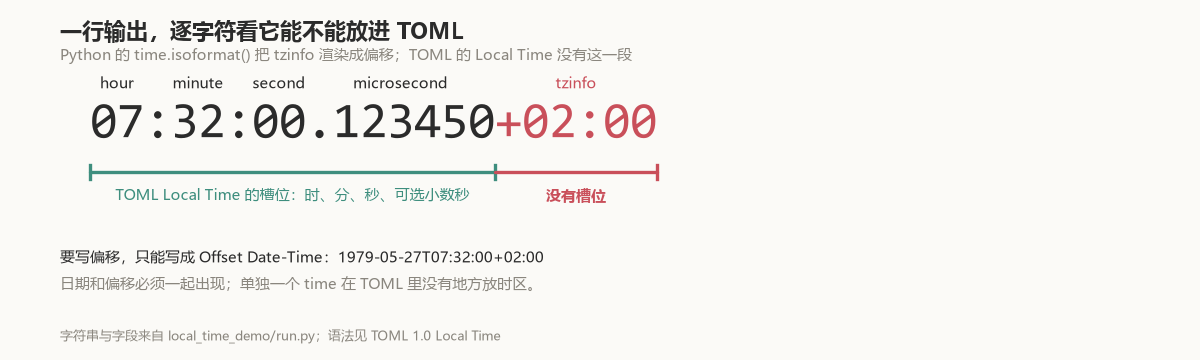
07:32:00 是 Local Time。+02:00 这六个字符,在 TOML 的 Local Time 语法里没有对应的位置。
偏移 TOML 也能写,但那叫 Offset Date-Time,必须同时带日期:1979-05-27T07:32:00+02:00。单独的 time 没有地方挂它。
raw 不是 isoformat 的副本
Time 这个 item 同时存两样东西:Python 的 tzinfo,和要写进 TOML 的 raw 字面量。
tzinfo 留在 Python 对象上没有问题——datetime.time 本来就可以带时区。问题出在 raw 被当成了 isoformat() 的副本。修前版里,item() 构造 Time 时这样写:
Time(
value.hour,
value.minute,
value.second,
value.microsecond,
value.tzinfo,
Trivia(),
value.isoformat(), # -> '07:32:00+02:00'
fold=value.fold,
)
在 item() 里,datetime 那一支就在这段上面几行,raw 是 value.isoformat().replace("+00:00", "Z");time 这一支直接是 value.isoformat()。
isoformat() 是 Python 的格式,会把 tzinfo 渲染成偏移,而 TOML 的 Local Time 没有这一段。
另一处是 Time._new(),replace() 走那里,raw 同样是 result.isoformat()。
只改写出端
#613 增加了一个 _format_time():
def _format_time(value: time) –> str:
# TOML local times carry no offset or timezone …
s = f"{value.hour:02d}:{value.minute:02d}:{value.second:02d}"
if value.microsecond:
s += f".{value.microsecond:06d}".rstrip("0")
return s
item() 和 Time._new() 都改用它。
合并版见 ce8f8ee 的 items.py 与 _format_time()。
只用时、分、秒、微秒,不读 tzinfo。微秒非零时补足六位再去尾零:123450 写成 .12345,0 不写小数点。
解析器没有改。parse("t = 07:32:00+02:00") 修前修后都抛 InvalidTimeError——TOML 里没有这个语法。
冲突来自隔壁
#613 合并前,维护者留了一句 “Please resolve the conflict”。
冲突来自 #620:它给 Time 和 DateTime 加了标准库的 fold 参数,改的正是 Time._new() 附近。两个 PR 在同一天合入,#620 早了三个半小时。作者 rebase 到最新 master 后,fold=result.fold 和 _format_time(result) 共存在同一个构造函数里:

def _new(self, result: time) –> Time:
raw = _format_time(result)
return Time(
...,
raw,
fold=result.fold,
)
fold 描述的是夏令时回拨时同一个本地时间出现两次,属于 Python time 对象自身的语义;_format_time() 决定的是这个对象怎么写进 TOML。两件事落在同一个构造函数里,互不相干。
七行输出
| item(time(7, 32, tzinfo=+02:00)).as_string() | 07:32:00+02:00 | 07:32:00 |
| 微秒 123450 | 07:32:00.123450+02:00 | 07:32:00.12345 |
| replace(hour=13) | 13:32:00+02:00 | 13:32:00 |
| dumps({"t": item(…)}) | t = 07:32:00+02:00 | t = 07:32:00 |
| 把上一步 parse() 回来 | InvalidTimeError | 成功,读回 07:32:00 |
| 无时区的 time(7, 32) | 07:32:00 | 07:32:00 |
| 直接 parse("t = 07:32:00+02:00") | InvalidTimeError | InvalidTimeError |
最后两行说明改的只是写出端:无时区的时间,输出一个字节没变;解析器对偏移的拒绝照旧。
0.15.2 的发布说明明确列出了 #613。用发布轮子 tomlkit-0.15.2-py3-none-any.whl 再跑一次,输出和合并版一致:07:32:00,读得回来。
读回来的是什么
parse(dumps({"t": item(t)}))["t"] # 07:32:00
能读回来了。读回来的 Time 是 07:32:00,tzinfo 是 None——那一行文本里没有这段信息。
local_time_demo/run.py –test 跑上表七行。
Time 里,Python 的 time 能带时区、能带 fold;写进 TOML 的那一段只有时分秒和可选的微秒。多出来的留在对象上,不进文件。




评论前必须登录!
注册