 网硕互联帮助中心
【从零开始学习C++】第 20 篇 系列定位:写给新手小白的 C++ 进阶之路。前面我们已经手撕完了 map / set 的底层数据结构——红黑树,这一篇我们就把它包一层皮,真正做出属于我们自己的 mymap 和 myset。
📌 全文思维导图
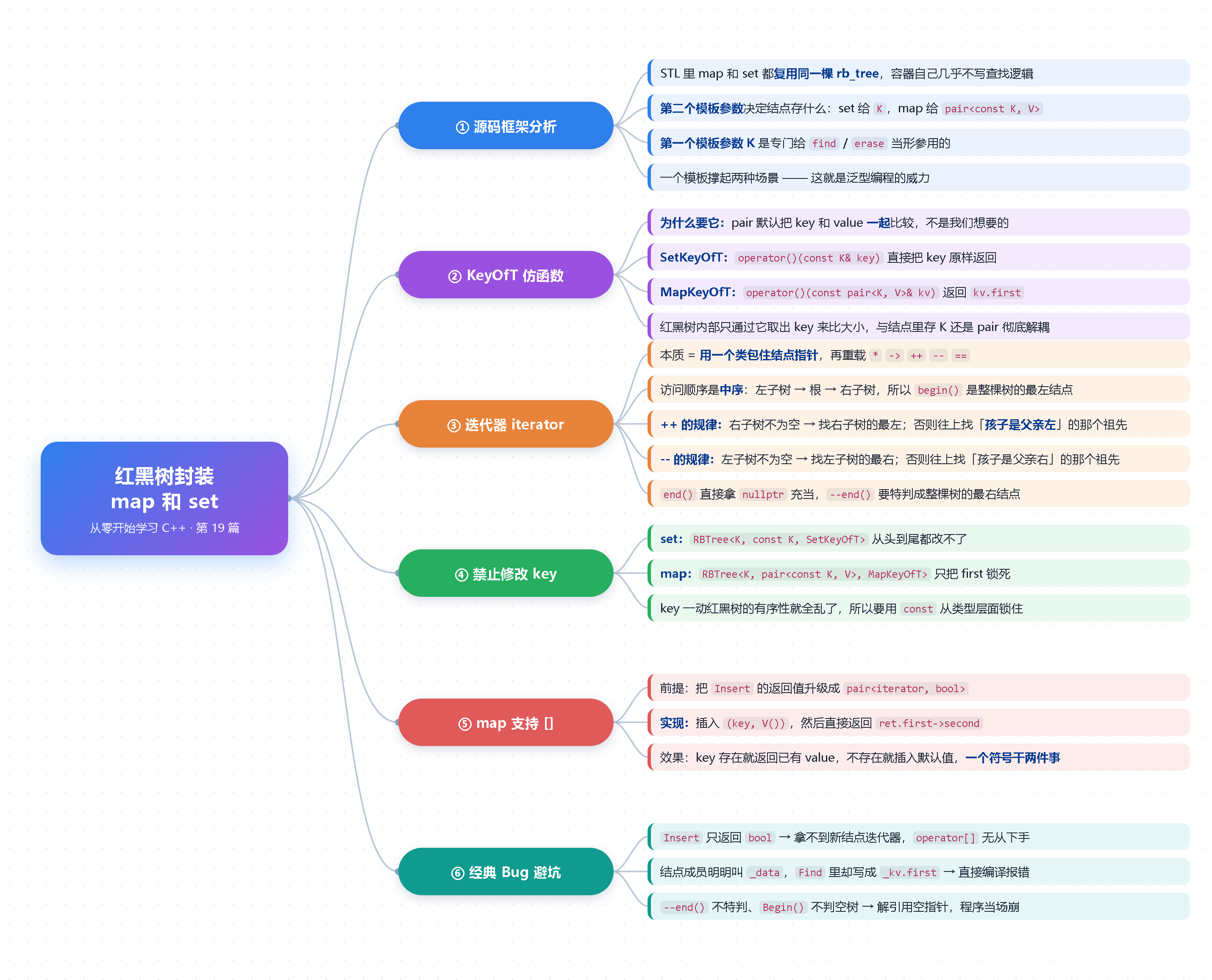
建议先把上面这张图保存下来,读到哪一步忘了就回头看哪一支。
一、先回答一个灵魂问题:为什么 map 和 set 能共用一棵树?
1.1 简介作用
set 是 key 搜索场景,存进去的就是一个 key,只关心"在不在"。
map 是 key/value 搜索场景,存进去的是一个 pair<const K, V>,关心"key 对应的 value 是多少"。
按理说这是两个完全不同的东西,但你看 STL 源码会发现一个惊人的事实:它们底层用的是同一棵红黑树。
那它是怎么做到"一棵树干两份活"的?答案就俩字:泛型。
1.2 例子一:从 STL 源码看它怎么复用的
(1)源码里 set 和 map 各自的定义
// stl_set.h
template <class Key, class Compare = less<Key>, class Alloc = alloc>
class set {
public:
typedef Key key_type;
typedef Key value_type; // set 的 value 就是 key 本身
private:
typedef rb_tree<key_type, value_type,
identity<value_type>, key_compare, Alloc> rep_type;
rep_type t; // 一棵红黑树
};
// stl_map.h
template <class Key, class T, class Compare = less<Key>, class Alloc = alloc>
class map {
public:
typedef Key key_type;
typedef T mapped_type;
typedef pair<const Key, T> value_type; // map 的 value 是 pair
private:
typedef rb_tree<key_type, value_type,
select1st<value_type>, key_compare, Alloc> rep_type;
rep_type t; // 还是一棵红黑树
};
💡 一句话看懂:set 和 map 里面都只有一个成员 —— 一棵红黑树 t。它们自己几乎不干活,全是"转发"给这棵树。
(2)关键差异只在第二个模板参数
|
容器 |
传给 rb_tree 的第 1 个参数 |
传给 rb_tree 的第 2 个参数 |
结果 |
|
set |
Key |
Key |
结点里存 key |
|
map |
Key |
pair<const Key, T> |
结点里存键值对 |
第二个模板参数决定了结点里到底存什么,所以同一份红黑树代码,喂 K 进去就变成 set,喂 pair<const K, V> 进去就变成 map。
(3)那个"多余的"第一个模板参数 K 是干嘛的?
很多同学到这儿都懵:既然第二个参数已经决定存什么了,set 里俩参数还写成一样的,那第一个参数是不是废话?
不是废话。因为 find / erase 的形参类型是 key,不是结点里存的那个整体:
// stl_tree.h
template <class Key, class Value, class KeyOfValue, class Compare, class Alloc = alloc>
class rb_tree {
public:
// insert 用第二个模板参数 Value 做形参
pair<iterator, bool> insert_unique(const value_type& x);
// 而 erase / find 用的是第一个模板参数 Key
size_type erase(const key_type& x);
iterator find(const key_type& x);
};
对 set 来说 key 和 value 是同一个东西,看起来"重复";但对 map 来说就完全不一样了:插入时给的是 pair,查找时给的是 key。所以第一个参数必须留着。
(4)顺手吐槽一下
源码里命名风格其实很乱:set 用 Key,map 用 Key 和 T,到了 rb_tree 又变成 Key 和 Value。而且源码里的 value_type 指的是结点里真实存储的类型,跟我们平时说的"key/value 里的 value"完全不是一回事。大佬写代码也不一定规整,所以看源码时一定要以实际定义为准,别被名字骗了。
二、KeyOfT 仿函数:整个封装最核心的一步
2.1 简介作用
我们自己的红黑树是泛型的,模板参数 T 到底是 K 还是 pair<K, V>,红黑树自己不知道。
那么问题来了:插入的时候要比较大小,如果 T 是 pair<K, V>,pair 默认的 < 是把 first 和 second 一起比的:
template <class T1, class T2>
bool operator<(const pair<T1, T2>& lhs, const pair<T1, T2>& rhs)
{
return lhs.first < rhs.first ||
(!(rhs.first < lhs.first) && lhs.second < rhs.second);
}
而我们希望的是:任何时候都只比较 key。
解决办法就是大名鼎鼎的 KeyOfT 仿函数:让 map 和 set 各自提供一个"从 T 里抠出 key"的小工具,传给红黑树用。
2.2 例子二:给 set 和 map 各写一个 KeyOfT
(1)SetKeyOfT:要的就是它自己
struct SetKeyOfT
{
const K& operator()(const K& key)
{
return key; // set 里 K 就是 key,直接返回
}
};
(2)MapKeyOfT:把 pair 的 first 抠出来
struct MapKeyOfT
{
const K& operator()(const pair<K, V>& kv)
{
return kv.first; // map 里取 pair 的第一个
}
};
(3)红黑树拿到它之后怎么用
template<class K, class T, class KeyOfT> // T 是结点存的数据类型
class RBTree
{
public:
bool Insert(const T& data)
{
// …
KeyOfT kot; // 造一个仿函数对象
Node* parent = nullptr;
Node* cur = _root;
while (cur)
{
if (kot(cur->_data) < kot(data)) // 只比 key
{
parent = cur;
cur = cur->_right;
}
else if (kot(cur->_data) > kot(data)) // 只比 key
{
parent = cur;
cur = cur->_left;
}
else
{
return false; // key 相同,不允许重复插入
}
}
// …
}
};
看到没?红黑树里所有比较都变成了 kot(…) < kot(…),它彻底不关心 T 到底是什么了。这就是解耦。
2.3 经典 Bug:直接比较 pair 会怎样?
如果你偷懒不写 KeyOfT,插入时直接 cur->_data < data,会发生两件事:
struct Date { int y, m, d; }; // 没有重载 <
map<string, Date> m;
m.insert({ "生日", {2025, 9, 14} });
// 编译报错:no match for 'operator<' (operand types are 'Date' and 'Date')
🐛 避坑结论:KeyOfT 不是一个可选项,它是 map 能用的前提。
三、搭框架:让 mymap / myset 第一次跑起来
3.1 简介作用
有了 KeyOfT,我们就可以把 set 和 map 的"外壳"搭起来了。这一步目标很简单:能插入、能按 key 查。
先规定好我们自己的命名(比源码干净一点):
- 红黑树模板参数:K(key 类型)、T(结点真实存储类型)、KeyOfT(取 key 的仿函数);
- 结点类:RBTreeNode<T>;容器在 bit 命名空间里。
3.2 例子三:Myset.h 的第一版
// Myset.h
#pragma once
#include "RBTree.h"
namespace bit
{
template<class K>
class set
{
struct SetKeyOfT
{
const K& operator()(const K& key)
{
return key;
}
};
public:
bool insert(const K& key)
{
return _t.Insert(key);
}
private:
RBTree<K, K, SetKeyOfT> _t; // 第二个参数给 K
};
}
3.3 例子四:Mymap.h 的第一版
// Mymap.h
#pragma once
#include "RBTree.h"
namespace bit
{
template<class K, class V>
class map
{
struct MapKeyOfT
{
const K& operator()(const pair<K, V>& kv)
{
return kv.first;
}
};
public:
bool insert(const pair<K, V>& kv)
{
return _t.Insert(kv);
}
private:
RBTree<K, pair<K, V>, MapKeyOfT> _t; // 第二个参数给 pair
};
}
3.4 例子五:配套的红黑树结点
// RBTree.h
enum Colour
{
RED,
BLACK
};
template<class T>
struct RBTreeNode
{
T _data;
RBTreeNode<T>* _left;
RBTreeNode<T>* _right;
RBTreeNode<T>* _parent;
Colour _col;
RBTreeNode(const T& data)
: _data(data)
, _left(nullptr)
, _right(nullptr)
, _parent(nullptr)
, _col(RED) // 新结点默认给红色,插入逻辑才好处理
{}
};
3.5 整件事的实现步骤清单
① 实现红黑树(前面已经搞定)
② 封装 map / set 框架,解决 KeyOfT
③ 给红黑树加 iterator
④ 加上 const_iterator
⑤ 解决 key 不支持修改的问题
⑥ 给 map 加 operator[]
四、迭代器 iterator:让容器能被 for 循环
4.1 简介作用
要能用范围 for,容器就得提供 begin() 和 end()。红黑树迭代器的思路和 list 完全一致:用一个类把结点指针包起来,再重载运算符,让它用起来像指针。
难点只有一个:++ 和 –。因为 map / set 的遍历顺序是中序(左子树 → 根 → 右子树),所以:
- begin() 返回的是整棵树的最左结点(中序第一个);
- end() 我们用一个特殊值表示"走完了"。
4.2 例子六:迭代器类的骨架(Ref / Ptr 分离)
template<class T, class Ref, class Ptr>
struct RBTreeIterator
{
typedef RBTreeNode<T> Node;
typedef RBTreeIterator<T, Ref, Ptr> Self;
Node* _node;
Node* _root; // 额外存一份根,为了支持 –end()
RBTreeIterator(Node* node, Node* root)
: _node(node)
, _root(root)
{}
Ref operator*()
{
return _node->_data;
}
Ptr operator->()
{
return &_node->_data;
}
bool operator!=(const Self& s) const { return _node != s._node; }
bool operator==(const Self& s) const { return _node == s._node; }
};
💡 为什么要 Ref / Ptr 两个额外参数? iterator 传 T& 和 T*,const_iterator 传 const T& 和 const T*——同一份代码,自动生成两个版本。这就是泛型的甜头。
4.3 例子七:operator++ 的两种走法(本文最烧脑的一段)
核心心法只有一句:不看全局,只看局部——只关心"当前中序的下一个结点是谁"。
情况一:右子树不为空
说明当前结点已经访问完了,下一个是右子树的中序第一个,也就是右子树的最左结点。
情况二:右子树为空
说明当前结点和它所在的子树都访问完了,得往上找祖先:
- 如果当前结点是父亲的左(比如 25 是 30 的左),那下一个就是父亲(30);
- 如果当前结点是父亲的右(比如 15 是 10 的右),说明连父亲那棵子树也结束了,继续往上爬,直到找到"孩子是父亲左"的那个祖先(15 → 10 → 18,18 就是 10 的父亲且 10 是左孩子,所以下一个是 18);
- 如果一直爬到根都没找到,说明整棵树走完了,把结点指针置为 nullptr,我们用 nullptr 充当 end()。
// ++it —— 中序的下一个结点
Self& operator++()
{
if (_node->_right)
{
// 情况一:右子树不为空 -> 右子树的最左结点
Node* leftMost = _node->_right;
while (leftMost->_left)
{
leftMost = leftMost->_left;
}
_node = leftMost;
}
else
{
// 情况二:右子树为空 -> 往上找"孩子是父亲左"的那个祖先
Node* cur = _node;
Node* parent = cur->_parent;
while (parent && cur == parent->_right)
{
cur = parent;
parent = cur->_parent;
}
_node = parent;
}
return *this;
}
💡 顺带一提:STL 源码里并没有用 nullptr 做 end(),而是在红黑树顶上挂了一个哨兵位头结点(它和根互为父亲,左指向最左、右指向最右)。不过实力告诉我们:它能的我们也能,用 nullptr 只是 –end() 要特殊处理一下而已。
4.4 例子八:operator– 与 –end() 的特殊处理
— 的逻辑和 ++ 完全对称,反过来想就行(顺序变成 右子树 → 根 → 左子树):
// –it —— 中序的上一个结点
Self& operator–()
{
if (_node == nullptr) // 处理 –end()
{
// end() 是空,–end() 应该走到整棵树的最右结点
Node* rightMost = _root;
while (rightMost && rightMost->_right)
{
rightMost = rightMost->_right;
}
_node = rightMost;
}
else if (_node->_left)
{
// 左子树不为空 -> 左子树的最右结点
Node* rightMost = _node->_left;
while (rightMost->_right)
{
rightMost = rightMost->_right;
}
_node = rightMost;
}
else
{
// 往上找"孩子是父亲右"的那个祖先
Node* cur = _node;
Node* parent = cur->_parent;
while (parent && cur == parent->_left)
{
cur = parent;
parent = cur->_parent;
}
_node = parent;
}
return *this;
}
4.5 例子九:红黑树里的 Begin() / End()
typedef RBTreeIterator<T, T&, T*> Iterator;
typedef RBTreeIterator<T, const T&, const T*> ConstIterator;
Iterator Begin()
{
Node* leftMost = _root;
while (leftMost && leftMost->_left) // 一路向左,就是中序第一个
{
leftMost = leftMost->_left;
}
return Iterator(leftMost, _root); // 记得把 _root 传进去
}
Iterator End()
{
return Iterator(nullptr, _root); // 用 nullptr 表示 end
}
const 版本同理,只是换成 ConstIterator。
4.6 经典 Bug:迭代器里的坑
Bug 1:–end() 直接崩溃
end() 里结点的指针是 nullptr,如果你在 operator– 里不加 _node == nullptr 的判断,第一件事就是解引用空指针 —— 程序当场去世。
Bug 2:忘记把 _root 传给迭代器
–end() 需要靠 _root 去找最右结点。如果你的迭代器构造函数只传了结点指针,_root 就是野指针,运行起来时好时坏(典型的"玄学 Bug")。记住 Iterator(node, _root) 两个参数都要传。
Bug 3:Begin() 不判空树
空树时 _root 就是 nullptr,上面的 while (leftMost && leftMost->_left) 里的判空不能少,否则空树 begin() 直接崩。
五、不让改 key:const K 的妙用
5.1 简介作用
红黑树是排序结构,它靠 key 的大小关系维持平衡。如果允许用户随手改 key,整棵树的有序性瞬间就乱了 —— 之后再查找就会找不到本来存在的元素。
所以在设计上必须从类型层面直接锁死:
- set 的 key 就是 value,全都不许改;
- map 的 key 是 pair 的 first,只锁死 first,second 随便改。
5.2 例子十:改一行模板参数就搞定了
// Myset.h —— 第二个参数加 const
RBTree<K, const K, SetKeyOfT> _t;
// Mymap.h —— 把 first 变成 const
RBTree<K, pair<const K, V>, MapKeyOfT> _t;
就这么简单! 加上 const 之后:
- iterator 的 Ref 变成 const T&,通过 *it / it-> 拿到的东西天然带 const;
- 想改 key?编译器第一个不答应。
5.3 例子十一:同时提供 iterator 和 const_iterator
// Myset.h
typedef typename RBTree<K, const K, SetKeyOfT>::Iterator iterator;
typedef typename RBTree<K, const K, SetKeyOfT>::ConstIterator const_iterator;
iterator begin() { return _t.Begin(); }
iterator end() { return _t.End(); }
const_iterator begin() const { return _t.Begin(); }
const_iterator end() const { return _t.End(); }
pair<iterator, bool> insert(const K& key)
{
return _t.Insert(key);
}
iterator find(const K& key)
{
return _t.Find(key);
}
5.4 例子十二:倒着打印一个 set
void Print(const set<int>& s)
{
set<int>::const_iterator it = s.end();
while (it != s.begin())
{
–it; // 从 end 往前退,正好是降序
// *it += 2; // ❌ 编译报错:read-only,说明 const 生效了
cout << *it << " ";
}
cout << endl;
}
void test_set()
{
set<int> s;
int a[] = { 4, 2, 6, 1, 3, 5, 15, 7, 16, 14 };
for (auto e : a)
{
s.insert(e);
}
for (auto e : s) // 范围 for 走中序,天然升序
{
cout << e << " ";
}
cout << endl;
Print(s); // 降序输出
}
运行结果:
1 2 3 4 5 6 7 14 15 16
16 15 14 7 6 5 4 3 2 1
5.5 经典 Bug:it->first += 'x' 编译不过
map<string, string>::iterator it = dict.begin();
// it->first += 'x'; // ❌ 报错:assignment of read-only member
it->second += 'x'; // ✅ 没问题,value 可以随便改
🐛 提示:如果你发现 it->first 居然能改,说明你在 Mymap.h 里第二参数写的是 pair<K, V>,漏了 const,赶紧补上。
六、map 的 operator[]:一行代码干两件事
6.1 简介作用
map 最爽的功能就是 operator[],它是"有则返回,无则插入":
dict["left"] = "左边,剩余"; // left 已存在 -> 改它的 value
dict["insert"] = "插入"; // insert 不存在 -> 插入后再赋值
dict["string"]; // 不存在 -> 插入默认值 ""
要支持它,前提是 Insert 得把"插入结果"告诉外面:既想知道有没有插入成功,又想拿到那个结点的迭代器。所以返回值要从 bool 升级成 pair<iterator, bool>。
6.2 例子十三:把 Insert 的返回值升级
pair<Iterator, bool> Insert(const T& data)
{
if (_root == nullptr)
{
_root = new Node(data);
_root->_col = BLACK;
return make_pair(Iterator(_root, _root), true); // 新根,插成功
}
KeyOfT kot;
Node* parent = nullptr;
Node* cur = _root;
while (cur)
{
if (kot(cur->_data) < kot(data))
{
parent = cur;
cur = cur->_right;
}
else if (kot(cur->_data) > kot(data))
{
parent = cur;
cur = cur->_left;
}
else
{
// key 已存在:把"已有结点"的迭代器返回去,bool 给 false
return make_pair(Iterator(cur, _root), false);
}
}
cur = new Node(data); // 到这儿 cur 才真正被接上
Node* newnode = cur;
cur->_col = RED;
if (kot(parent->_data) < kot(data))
parent->_right = cur;
else
parent->_left = cur;
cur->_parent = parent;
// ……中间是红黑树的旋转 + 变色调整(前面文章已详解,这里略)
_root->_col = BLACK; // 根永远是黑的
return make_pair(Iterator(newnode, _root), true);
}
💡 注意最后一行用的是 newnode。因为在调整过程中 cur 可能已经被改成了祖先结点,而我们要返回的是新插入的那个结点的迭代器。
6.3 例子十四:operator[] 的实现
有了上面这个返回值,operator[] 只有三行:
V& operator[](const K& key)
{
pair<iterator, bool> ret = insert(make_pair(key, V()));
return ret.first->second; // 直接返回 value 的引用
}
拆开看就是:
所以 operator[] 返回的是引用,既能读也能写。
6.4 例子十五:跑一遍 map
void test_map()
{
map<string, string> dict;
dict.insert({ "sort", "排序" });
dict.insert({ "left", "左边" });
dict.insert({ "right", "右边" });
dict["left"] = "左边,剩余"; // 修改已有
dict["insert"] = "插入"; // 插入新的
dict["string"]; // 插入默认值 ""
map<string, string>::iterator it = dict.begin();
while (it != dict.end())
{
// it->first += 'x'; // ❌ key 不能改
it->second += 'x'; // ✅ value 可以改
cout << it->first << ":" << it->second << endl;
++it;
}
cout << endl;
}
运行结果(key 自动升序,因为中序遍历):
insert:插入x
left:左边,剩余x
right:右边x
sort:排序x
string:x
6.5 经典 Bug:Insert 只返回 bool
如果你前面的 Insert 写的是:
bool Insert(const T& data); // ❌ 没有迭代器
那 operator[] 就完全没法实现了 —— 你既不知道新结点在哪,也不知道到底插入没有:
V& operator[](const K& key)
{
bool ret = insert(make_pair(key, V()));
// ret.first -> ❌ 编译报错,bool 没有 first
return ???; // 卡死在这里
}
🐛 避坑结论:map 想要 operator[],Insert 必须返回 pair<iterator, bool>。这也是为什么 STL 的 insert 要返回 pair<iterator, bool> 的真正原因。
七、完整代码汇总
7.1 RBTree.h
#pragma once
#include <iostream>
#include <utility>
using namespace std;
enum Colour
{
RED,
BLACK
};
template<class T>
struct RBTreeNode
{
T _data;
RBTreeNode<T>* _left;
RBTreeNode<T>* _right;
RBTreeNode<T>* _parent;
Colour _col;
RBTreeNode(const T& data)
: _data(data)
, _left(nullptr)
, _right(nullptr)
, _parent(nullptr)
, _col(RED)
{}
};
// 迭代器
template<class T, class Ref, class Ptr>
struct RBTreeIterator
{
typedef RBTreeNode<T> Node;
typedef RBTreeIterator<T, Ref, Ptr> Self;
Node* _node;
Node* _root;
RBTreeIterator(Node* node, Node* root)
: _node(node)
, _root(root)
{}
Ref operator*() { return _node->_data; }
Ptr operator->() { return &_node->_data; }
bool operator!=(const Self& s) const { return _node != s._node; }
bool operator==(const Self& s) const { return _node == s._node; }
Self& operator++()
{
if (_node->_right)
{
Node* leftMost = _node->_right;
while (leftMost->_left)
{
leftMost = leftMost->_left;
}
_node = leftMost;
}
else
{
Node* cur = _node;
Node* parent = cur->_parent;
while (parent && cur == parent->_right)
{
cur = parent;
parent = cur->_parent;
}
_node = parent;
}
return *this;
}
Self& operator–()
{
if (_node == nullptr) // –end()
{
Node* rightMost = _root;
while (rightMost && rightMost->_right)
{
rightMost = rightMost->_right;
}
_node = rightMost;
}
else if (_node->_left)
{
Node* rightMost = _node->_left;
while (rightMost->_right)
{
rightMost = rightMost->_right;
}
_node = rightMost;
}
else
{
Node* cur = _node;
Node* parent = cur->_parent;
while (parent && cur == parent->_left)
{
cur = parent;
parent = cur->_parent;
}
_node = parent;
}
return *this;
}
};
template<class K, class T, class KeyOfT>
class RBTree
{
typedef RBTreeNode<T> Node;
public:
typedef RBTreeIterator<T, T&, T*> Iterator;
typedef RBTreeIterator<T, const T&, const T*> ConstIterator;
RBTree() = default;
~RBTree()
{
Destroy(_root);
_root = nullptr;
}
Iterator Begin()
{
Node* leftMost = _root;
while (leftMost && leftMost->_left)
{
leftMost = leftMost->_left;
}
return Iterator(leftMost, _root);
}
Iterator End()
{
return Iterator(nullptr, _root);
}
ConstIterator Begin() const
{
Node* leftMost = _root;
while (leftMost && leftMost->_left)
{
leftMost = leftMost->_left;
}
return ConstIterator(leftMost, _root);
}
ConstIterator End() const
{
return ConstIterator(nullptr, _root);
}
pair<Iterator, bool> Insert(const T& data)
{
if (_root == nullptr)
{
_root = new Node(data);
_root->_col = BLACK;
return make_pair(Iterator(_root, _root), true);
}
KeyOfT kot;
Node* parent = nullptr;
Node* cur = _root;
while (cur)
{
if (kot(cur->_data) < kot(data))
{
parent = cur;
cur = cur->_right;
}
else if (kot(cur->_data) > kot(data))
{
parent = cur;
cur = cur->_left;
}
else
{
return make_pair(Iterator(cur, _root), false);
}
}
cur = new Node(data);
Node* newnode = cur;
cur->_col = RED;
if (kot(parent->_data) < kot(data))
parent->_right = cur;
else
parent->_left = cur;
cur->_parent = parent;
// 平衡调整
while (parent && parent->_col == RED)
{
Node* grandfather = parent->_parent;
if (parent == grandfather->_left)
{
Node* uncle = grandfather->_right;
if (uncle && uncle->_col == RED)
{
// 叔叔存在且为红 -> 变色继续往上处理
parent->_col = uncle->_col = BLACK;
grandfather->_col = RED;
cur = grandfather;
parent = cur->_parent;
}
else
{
if (cur == parent->_left)
{
// 单旋:g 左,p 左,c 左
RotateR(grandfather);
parent->_col = BLACK;
grandfather->_col = RED;
}
else
{
// 双旋:左右
RotateL(parent);
RotateR(grandfather);
cur->_col = BLACK;
grandfather->_col = RED;
}
break;
}
}
else
{
Node* uncle = grandfather->_left;
if (uncle && uncle->_col == RED)
{
parent->_col = uncle->_col = BLACK;
grandfather->_col = RED;
cur = grandfather;
parent = cur->_parent;
}
else
{
if (cur == parent->_right)
{
// 单旋:右右
RotateL(grandfather);
parent->_col = BLACK;
grandfather->_col = RED;
}
else
{
// 双旋:右左
RotateR(parent);
RotateL(grandfather);
cur->_col = BLACK;
grandfather->_col = RED;
}
break;
}
}
}
_root->_col = BLACK;
return make_pair(Iterator(newnode, _root), true);
}
Iterator Find(const K& key)
{
KeyOfT kot; // 用 KeyOfT 取 key,不要直接写 _kv.first!
Node* cur = _root;
while (cur)
{
if (kot(cur->_data) < key)
{
cur = cur->_right;
}
else if (kot(cur->_data) > key)
{
cur = cur->_left;
}
else
{
return Iterator(cur, _root);
}
}
return End();
}
private:
void RotateL(Node* parent)
{
Node* subR = parent->_right;
Node* subRL = subR->_left;
parent->_right = subRL;
if (subRL)
subRL->_parent = parent;
Node* parentParent = parent->_parent;
subR->_left = parent;
parent->_parent = subR;
if (parentParent == nullptr)
{
_root = subR;
subR->_parent = nullptr;
}
else
{
if (parent == parentParent->_left)
parentParent->_left = subR;
else
parentParent->_right = subR;
subR->_parent = parentParent;
}
}
void RotateR(Node* parent)
{
Node* subL = parent->_left;
Node* subLR = subL->_right;
parent->_left = subLR;
if (subLR)
subLR->_parent = parent;
Node* parentParent = parent->_parent;
subL->_right = parent;
parent->_parent = subL;
if (parentParent == nullptr)
{
_root = subL;
subL->_parent = nullptr;
}
else
{
if (parent == parentParent->_left)
parentParent->_left = subL;
else
parentParent->_right = subL;
subL->_parent = parentParent;
}
}
void Destroy(Node* root)
{
if (root == nullptr)
return;
Destroy(root->_left);
Destroy(root->_right);
delete root;
}
private:
Node* _root = nullptr;
};
7.2 Myset.h
#pragma once
#include "RBTree.h"
namespace bit
{
template<class K>
class set
{
struct SetKeyOfT
{
const K& operator()(const K& key)
{
return key;
}
};
public:
typedef typename RBTree<K, const K, SetKeyOfT>::Iterator iterator;
typedef typename RBTree<K, const K, SetKeyOfT>::ConstIterator const_iterator;
iterator begin() { return _t.Begin(); }
iterator end() { return _t.End(); }
const_iterator begin() const { return _t.Begin(); }
const_iterator end() const { return _t.End(); }
pair<iterator, bool> insert(const K& key)
{
return _t.Insert(key);
}
iterator find(const K& key)
{
return _t.Find(key);
}
private:
RBTree<K, const K, SetKeyOfT> _t; // 第二个参数加 const,key 不可改
};
}
7.3 Mymap.h
#pragma once
#include "RBTree.h"
namespace bit
{
template<class K, class V>
class map
{
struct MapKeyOfT
{
const K& operator()(const pair<K, V>& kv)
{
return kv.first;
}
};
public:
typedef typename RBTree<K, pair<const K, V>, MapKeyOfT>::Iterator iterator;
typedef typename RBTree<K, pair<const K, V>, MapKeyOfT>::ConstIterator const_iterator;
iterator begin() { return _t.Begin(); }
iterator end() { return _t.End(); }
const_iterator begin() const { return _t.Begin(); }
const_iterator end() const { return _t.End(); }
pair<iterator, bool> insert(const pair<K, V>& kv)
{
return _t.Insert(kv);
}
iterator find(const K& key)
{
return _t.Find(key);
}
V& operator[](const K& key)
{
pair<iterator, bool> ret = insert(make_pair(key, V()));
return ret.first->second;
}
private:
RBTree<K, pair<const K, V>, MapKeyOfT> _t; // 只锁死 first
};
}
7.4 test.cpp
#include "RBTree.h"
#include "Myset.h"
#include "Mymap.h"
void test_set()
{
bit::set<int> s;
int a[] = { 4, 2, 6, 1, 3, 5, 15, 7, 16, 14 };
for (auto e : a)
{
s.insert(e);
}
for (auto e : s)
cout << e << " ";
cout << endl;
}
void test_map()
{
bit::map<string, string> dict;
dict.insert({ "sort", "排序" });
dict.insert({ "left", "左边" });
dict.insert({ "right", "右边" });
dict["left"] = "左边,剩余";
dict["insert"] = "插入";
dict["string"];
bit::map<string, string>::iterator it = dict.begin();
while (it != dict.end())
{
it->second += 'x';
cout << it->first << ":" << it->second << endl;
++it;
}
cout << endl;
}
int main()
{
test_set();
test_map();
return 0;
}
八、本篇小结
把整件事捋一遍,其实就只有 6 步:
|
步骤 |
要做的事 |
关键点 |
|
① |
实现红黑树 |
泛型模板 RBTree<K, T, KeyOfT> |
|
② |
封装 map / set 框架 |
第二个模板参数决定存 K 还是 pair;写 SetKeyOfT / MapKeyOfT |
|
③ |
加 iterator |
operator++ / operator– 走中序;end() 用 nullptr |
|
④ |
加 const_iterator |
Ref / Ptr 分离,一套代码两个版本 |
|
⑤ |
锁死 key |
const K / pair<const K, V> |
|
⑥ |
map 的 operator[] |
Insert 返回 pair<iterator, bool> |
最容易踩的三个坑,再强调一次:
到这里,map 和 set 的底层对我们来说就不再是黑盒了 —— 它们不过是一棵红黑树 + 一层薄薄的封装而已。
前面我们手撕了红黑树的旋转与变色,这一篇把"外壳"补齐。下一篇我们继续往前推进,别忘了把思维导图存下来随时复习~
如果这篇帮你理清了思路,欢迎点赞 + 收藏 + 关注,你的支持是我持续更新的最大动力! 🔥




评论前必须登录!
注册